

Reading time (short enough for your break): 11 minutes
Ever kicked off the year with big plans to “take better care of yourself,” only to watch it all fizzle out three weeks later? The skincare routine abandoned, the meditation forgotten, the gym membership canceled?
You're not alone. Psychologist John Norcross of the University of Scranton followed 200 people who made New Year's resolutions: 77% kept their pledge for the first week, but only 19% were still at it two years later. Almost everyone gives up somewhere along the way. And when it comes to emotional self-care, failure is even more common, because we try to adopt practices without understanding the principles that hold them up.
This article will show you how to build an emotional self-care routine that actually works. Not because it's perfect, but because it's sustainable, realistic and built for YOU.
Why most emotional self-care routines fail
Before building a routine that works, we need to understand why so many fall apart:
1. Unrealistic goals
“I'm going to meditate for an hour a day, do yoga at 6 a.m., cook every meal, read a book a week…”
The problem: You're designing a routine for an idealized version of yourself, not for who you really are.
2. Quantity over quality
Piling up self-care practices (a 10-step skincare routine, 5 kinds of workouts, 3 new hobbies) with no real connection to what you need.
The problem: Self-care turns into one more stressful to-do list.
3. All or nothing
“If I can't do it perfectly, it's not worth doing.”
The problem: Rigid thinking that turns self-care into yet another source of guilt.
4. Copying someone else's routine
Following whatever works for influencers, friends or gurus without adapting it to your own reality.
The problem: The routine of someone with 3 kids and shift work can't look like the routine of a single person with a flexible schedule.
5. Not knowing the “why”
Adding practices because “everyone does it” without understanding what you actually need.
The problem: Without personal meaning, you end up quitting.
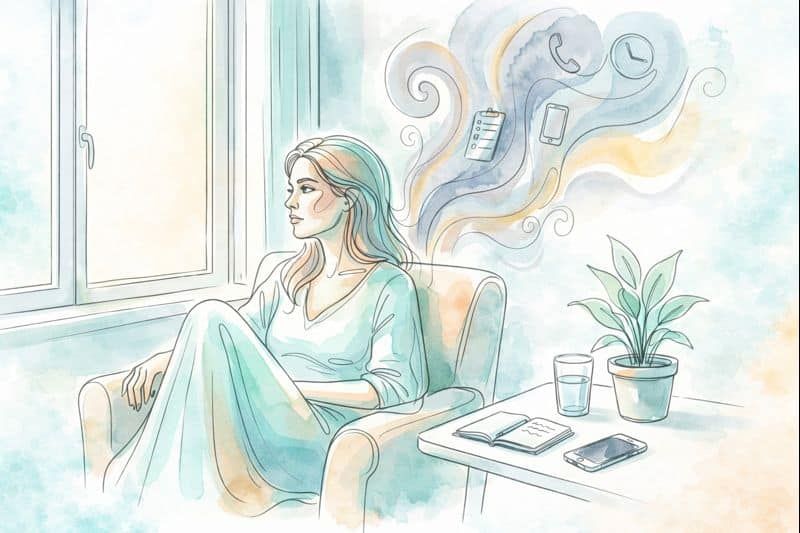
What emotional self-care really is
Before you build your routine, let's get on the same page.
Emotional self-care is NOT:
- Just beauty rituals (a relaxing bath, a face mask)
- A reward for having “made it through” the week
- A one-off, occasional activity
- A list of obligations for being “productive at being happy”
Emotional self-care IS:
- ✓ A set of regular practices that nourish your physical, emotional, mental and social well-being
- ✓ An act of responsibility toward yourself
- ✓ Prevention against burnout and illness
- ✓ Recognizing that you are a priority, not just a means to other people's ends
What the evidence actually says:
Let's be honest: self-care is not a vaccine against burnout, and no serious study promises that. What the research shows is more modest and more useful. A 2014 review in JAMA Internal Medicine, pooling 47 clinical trials and 3,515 participants, found moderate evidence that mindfulness meditation programs ease symptoms of anxiety and depression. The improvements were real, but modest.
The 5 pillars of effective self-care
Well-rounded self-care covers five dimensions:
1. Physical self-care
Caring for the body that carries you through life.
Examples:
- Good-quality sleep (7 to 9 hours for adults)
- Food that's nourishing and enjoyable
- Regular movement (not necessarily the gym)
- Staying hydrated
- Keeping up with medical checkups
2. Emotional self-care
Processing and regulating your feelings in healthy ways.
Examples:
- Letting yourself feel emotions without judgment
- Emotional regulation practices (breathing, mindfulness)
- Therapy or support groups
- Expressing emotions constructively
- Setting emotional boundaries
3. Mental self-care
Feeding your mind and your thinking.
Examples:
- Being intentional about what you consume (social media, news)
- Nurturing curiosity and learning
- Practicing gratitude and balanced thinking
- Taking breaks to rest your mind
- Self-reflection tools (journaling, specialized AI)
4. Social self-care
Cultivating meaningful connections.
Examples:
- Quality time with the people you love
- Setting boundaries with toxic relationships
- Asking for help when you need it
- Joining communities that share your values
- Balancing social time and time alone
5. Spiritual/existential self-care
Connecting with purpose and values.
Examples:
- Spiritual or philosophical practices (not necessarily religious)
- Time in nature
- Creative activities
- Reflecting on your personal values
- Looking for meaning in everyday life
How to build YOUR self-care routine (step by step)
STEP 1: Do an honest check-in
Before adding any practice, take stock of where you are:
Ask yourself:
- Which pillar of self-care am I neglecting the most?
- When was the last time I felt truly rested?
- Which areas of my life are draining the most energy?
- What leaves me energized and what leaves me depleted?
- How much time and energy do I realistically have?
Practical tool: Use the “Self-Care Wheel”
Rate your satisfaction with each pillar from 0 to 10. The lowest scores point to your priorities.
STEP 2: Pick 1 to 3 priorities
Golden rule: Start small and build up gradually.
Examples of realistic goals:
❌ Unrealistic: “I'll wake up at 5 a.m., meditate for an hour, do yoga, make an elaborate breakfast, journal for 30 minutes…”
✅ Realistic: “I'll choose ONE 10- to 15-minute morning practice that energizes me.”
❌ Vague: “I'm going to take better care of myself.”
✅ Specific: “I'll be asleep before 11 p.m. on weeknights.”
Your first month: Choose just 1 to 3 specific practices.
STEP 3: Habit stacking
New practices stick better when you hang them on routines you already have. The person who systematized this was BJ Fogg, of Stanford, in his Tiny Habits method, and James Clear popularized the name habit stacking in Atomic Habits.
Formula: “After I [CURRENT HABIT], I will [NEW SELF-CARE HABIT].”
Examples:
- “After I brush my teeth at night, I'll take 5 deep breaths.”
- “After lunch, I'll go for a 10-minute walk.”
- “After I get home from work, I'll change clothes and take a 5-minute mental transition.”
STEP 4: Create a flexible structure
A routine isn't a cage; it's the structure that holds up your freedom.
Build it on three levels:
Level 1: Non-negotiables (daily): Essential practices for basic functioning.
- Example: 7 hours of sleep, 3 meals, 10 minutes to decompress
Level 2: Regulars (3 to 5 times a week): Important practices that nourish your well-being.
- Example: Exercise, time with friends, a creative hobby
Level 3: Occasionals (flexible): Enjoyable practices for when you have the time and energy.
- Example: Reading, a relaxing bath, a walk in nature
Ground rule: If all you manage is your “non-negotiables,” you're still taking care of yourself.
STEP 5: Remove the barriers
Identify the obstacles you can see coming and clear them out of the way.
Examples:
Barrier: “I don't have time to exercise.” Solution: Cut it down to 10 minutes (better than zero), work out at home, build movement into your commute.
Barrier: “I forget to drink water.” Solution: Phone alarms, a water bottle always in sight, reminder apps.
Barrier: “I stay on my phone late and sleep badly.” Solution: Airplane mode after 10 p.m., charger outside the bedroom, a screen-free evening routine.
STEP 6: Track without obsessing
Keep an eye on your progress, but steer clear of perfectionism.
Simple tools:
- ✓ A weekly checklist (not a daily one)
- ✓ A habit app (Habitica, Streaks, Way of Life)
- ✓ Quick journaling (3 lines about the day's self-care)
- ✓ A monthly check-in: “How am I feeling compared with last month?”
The right mindset:
- 5 days out of 7 = excellent
- 3 days out of 7 = progress
- 1 day out of 7 = better than zero
Practical routines for different lives
If you work long hours and have little time
Morning (15 min):
- Wake up 15 minutes earlier than you need to
- 5 min: Breathing + an intention for the day
- 10 min: A calm cup of coffee WITHOUT your phone
During the workday:
- 2-minute breaks every 90 minutes (stand up, stretch, look at something far away)
- Lunch away from the screen (even if it's only 20 minutes)
Evening (20 min):
- Work→home transition (5 minutes walking, or sitting in the car in silence)
- An unhurried dinner
- Evening routine: screens off 1 hour before bed
If you're a parent of young kids
Self-care micro-moments:
- 3 deep breaths before getting out of bed
- A hot cup of coffee (even if you have to reheat it three times)
- 10 minutes of movement while the kids play
- Texting with friends during the day
- Sleeping when the baby sleeps (at least once)
Non-negotiable:
- Asking for help (family, partner, support network)
- 1 moment just for you each week (even if it's only an hour)
If you live with anxiety or depression
Focus on stability, not perfection:
Morning:
- Open the curtains + let in natural light
- Drink water before coffee
- 1 thing that brings you joy (a favorite song, a funny meme)
During the day:
- The 5-4-3-2-1 technique for anxiety (when needed)
- An emotional check-in: “How am I feeling right now?”
- Gentle movement (walking to the window counts)
Evening:
- Journaling: 3 things I'm grateful for + 1 worry left on the page
- A comforting routine (the same sequence every night)
Support: Regular therapy + a complementary tool (like EITA Mentor) for support between sessions.
If you work from home
Create boundaries at home:
Morning:
- A symbolic “commute” (a walk around the block)
- Get dressed (pajamas → work-from-home clothes)
- A clearly defined workspace
During the day:
- Mandatory breaks (a 90-minute timer)
- Lunch away from your workspace
- Social contact (a call with a friend, coffee in person)
End of the workday:
- A shutdown ritual (close the laptop, tidy the desk)
- Change clothes again
- A transition activity (exercise, a shower, a hobby)
Tools and support resources
Helpful apps:
- Meditation: Headspace, Calm, Insight Timer
- Habits: Habitica, Streaks, Done
- Sleep: Sleep Cycle, Twilight (reduces blue light)
- Journaling: Day One, Reflectly
- Specialized AI: EITA Mentor (emotional support between therapy sessions)
Free resources:
- Yoga and workout videos on YouTube
- Guided meditation podcasts
- Breathing apps (Breathe, Prana Breath)
- Public libraries (books, quiet spaces)
Investments worth making:
- Therapy (in person or online)
- Basic home exercise equipment
- Noise-canceling headphones (if your environment is stressful)
- A paper planner for analog planning
How to stay consistent (without becoming obsessive)
Strategies that help:
1. Forgive the imperfect One missed day doesn't undo weeks of progress. Get back to it without guilt.
2. The 2-minute rule In James Clear's version from Atomic Habits: if it's hard to get started, shrink the habit until it fits into two minutes. Once you start, you usually keep going.
3. Have a plan B Can't meditate for 20 minutes? Take 5 deep breaths. Can't make it to the gym? Stretch at home.
4. Gentle accountability Share your practices with a friend or family member. Support > pressure.
5. Celebrate small wins Every day of self-care is a win. Give yourself credit for it.
6. Reassess every three months Your needs change. Adjust your routine as your life evolves.
Signs your routine is working
- ✓ You feel more energized throughout the day
- ✓ You handle stress and surprises better
- ✓ You can identify and name your emotions
- ✓ Your sleep quality has improved
- ✓ Your relationships feel lighter
- ✓ You don't feel guilty about putting your needs first
- ✓ Small practices have become automatic
Signs it needs adjusting
- ⚠️ The routine is causing more stress than relief
- ⚠️ You feel guilty when you don't do it all
- ⚠️ You're sacrificing basic needs (sleep, food)
- ⚠️ You don't feel any emotional connection to the practices
- ⚠️ You're just copying other people's routines without making them your own
- 5 Myths About Therapy and Self-Care You Need to Stop Believing
- Emotional planning for the new year: a self-awareness guide
- Who is Anaclaudia Zani? The neuroscientist behind EITA Mentor
- Janeiro Branco 2026: why start the year by taking care of your mind
- 10 signs you might need therapy
The bottom line: self-care is practice, not perfection
The most effective self-care routine isn't the one that looks perfect on paper: it's the one you actually stick with.
Remember:
- Start small: 10 well-spent minutes > 1 hour of good intentions you never act on
- Be specific: “Walk for 15 minutes after dinner” > “exercise more”
- Fit it to YOUR life: There's no one-size-fits-all routine
- Flexibility isn't failure: So adjust as needed
- Self-care isn't selfish: It's taking responsibility for yourself
Make technology work for you: Tools like EITA Mentor can support your self-care routine with emotional check-ins, regulation techniques and space for self-discovery between therapy sessions, always following protocols designed to prevent dependence and encourage autonomy.
This January, don't commit to the perfect routine. Commit to the POSSIBLE one. The kind that nourishes instead of draining you. The kind that cares for you instead of making demands.
Self-care that works is the kind that lasts, not the kind that impresses.
Want support building and sticking with your self-care routine?
Meet EITA Mentor: AI specialized in mental health for emotional check-ins, regulation practices and self-discovery at your own pace.
See EITA's plans | Follow us: @eita.mentoravirtual (posts in Portuguese)
Sources
- Goyal, M. et al. (2014). Meditation Programs for Psychological Stress and Well-being. JAMA Internal Medicine. johnshopkins.edu
- Norcross, J. C., & Vangarelli, D. J. (1988-1989). The resolution solution: longitudinal examination of New Year's change attempts. Journal of Substance Abuse, 1(2), 127-134. pubmed.ncbi.nlm.nih.gov
- Hirshkowitz, M. et al. (2015). National Sleep Foundation's sleep time duration recommendations: methodology and results summary. Sleep Health, 1(1), 40-43. pubmed.ncbi.nlm.nih.gov
- Clear, J. Habit Stacking (crediting BJ Fogg). jamesclear.com
- Stanford Behavior Design Lab (based on the work of BJ Fogg). behaviordesign.stanford.edu
- Clear, J. How to Stop Procrastinating by Using the 2-Minute Rule (excerpt from Atomic Habits). jamesclear.com
Anaclaudia Zani is a psychologist (CRP 06/128106, Brazil) and neuroscientist, creator of the EITA method and of EITA Mentor.