
Estimated reading time (fits in your break): 7 minutes
A guide to help you notice what's going on inside you and recognize when reaching out for psychological help, emotional support or trustworthy emotional mentoring can change everything.
Most emotional distress doesn't arrive all at once. It starts in quiet details: in habits, in reactions, in thoughts that seem "too normal" to count as a problem. And that's exactly why so many people wait so long to get psychological support.
What we see again and again in conversations with EITA Mentor is simple:
Deep down, you almost always know when something inside you is asking for help. The hard part is recognizing it, and acting on it.
Below are 10 emotional warning signs that it may be time to look for emotional guidance, online psychological support or more structured care.
Emotional warning signs: when to seek psychological help
1. You feel like your emotions are running the show
You react before you even think. You blow up, cry, freeze or shut down, and only afterward realize what happened.
It's a sign you're running on automatic survival mode, not in conscious-choice mode.
EITA Mentor is trained for exactly this: helping you create space between emotion and action.
2. Your mind won't slow down
Even when you're exhausted, your head won't stop. You replay conversations, brace for problems and build out scenarios that haven't even happened.
It's a clear sign of an overloaded mind and too much emotional tension.
3. Simple tasks feel way too big
Answering messages, making small decisions, planning your day… everything starts to feel like a huge weight.
That's emotional overload. And it often shows up as an early warning, before things fall apart.
4. Your body is sending signals you keep ignoring
Constant aches, a stiff neck, a knotted stomach, insomnia, a racing heart…
When emotions don't get any attention, the body often starts speaking for them. (Physical symptoms can have many causes, so they deserve a medical checkup too.)
5. You're reacting, not choosing
Do you notice that you act on impulse and regret it later? That points to a lack of emotional self-awareness in the moment you decide.
EITA (artificial emotional intelligence) was created precisely to help you sort out your thoughts before you decide.
6. Your relationships are getting harder
Irritability, wanting to pull away from everyone, constant conflict…
Your relationships become the clearest mirror of what's going on inside you.
7. Nothing that used to make you feel good seems to make sense anymore
Losing interest in the things you used to enjoy is one of the most important, and most overlooked, signs that something isn't right emotionally. The US National Institute of Mental Health (NIMH) lists loss of interest or pleasure in hobbies and activities among the common signs and symptoms of depression.
8. Your self-criticism is louder than your self-compassion
Your inner voice turns heavy, cruel, always comparing. You push yourself much harder than you support yourself.
That's a strong warning sign of mental wear and tear.
9. You feel like you're carrying everything alone
Even when you're surrounded by people, there's a constant sense of loneliness and weight.
Telling yourself "it's not that bad" becomes a form of emotional denial.
10. Something inside you keeps insisting things aren't okay
This is the most powerful sign, and the one most often ignored.
It's exactly how a lot of conversations with EITA Mentor begin.
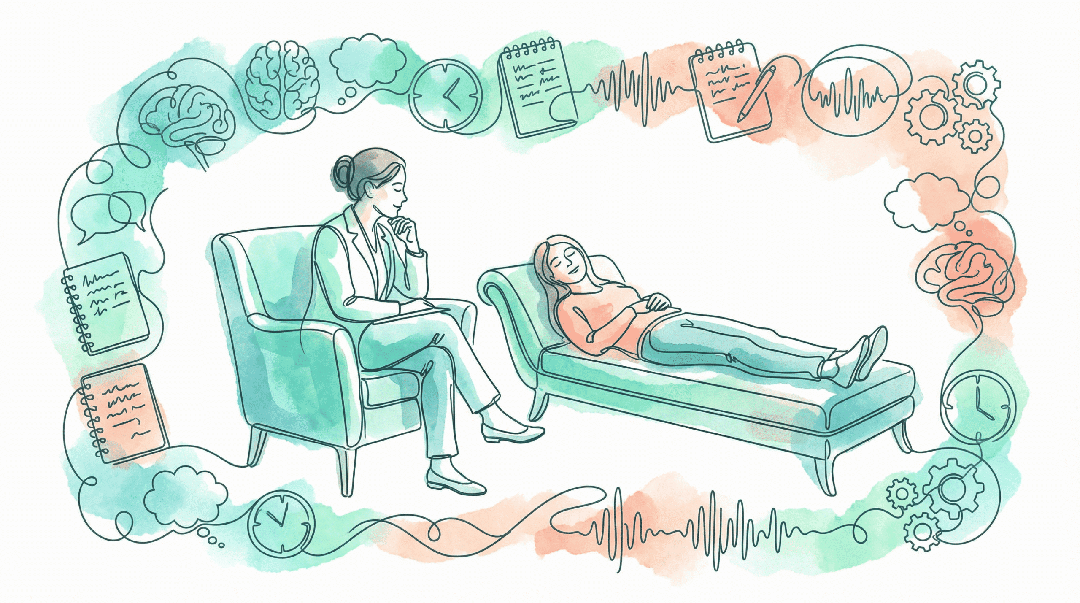
So what do you do when these signs show up?
(Emotional support + virtual mentoring)
Recognizing them is already a form of care.
Getting psychological care whenever possible is the ideal path.
But day to day, it also matters to have tools for emotional self-regulation.
EITA Mentor (EITA stands for Elevar a Inteligência a Treino de Autopercepção, Portuguese for roughly "turning intelligence into self-awareness training") works as AI-powered emotional mentoring, helping you:
How EITA Mentor supports your emotional health:
- Recognize emotional triggers
- Build emotional self-awareness
- Understand your behavior patterns
- Name emotions clearly
- Sort out your thoughts before deciding
- React less on impulse
It does not replace therapy and does not diagnose, but it creates a safe space for reflection and awareness, every day.
Because emotional care begins when you decide to listen to yourself with more kindness.
Frequently asked questions
How do I know if I need psychological support?
If you're noticing signs like emotional overwhelm, a racing mind, a loss of meaning, isolation, physical symptoms or extreme exhaustion, it's strongly recommended that you seek psychological care.
When should I seek psychological help?
When you feel you can no longer handle your thoughts, emotions or behaviors on your own. The sooner, the better. If you are in crisis or thinking about suicide, contact your local emergency number right away. In the US, call or text 988 (Suicide & Crisis Lifeline); in the UK and Ireland, call Samaritans on 116 123; in Brazil, call CVV on 188.
Does EITA Mentor replace therapy?
No. EITA Mentor works as AI-powered emotional mentoring that helps you get your emotions in order, but it does not replace care from a psychologist or psychiatrist.
Can you trust AI with your emotional health?
Only if it's an AI built specifically for emotional support, like EITA. General-purpose chatbots weren't designed specifically to handle human emotions safely.
Sources
- National Institute of Mental Health (NIMH). Depression. nimh.nih.gov
Anaclaudia Zani is a psychologist (CRP 06/128106, Brazil) and neuroscientist, creator of the EITA method and of EITA Mentor.