
Estimated reading time (fits in your break): 6 minutes
A new year usually arrives with goal lists, promises of change and ambitious plans. But have you ever stopped to ask yourself: is your mental health ready to carry all those goals? In 2026, taking care of your mental health belongs in the plan, because goals and mental health go hand in hand.
In Brazil, January has a campaign that exists precisely to remind us of a basic truth: without mental health, no goal holds up. Before diving into New Year's resolutions, we need to look inward and understand our emotions, building self-knowledge and emotional well-being along the way.
What is Janeiro Branco?
Janeiro Branco (Portuguese for “White January”) is a Brazilian awareness campaign, not a global one. It was created in 2014 by Leonardo Abrahão, a psychologist from Uberlândia, in the state of Minas Gerais. In 2023 it became federal law (Law No. 14,556/2023), and today it is part of Brazil's official calendar. The campaign is dedicated to raising awareness about mental health and emotional well-being. The choice of January isn't random: it's the month when people tend to be most reflective, looking back on the year that just ended and planning the one ahead. Throughout the month, the campaign promotes conversations and educational activities across the country.
Why does mental health come before goals?
In Brazil, Covitel 2023, a telephone survey conducted by the public health organization Vital Strategies with the Federal University of Pelotas (UFPel), interviewed 9,000 people and found that 26.8% had already received a medical diagnosis of anxiety, a figure that rises to 34.2% among women. When we neglect our emotional foundation, the results are predictable:
- Goals abandoned in the first months of the year
- Burnout from relentless self-pressure
- Constant frustration at not reaching your goals
- Cycles of self-sabotage that repeat year after year
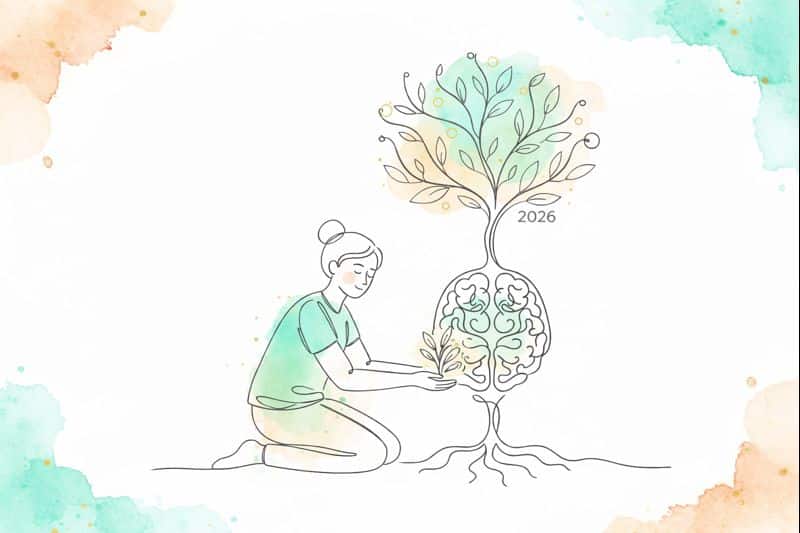
The math is simple: you can't put up a solid building on a cracked foundation. In the same way, you can't sustain big achievements when your mental health is fragile.
Self-knowledge: the real first step
Before you write down “lose 20 pounds,” “change jobs” or “make more money,” ask yourself:
- Why do these goals matter to me?
- What feelings am I hoping these achievements will give me?
- Am I running away from something, or genuinely looking to grow?
- Do I have the emotional resources to handle the challenges along the way?
Self-knowledge isn't a luxury or “life coach talk.” It's the most practical tool there is for making decisions that line up with who you really are, not with who society expects you to be. The process strengthens your emotional intelligence and brings clarity when it's time to prioritize what matters.
How to practice self-knowledge in January
1. Take an emotional inventory of 2025
Set aside a few hours to reflect: what were your biggest emotional challenges? What brought you genuine joy? When did you feel most like yourself? Look at all of it as part of the story of your mental health in 2025.
2. Identify your emotional triggers
Understanding what throws you off balance is essential for building self-care strategies. Pressure at work? Family conflict? Comparing yourself to others on social media?
3. Recognize your patterns
We all have behavioral tendencies that repeat. Do you tend to withdraw when you're sad? Procrastinate when you're anxious? Overwork when you're feeling insecure?
4. Use support tools
Self-knowledge can go further with professional support. Therapy, support groups, mental health apps and even specialized artificial intelligence (like EITA Mentor) can be allies in this process, helping you develop your emotional intelligence and care for your mental health consistently.
5. Practice self-compassion
Knowing yourself also means accepting your imperfections. You don't need to “fix” everything before moving forward, but you do need to be honest about where you are.
Janeiro Branco as a turning point
Use Janeiro Branco as a real milestone for change. Not another January of empty promises, but a month of genuine commitment to your emotional well-being.
A few practical actions for this month:
- Book an appointment with a psychologist or psychiatrist
- Set aside 15 minutes a day for an emotional check-in, a simple way to care for your mental health
- Cut back on content that drags your mental health down
- Talk openly about your emotions with people you trust
- Try digital tools for emotional support
- Practice emotional regulation techniques (breathing, mindfulness)
EITA: technology on the side of mental health
EITA Mentor is an artificial intelligence platform specialized in emotional health, developed with a scientific methodology and specific training. It isn't an ordinary generative AI.
Unlike generic chatbots, EITA was created by Anaclaudia Zani (@anaclaudia.eita), psychologist and neuroscientist, with protocols that:
- Use validated therapeutic techniques
- Encourage people to seek professional help when needed
- Include safeguards against dependence
- Respect the ethical limits of technology in mental health
Get to know EITA Mentor and see the plans. The platform also helps you build emotional intelligence for everyday life.
- Emotional planning for the new year: a self-awareness guide
- Who is Anaclaudia Zani? The neuroscientist behind EITA Mentor
- 10 signs you might need therapy
- Trustworthy Online Mentoring: A Complete Guide to Choosing Safely
Conclusion: goals, yes, but on a solid foundation
Your 2026 goals are valid and important. But they'll only become reality if you have the emotional clarity to pursue them and the mental resilience to get past the obstacles. In other words, goals and mental health have to go hand in hand.
This Janeiro Branco, do it differently:
- 👉 Understand your emotions BEFORE you set goals
- 👉 Invest in self-knowledge BEFORE you demand results
- 👉 Take care of your mind BEFORE you expect performance
Because, at the end of the day, without mental health, nothing moves forward.
Sources
- CNN Brasil (2023). Mais de 26% dos brasileiros têm diagnóstico de ansiedade (Covitel 2023). cnnbrasil.com.br (in Portuguese)
- Brazil. Law No. 14,556 of April 25, 2023 (establishes the Janeiro Branco campaign). camara.leg.br (in Portuguese)
- TRT12, Regional Labor Court of Santa Catarina (2024). Janeiro Branco completa dez anos conscientizando sobre importância da saúde mental (on the campaign's creation in 2014 by Leonardo Abrahão, in Uberlândia). portal.trt12.jus.br (in Portuguese)
Anaclaudia Zani is a psychologist (CRP 06/128106, Brazil) and neuroscientist, creator of the EITA method and of EITA Mentor.