

Reading time (fits in your break): 5 minutes
Why do so many people confuse self-awareness with being hard on themselves?
Lots of people say they want to get to know themselves better. But in practice, when they look inward, they end up stuck in cycles of criticism, comparison and impossible standards.
Thoughts like:
- “I should be handling this better”
- “Why do I still feel this way?”
- “I should be over this by now”
are common, and they usually come with guilt, anxiety and a sense of not measuring up.
This doesn't happen because you lack emotional maturity. It happens because nobody ever taught us the difference between self-awareness and inner judgment.
From a mental health standpoint, that difference matters enormously. And neuroscience helps explain why.
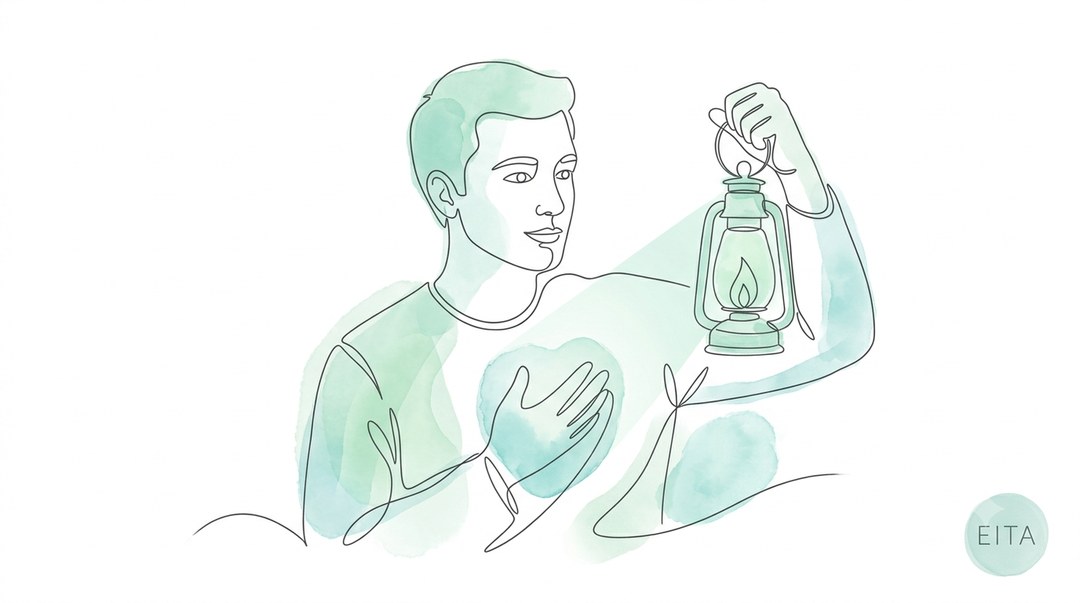
What is self-awareness, according to neuroscience?
Self-awareness isn't just reflecting on your life story or your personality. Through the lens of neuroscience, it's tied to the brain's ability to observe internal states (thoughts, emotions and sensations) without reacting to them automatically.
In other words: noticing what's happening inside you before autopilot takes over.
Emotional awareness and how the brain works
When an emotion shows up, several systems kick in at the same time:
- emotional areas (such as the amygdala)
- the body (physical sensations)
- cognitive areas (interpretations and thoughts)
Without self-awareness, all of this happens in one fast, tangled rush. The brain reacts, but it doesn't reflect.
With self-awareness, we create a small space between:
what we feel → what we think → what we do.
That space is essential for mental health.
Why does being hard on yourself get in the way of self-awareness?
In clinical practice, it's common to see harsh self-criticism land the way any other attack does. Even when the attack comes from inside, you respond as if you were under threat.
When that happens:
- you go on high alert
- your body tenses up
- your thinking gets rigid
- there's less room to learn anything about your emotions
In other words: the harder you are on yourself, the less you learn about yourself.
Healthy self-awareness doesn't grow out of criticism. It grows out of conscious curiosity.
How self-awareness supports mental health
When practiced the right way, self-awareness can help you:
- react less on autopilot
- make better decisions
- see your situation more clearly
- build emotional intelligence
- catch anxious spirals and rumination sooner
- recognize your real limits
One well-known study points in this direction. In 2007, a UCLA team led by psychologist Matthew Lieberman found that simply putting a feeling into words (what researchers call affect labeling) dampened the amygdala's response to pictures of emotional faces and increased activity in the right ventrolateral prefrontal cortex, a region the authors linked to toning down emotional reactions.
Self-awareness practices for everyday life
Here are some simple, steady strategies for building self-awareness without falling into the self-criticism trap.
1) Observe emotions before you try to “fix” them
Why it works:
Naming what you feel, as the UCLA study showed, tends to turn the alarm down instead of feeding it.
How to do it:
When an emotion comes up, swap the urge to solve it for questions like:
- “What am I feeling right now?”
- “Does this feel familiar?”
- “In what situations does this usually show up?”
Don't try to change anything. Just observe.
2) Separate the emotion from your identity
Why it works:
It's easy to turn a passing state into a fixed truth about who you are.
How to do it:
Swap:
- “I'm an anxious person”
for - “I'm feeling anxious right now”
This simple shift puts some distance between you and the feeling, and leaves more room to take care of yourself.
3) Pay attention to your body's signals
Why it works:
Your body often picks up on an emotion before you've found the words for it.
How to do it:
Throughout the day, ask yourself:
- Where am I holding tension right now?
- Is my breathing short or easy?
- Am I racing, or am I present?
Body awareness is one of the foundations of emotional self-awareness.
4) Question your inner critic, gently
Why it works:
A question invites curiosity; an accusation puts you on the defensive.
How to do it:
When you catch yourself demanding too much, ask:
- “Is this expectation realistic?”
- “Is this helping me or freezing me?”
- “What's possible right now, rather than ideal?”
Guided exercise: self-awareness without judgment
Set aside 5 minutes and answer, in your head or on paper:
- Which emotion showed up most often today?
- When did it show up?
- What thoughts came along with it?
- How did your body react?
- What does this tell you about what you need right now?
This exercise isn't about changing anything. It's about understanding. And understanding is already a change.
How EITA Mentor supports self-awareness day to day
In theory, self-awareness sounds simple. In practice, it tends to fall apart right when emotions run high.
EITA Mentor was created to support this process in real time, in the context of your actual life rather than some ideal scenario.
On WhatsApp, EITA:
- helps you name emotions clearly
- guides you through reflection without judgment
- spots recurring thought patterns
- helps you ease up on excessive self-criticism
- encourages more conscious, realistic choices
All of this is built on the method created by neuroscientist and psychologist Anaclaudia Zani, bringing together science, empathy and practical application.
EITA is a tool for everyday emotional support and self-awareness training. It does not replace therapy or psychiatric care.
Get to know EITA and start training your mind today
Self-awareness doesn't have to be heavy, confusing or lonely.
It can be guided, human and respectful of where you are right now.
Want support building and sticking with a self-care routine?
Meet EITA Mentor: an AI built for emotional check-ins, self-regulation practices and self-awareness at your own pace.
Visit: mentoravirtual.com.br | Follow: @eita.mentoravirtual (in Portuguese)
Sources
- Lieberman, M. D., Eisenberger, N. I., Crockett, M. J., Tom, S. M., Pfeifer, J. H., & Way, B. M. (2007). Putting feelings into words: affect labeling disrupts amygdala activity in response to affective stimuli. Psychological Science, 18(5), 421-428. PubMed record
Anaclaudia Zani is a psychologist (CRP 06/128106, Brazil) and neuroscientist, creator of the EITA method and of EITA Mentor.