

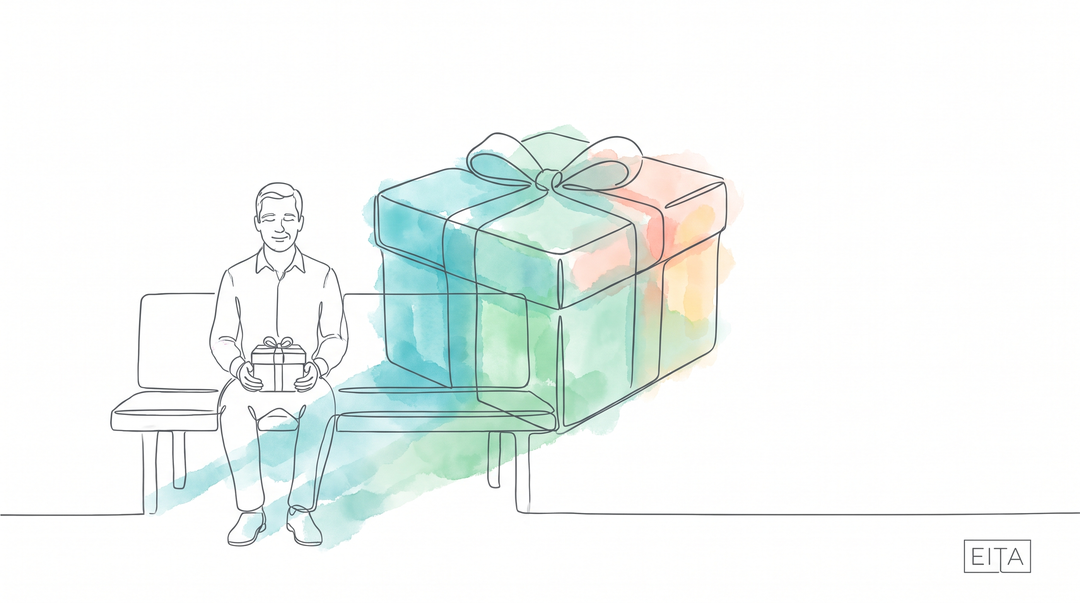
Wednesday, 10:47 p.m. The house has gone quiet, the dishes are in the rack, and you're brushing your teeth, staring at nothing in particular. Nobody asked you anything all day. Nobody suspects a thing. And yet, somewhere between the toothpaste and the rinse, it comes back: the thing you've never told anyone.
It might be big or it might be silly. The debt your family doesn't know about. The urge to quit the career everyone thinks you love. An old lie that got too small to bother correcting. During the day, keeping it under wraps took no effort at all. It's now, with no audience whatsoever, that it gets heavy.
It sounds backwards: if nobody's asking, why now of all times? Because the weight of a secret almost never sits in the moment of hiding it. It sits in the moments when you're alone with it.
There's a name for this: the weight of secrets
For a long time, psychology treated secrecy as a two-person scene: one person hiding something from another in the middle of a conversation. In 2017, Michael Slepian, Jinseok Chun and Malia Mason, of Columbia Business School in New York, proposed a different lens. A secret, they argued, is the intention to keep a piece of information from others, and that intention only occasionally requires actually hiding anything. Most of the time, it lives entirely inside your head.
The paper, published in the Journal of Personality and Social Psychology, brings together ten studies and more than 13,000 secrets. Working from the answers of 2,000 people, the authors built a list of 38 categories of secrets, ranging from lies, debt and infidelity to ambitions, hobbies, surprises and marriage proposals. Then they asked new groups of 200 people which of those they were keeping at that moment.
On average, each participant was keeping 13 of the 38 categories, and 5 of them had never been told to anyone. Depending on the study, between 96% and 97.5% of people had at least one active secret. The categories most often kept from everyone were thoughts about someone outside the relationship, sexual behavior, a lie and romantic desire.
The part almost nobody mentions: you hide it rarely, but you think about it a lot
The core question in the studies was simple. How many times in the past month did you have to actively hide this secret from someone during a conversation? And how many times did it just pop into your head, outside of any situation where it needed hiding?
The second number was always bigger. In Study 7, the researchers followed 100 people in committed relationships, night after night, each one keeping a significant secret from their own partner, the very person they spend the most time with. Even so, they thought about the secret, away from any moment of concealment, twice as often as they had to hide it.
That's where the cost lies. After accounting for how often people had to conceal, the more often they spontaneously thought about the secret, the lower their well-being. The reverse didn't hold: how often they concealed, on its own, didn't explain the drop. The authors put it this way: the most common form a secret takes is a spontaneous thought outside of conversations, and that's the form most closely tied to the harm.
Hiding takes work, but it's work with a schedule. Thinking about the secret keeps no schedule at all.

The secret you picture and the secret the studies found
| What we picture | What the studies found |
| The hard part is the conversation where someone might find out | What happens most is the secret coming back when you're alone |
| Secrets are rare and dramatic | Almost everyone keeps several, including surprises and plans |
| It weighs on you because you have to lie | It weighs more the more often it visits your mind |
| Telling means revealing it to the person who can't know | Telling a trusted third person already changes how you carry it |
How big this really is
The results hold up across all ten studies, but there are four things these numbers don't tell you.
First: participants were recruited on an online research platform in the United States, with an average age in the early-to-mid 30s. They're adults from many walks of life, a broader group than the college students behind most psychology studies, but they're not a sample of the whole population.
Second: the frequencies are people's own estimates of the past month or of that day. Nobody has a thought counter in their head. The authors addressed this by repeating the measure day by day in Study 7, and the pattern held.
Third: the link between thinking about a secret and lower well-being is an association. The authors used designs that follow people over time to strengthen the case for the direction of the effect, but that's not the same as an experiment that proves cause.
Fourth: not every secret is bad for you. The list includes surprise parties and marriage proposals, and an old secret that's no longer a secret didn't have the same effect as a current one. What Slepian and his colleagues point to as the cost isn't having something tucked away. It's having something tucked away that keeps coming back.
From the secret that keeps coming back to the secret you can carry: the EITA path
The EITA method trains the shift from an automatic reaction to a conscious process. Applied to the weight of a secret, the path has four steps.
Step 1: Notice when it shows up
For one week, write down just one thing: the moments when the secret showed up. In the shower, in traffic, in the checkout line, right before bed? The goal isn't to push it away, it's to see the pattern. It almost always arrives when your mind is idle, not when someone is close to finding out. Knowing that alone takes the air out of the feeling that you're one step away from getting caught.
Step 2: Name what's heavy
"That thing" weighs more than a sentence does. Write one line about what the secret is and another about what exactly bothers you about it: fear of what people would think, shame about what you did, guilt about what you're not doing. A secret with no name takes over your whole head. Once it has a name, it becomes a topic, and a topic is something you can think through from start to finish.
Step 3: Pick a confidant, not an audience
In 2019, Slepian and Edythe Moulton-Tetlock, also at Columbia, looked at more than 800 people and more than 10,000 secrets in the journal Social Psychological and Personality Science. Telling a secret to someone they knew didn't make people hide it any less: the situations that called for concealment stayed the same. What changed was something else. People who had confided felt they had support and felt more capable of dealing with the secret, and, through that, thought about it less often and reported higher well-being. The authors found this in both correlational studies and experiments.
Notice that the confidant doesn't have to be the person you're keeping it from. One trustworthy person is enough, someone who won't spread it and won't turn your secret into a verdict.

Step 4: Swap "what if they find out?" for "what do I do with this?"
When the secret comes back, instead of replaying the scene where it all comes out, ask a problem-solver's question: is there something to do about this this week? If there is, put it on the calendar. If there isn't, tell yourself the topic has a place, the conversation with your confidant or your notebook, and go back to what you were doing. It's the sense of being able to handle it, the same thing the 2019 study tied to well-being, trained on purpose.
EITA Mentor walks you through this process on WhatsApp, 24 hours a day, including Wednesday at 10:47 p.m., toothbrush in hand, when the secret comes back and there's nobody awake to listen. She helps you put into words what's weighing on you, separate the fear of being found out from the shame of what happened, and think calmly about who would make a good confidant and how to start that conversation. Slepian's studies measured confiding in people you know, so EITA doesn't take that place: she helps you get there.
Talking it out helps in the moment. When the pattern keeps repeating, understanding where it comes from is what brings change: at EITA Academy, EITA's training area, the mini-course "Os nove sabotadores" ("The Nine Saboteurs"), by neuroscientist Marina Marzotto, shows where your inner critic comes from and how to recognize each saboteur, with exercises to work through alongside EITA. The courses are in Portuguese.
Two everyday examples
The cases below are illustrative, created to explain the concept. They are not real people or accounts from clinical sessions.
Mark, 49, accountant. For two years he's been thinking about leaving accounting to open a woodworking shop, and he's never mentioned it to his wife, who always says he was "born for numbers." In Step 1, he noticed the idea came back almost every Sunday night, never at the office. In Step 3, he told his brother first. He didn't change careers, but Sunday night stopped feeling like a trial, and the conversation with his wife started to seem possible.
Patricia, 41, nurse. She was hiding a credit card balance from her family that started with a loan to a friend. In Step 2, she wrote down what was heavy and realized it wasn't the debt itself, but the shame of having been "naive." In Step 4, she traded the scene where everyone finds out for a payment plan with a date on it. The balance stuck around for a few more months. The shame shrank well before that.
This is a skill, not a gift
The people who seem light on their feet, even while keeping something to themselves, rarely have fewer secrets than you. They've learned not to let the secret roam loose in their heads: they gave it a name, a place and, when possible, a person. At first, telling someone feels risky and writing it down feels silly. With practice, it's just a way of tidying up the house on the inside.
And there's a hidden bonus: once the secret stops visiting you in every free moment, your free moments are yours again. The shower goes back to being a shower, traffic goes back to being traffic, and Wednesday at 10:47 p.m. goes back to being the time you brush your teeth.
If the hard part is precisely showing what you've been hiding, it's also worth reading about the beautiful mess effect, which shows how other people tend to see our vulnerability more kindly than we expect.
Frequently asked questions
Is constantly thinking about a secret a sign of OCD or anxiety?
Not necessarily. Coming back to a secret again and again is a common experience, one the studies found in the average person. Obsessive-compulsive disorder and anxiety disorders are clinical conditions, with intrusive thoughts or intense worry that go far beyond a single topic, eat up time and cause problems at work, with sleep or in relationships. If that's what you're living with, it's worth getting an evaluation from a psychologist or psychiatrist.
So do I have to tell the person I'm keeping it from?
That's not what the 2019 study tested. It looked at the effect of telling someone you trust, and that someone doesn't have to be the person involved. Whether to tell the person it concerns is a separate decision, with different risks, and it deserves to be thought through calmly, ideally with help. If the secret involves violence, abuse or a risk to you or someone else, reach out for professional help before deciding anything.
Does this replace therapy?
No. EITA is self-awareness training and day-to-day support, and it doesn't replace care from a psychologist or psychiatrist. A therapist's office, by the way, is a place built for exactly this kind of conversation. If you are in crisis or thinking about suicide, contact your local emergency number right away. In the US, call or text 988 (Suicide & Crisis Lifeline); in the UK and Ireland, call Samaritans on 116 123; in Brazil, call CVV on 188.
Sources
- Slepian, M. L., Chun, J. S., & Mason, M. F. (2017). The experience of secrecy. Journal of Personality and Social Psychology, 113(1), 1-33. Article DOI · Article PDF (Columbia University)
- Slepian, M. L., & Moulton-Tetlock, E. (2019). Confiding secrets and well-being. Social Psychological and Personality Science, 10(4), 472-484. Article DOI
Anaclaudia Zani is a psychologist and neuroscientist, creator of the EITA method and of EITA Mentor.