

Monday, 10:17 a.m., weekly status meeting. You open the spreadsheet you sent out on Friday and spot it before anyone else does: the total in column F is wrong. The number the director quoted in Saturday's email came straight from that cell. Nobody has noticed yet. Two more agenda items and it's your turn to talk.
Your mind does what it does best: it runs the movie. You saying "I made a mistake," the silence in the room, someone glancing at the clock, the director quietly filing your name under people who can't be trusted. Thirty seconds in, you've already come up with three ways to fix the number without admitting it was you.
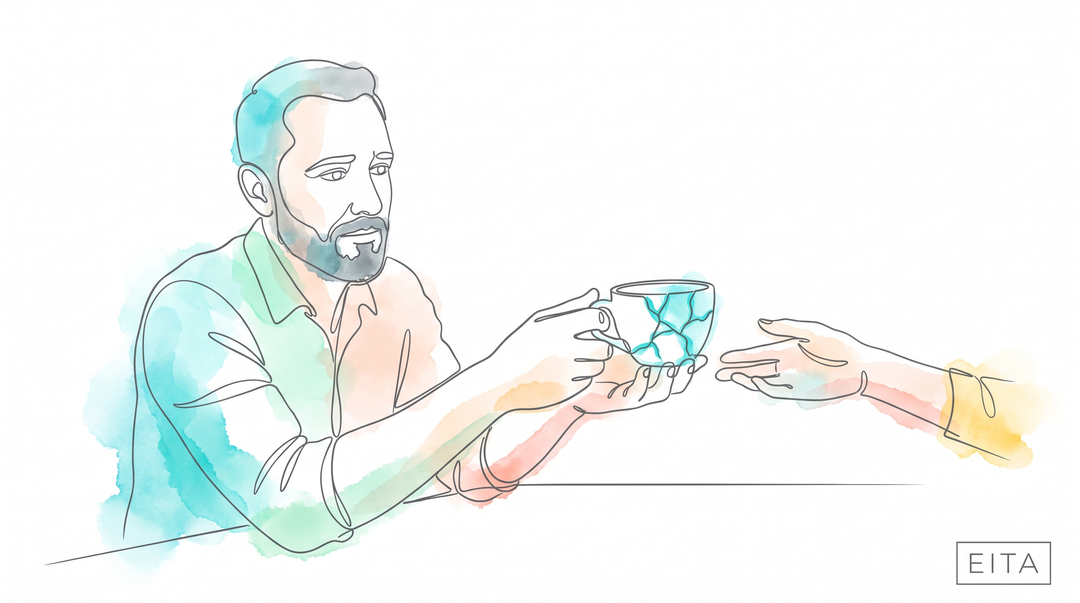
Now flip the scene. Last week it was Mark who opened the meeting with "I found an error of mine in the report. It's fixed, and the corrected version is in the shared folder." What did you think of him? Probably something like "glad he flagged it." Maybe even "that's a guy I can trust." Same move, two opposite verdicts. One for him, another for you.
There's a name for this: the beautiful mess effect
In 2018, Anna Bruk, Sabine Scholl and Herbert Bless, three psychologists in the Department of Psychology at the University of Mannheim in Germany, published a paper with seven studies on exactly this asymmetry in the Journal of Personality and Social Psychology. They called it the beautiful mess effect: showing vulnerability is judged more favorably when someone else does it than when you do.
In the paper, vulnerability doesn't mean fragility. It means the authentic, intentional willingness to open yourself up to uncertainty, risk and emotional exposure despite the fear. The examples at the top of the abstract come straight from everyday life: confessing a feeling, asking for help, taking responsibility for a mistake. And the next line is blunt: out of fear, many people decide not to.
Across the seven studies, the situations varied (confessing love, revealing imperfections in your own body, asking for help), and the pattern held. When people pictured themselves in the scene, they saw their own exposure as weaker and less desirable. When they pictured someone else doing the very same thing, they saw more courage. One of the studies took the question off the page and into a real situation, and the effect showed up there too.
The part almost nobody mentions: it's a matter of distance
The explanation the authors tested comes from construal level theory, which deals with psychological distance. What's close to us gets represented concretely, in rich detail. What's far away gets represented abstractly, by its overall meaning.
And nobody is closer to you than you. So when it's your turn to put yourself out there, your mind sees it in high resolution: the voice that might crack, the look on the director's face, the exact thing someone might say afterward. At that level of detail, according to the research, the focus lands on the negatives. Mark's vulnerability, on the other hand, you see from a distance, in low resolution. From there, what comes through is the bigger picture: someone honest, someone who owns it.

If the meeting scene reminded you of the spotlight effect, that makes sense: both get the math wrong on what other people think of you. But the spotlight effect is about the slip that already happened. The beautiful mess effect is about the decision to open up, and that's why it costs so much: it makes you hide the very thing you should be saying.
How you judge yourself vs. how you judge others
| When it's you | When it's someone else |
| A close-up, in full detail: your voice, everyone's face, the wrong word | A wide shot, focused on what the gesture means overall |
| The focus goes to what could go wrong | The focus goes to what's good about it |
| "Admitting the mistake will make me look weak" | "Glad she flagged it" |
| "They must think I'm boring" after a conversation | The person you talked to liked you more than you think (Boothby and colleagues, 2018) |
That last row comes from another study, which the Mannheim researchers themselves cite as a close cousin of the effect. In 2018, Erica Boothby, Gus Cooney, Gillian Sandstrom and Margaret Clark described in Psychological Science what they called the liking gap: after talking with someone new, people systematically underestimate how much the other person liked them and enjoyed their company. The gap showed up among strangers in the lab, among first-year college students sharing dorm suites and among adults at a workshop, and for the college students it lasted for months.
How big this really is, minus the hype
The effect itself isn't small: in their 2022 paper, the authors describe the size of the beautiful mess effect as relatively large. But there are three things those numbers don't tell you.
The first is who was studied. In the four 2022 studies, the participants were German university students with average ages between 20 and 22. It's reasonable to assume the lens works much the same way at 45, but nobody measured that in these studies.
The second is the format. In the 2022 studies, participants imagined the situation from a written scenario, such as confessing your love to your best friend, and rated it on a scale from 1 to 7, with items along the lines of "showing vulnerability is courage" or "is weakness." The 2018 paper includes evidence from a real situation, but imagining the meeting isn't the same as sitting in it.
The third matters most: the research doesn't say that opening up never comes at a cost. The authors themselves point out that the fear of being judged has some basis, because risk is part of the very definition of vulnerability. The question the effect answers isn't "is it risky?" but "is it as risky as it feels?" And the answer, on average, is no.
Pulling the camera back: the EITA approach
The EITA method trains the shift from an automatic reaction to a conscious process. Applied to those thirty seconds before it's your turn to speak, the approach has four steps.
Step 1: Recast the lead
Before you decide, put someone else in your chair, ideally someone you respect, doing exactly what you're afraid to do. How would you rate them? You're deliberately borrowing the same distance you already use, without noticing, whenever you judge other people.
Step 2: Pull the camera back in time
Ask what this scene will say about you a year from now, not ten minutes from now. Ten minutes out, all you can see is your voice cracking. A year out, what matters is whether you were the person who fixed the number or the one who hoped nobody would notice. Looking from farther away gives you back the whole picture.
Step 3: Talk to yourself the way you'd talk to a colleague
In 2022, Bruk, Scholl and Bless published four studies in Personality and Social Psychology Bulletin showing that self-compassion shrinks the effect. Self-compassion has a precise definition here: treating yourself the way you'd treat a good friend, with kindness, remembering that making mistakes is part of being human, and looking at your weak spots without blowing them out of proportion. In the three situations tested (confessing love, revealing bodily imperfections and admitting a mistake), people who scored higher on this trait judged their own exposure more like they judged other people's. The interesting part: the difference came from people judging themselves more kindly, not from changing how they judged others. And the result held even after accounting for self-esteem and neuroticism.

Step 4: Say it in one sentence, then stop
When the lens is too close, the urge is to overcompensate with explanations: three sentences of justification, two apologies, one "I have no idea how this happened." In practice, what tends to work is Mark's format: what happened, what's already been done, where the correct version lives. One short sentence is what other people already see from a distance. Everything else is the high resolution talking.
EITA Mentor walks you through this process on WhatsApp, 24 hours a day, including the night before the hard conversation, at 11:40 p.m., when you're rehearsing the worst-case script for the fifth time. She doesn't promise it will all be fine. She asks the questions that recast the lead, pull the camera back and help you land on that one short sentence.
Two everyday examples
The cases below are illustrative, created to explain the concept. They are not real people or accounts from actual sessions.
Patricia, 47, instructional coordinator at a school. She had been overloaded for months and wouldn't ask the principal for help, because "a coordinator who can't keep up isn't fit for the job." She did Step 1, picturing a colleague from another school in her place, and realized that if it were her colleague asking, she'd think the request was perfectly reasonable. She went into the meeting with a single sentence and two tasks she needed to hand off. The principal reassigned both and asked why she hadn't said something sooner.
Ryan, 39, maintenance engineer. He discovered that a procedure he had written himself had a step out of order. He spent an entire weekend rehearsing how to tell people. On Monday, he used the Step 4 format: the error, the fix, the new version in the system. The conversation took less than two minutes, and his supervisor asked him to review the rest of the team's procedures.
This is a skill, not a gift
People who own their mistakes with ease weren't born less afraid. They learned to change the distance they look from. At first, recasting the lead is slow and deliberate, and the thirty seconds before you speak feel like five minutes. With practice, the question "what would I think if this were someone else?" starts showing up on its own, before the disaster movie starts rolling.
And there's a hidden bonus: every time you open up and the room doesn't cave in, you collect a real data point against your high-resolution forecast. The next forecast comes out a little less dramatic. That's how the lens recalibrates: not by thinking harder about the risk, but by piling up evidence that it was smaller than it looked.
Frequently asked questions
Is the beautiful mess effect the same thing as social anxiety?
No. The beautiful mess effect is a judgment bias that showed up on average among the people studied, not a diagnosis. Social anxiety disorder involves an intense, persistent fear of social situations, to the point where you avoid them and it gets in the way of work, school or relationships. If the fear of opening up makes you skip things, turn down opportunities or dread a conversation for days ahead of time, it's worth getting an evaluation from a psychologist or psychiatrist.
So should I open up all the time, with everyone?
No. The research compares how you and others rate the same behavior. It doesn't say that any kind of disclosure, in any setting, will be well received. Hostile environments exist, and so do people who use someone's vulnerability against them. The idea is to correct the lens's exaggeration, not to give up good judgment about where and with whom.
Does this replace therapy?
No. EITA is self-awareness training and everyday support, and it doesn't replace care from a psychologist or psychiatrist. If the fear of being judged is paralyzing your life, or if you're dealing with intense, persistent distress, reach out to a professional. If you are in crisis or thinking about suicide, contact your local emergency number right away. In the US, call or text 988 (Suicide & Crisis Lifeline); in the UK and Ireland, call Samaritans on 116 123; in Brazil, call CVV on 188.
Sources
- Bruk, A., Scholl, S. G., & Bless, H. (2018). Beautiful mess effect: Self-other differences in evaluation of showing vulnerability. Journal of Personality and Social Psychology, 115(2), 192-205. PubMed record
- Bruk, A., Scholl, S. G., & Bless, H. (2022). You and I both: Self-compassion reduces self-other differences in evaluation of showing vulnerability. Personality and Social Psychology Bulletin, 48(7), 1054-1067. Full text (open access)
- Boothby, E. J., Cooney, G., Sandstrom, G. M., & Clark, M. S. (2018). The liking gap in conversations: Do people like us more than we think? Psychological Science, 29(11), 1742-1756. PubMed record
Anaclaudia Zani is a psychologist (CRP 06/128106, Brazil) and neuroscientist, creator of the EITA method and of EITA Mentor.