

Thursday, 9:52 a.m., client meeting. The presentation is going well, until you call Martha "Marsha." Twice. Someone corrects you, you laugh it off, fix it and keep going. The meeting wraps up, everyone says "great presentation" and heads off to get on with their own Thursday.
Everyone except you. At lunch, the scene comes back. At 3 p.m., you're replaying every face in the room, trying to calculate the damage. That night, brushing your teeth, your brain screens the moment again in close-up, with courtroom music. By now, a four-second slip has earned itself a six-hour trial in your head.
Now for the question psychology actually asked, clipboard in hand: how many people really noticed? The answer comes with a number and a name, and it's one of the most reassuring findings social science has produced in decades.
The embarrassing T-shirt experiment
In the late 1990s, Cornell University psychologist Thomas Gilovich, together with Victoria Medvec and Kenneth Savitsky, ran an experiment that became a classic. Students were asked to put on a T-shirt with a giant picture of singer Barry Manilow, considered mortifying for a college student at the time, and walk into a room where other students were working. Afterward, each one estimated: how many people in there noticed the shirt?
The wearers guessed that about half the room had noticed. The real number was closer to a quarter. In a follow-up study with shirts that weren't embarrassing at all, the gap was even wider: participants estimated that 48% of the room would identify the image, and only 8% did.
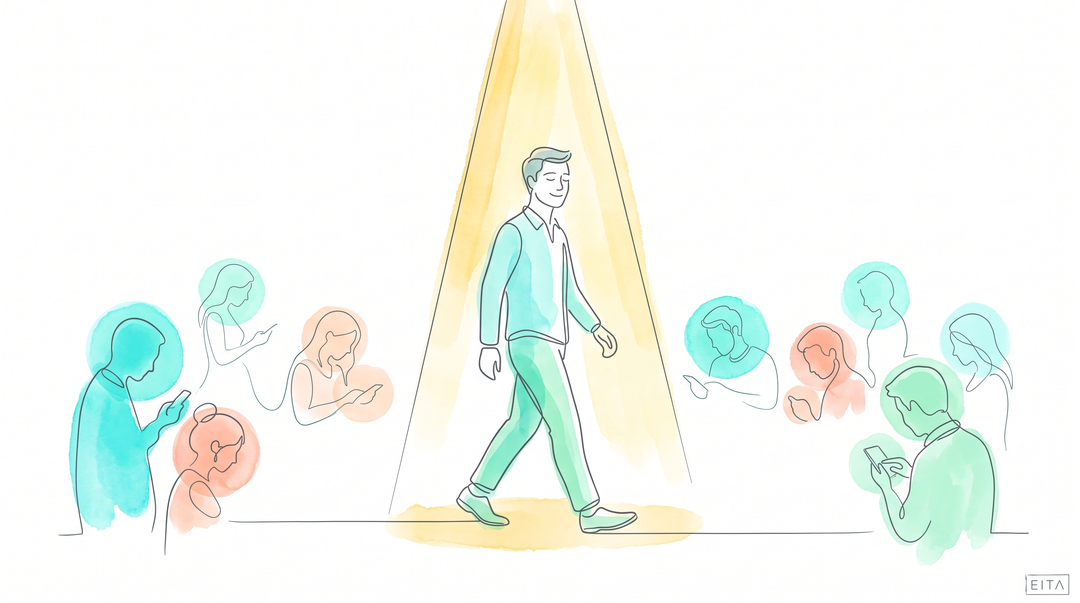
The authors published the results in 2000 in the Journal of Personality and Social Psychology and gave the phenomenon a name: the spotlight effect. The definition fits in one sentence: we systematically overestimate how much other people notice our appearance and our actions. You're standing under a spotlight that only you can see.

Why your brain overestimates the audience
The mechanism behind it was described by the same group in a 1998 study, also in the Journal of Personality and Social Psychology, about a close cousin of the spotlight: the illusion of transparency, the feeling that other people can read what's going on inside you.
The authors' explanation is elegant: it works like a badly adjusted anchor. You're the absolute center of your own experience. For you, the slip was the main event of the meeting, full screen, with instant replay. When you try to estimate what others saw, you start from that intense experience and try to discount it. But the discount always falls short: you adjust down a little and stop halfway, still far above what the audience actually registered.
In the 1998 study, people speaking in public were sure their nerves were written all over their faces: the shaky voice, the sweaty palms, the two-second blank. The audiences, asked right afterward, had picked up far less of it than the speakers believed. What feels like an earthquake on the inside reaches the outside as, at most, a faint tremor.
And there's the other side of the equation, the one we tend to forget: every person in that room is the center of their own experience. While you were tallying the damage from "Marsha," the person to your right was making sure nobody had spotted the error in their spreadsheet, and the one at the end of the table was silently rehearsing the question they wanted to ask without stumbling. The spotlight is personal and non-transferable: everyone is lighting their own stage.

What you're sure of vs. what the experiments measured
| The inner certainty | What the research found |
| "Half the room noticed" | With the embarrassing T-shirt, the estimate was about double the real number |
| "There's no way they missed it" | With ordinary T-shirts, 48% estimated vs. 8% actual |
| "My nerves were written all over my face" | Audiences picked up far less nervousness than the speakers thought |
| "They'll remember this tomorrow" | Most people didn't register it in the moment, let alone later |
An important bit of honesty before we go on: these experiments measure everyday situations, the T-shirt, the bad hair day, tripping over a word. They don't mean nobody ever notices anything, and they're no excuse to sweep a mistake that caused someone real harm under the rug. A mistake with consequences gets fixed with repair, not with statistics. The spotlight effect covers the vast majority of slip-ups: the ones that sting for hours on the inside and last seconds on the outside.
The antidote that became an experiment
Here's the most useful part of the story. In 2003, Savitsky and Gilovich published a simple test in the Journal of Experimental Social Psychology. The idea: before giving impromptu speeches, one group of participants was told about the illusion of transparency, the fact that nervousness looks far more obvious to the person feeling it than to the people watching.
The result: those who heard the explanation reported less anxiety, rated their own speeches more favorably and, the loveliest finding of all, were rated by the audience as more confident and more composed than the group that didn't know about the bias. In other words, the information you've just read in this article was tested as an intervention, and it worked. Simply knowing the spotlight exists turns down the wattage.
Switching off the spotlight: the EITA way
The EITA method trains exactly this: turning an automatic reaction into a conscious process. Applied to a slip-up in a meeting, the path has four steps.
Step 1: Name what lit up
After a slip, what shows up is usually a combo: embarrassment in the moment, then rumination, that replay on a loop. Name both: "I felt embarrassed, and now I'm overestimating the audience." Putting the phenomenon into words takes the process off autopilot and makes room for everything else.
Step 2: Apply the research discount
Take your gut estimate of how many people noticed and cut it in half, at the very least. It's the correction your brain won't make on its own, so you make it on purpose. In the experiments, the estimate was about double the real number in the worst case, and six times the real number in the ordinary case. Your slip is probably closer to the second scenario than the first.
Step 3: Run the reverse test
Try to remember, right now, the last time a coworker slipped up in a meeting. A mixed-up name, a blank, a typo on a slide. Hard, isn't it? Maybe you vaguely recall one, with no details, no date and no lingering judgment about the person. Exactly: that's the very shelf where your slip got filed in everyone else's mind.
Step 4: Get back in the game, in small doses
Embarrassment's instinct is to shrink: speak less at the next meeting, avoid the person, disappear from the room. But shrinking confirms to your brain that there really was a danger. Do the opposite, in a small dose: speak up again in the same meeting, ask a question, send the message you were going to send. And take the 2003 finding with you: you now know the audience sees far less than you feel. That piece of information, on its own, already improves your performance and how others read you.
EITA Mentor walks you through this process on WhatsApp, 24 hours a day, including at 11:40 p.m., when the toothbrush turns into a gavel and there's no one left awake to tell you "nobody noticed." She doesn't hand out canned phrases: she asks the questions that take the overestimate apart and help you decide on tomorrow's small step.
Talking it through brings relief in the moment. When the pattern keeps coming back, understanding where it comes from is what changes it: at EITA Academy, EITA's training area (courses in Portuguese), the micro-course "Os nove sabotadores" (The Nine Saboteurs), by neuroscientist Marina Marzotto, shows where your inner critic comes from and how to recognize each saboteur, with exercises to do alongside EITA.
Two everyday examples
The cases below are illustrative, created to explain the concept. They are not real people or accounts from clinical sessions.
Jennifer, 47, program manager. She spilled coffee on her blouse twenty minutes before presenting to the leadership team. She presented with her blazer buttoned, convinced everyone was staring at the stain peeking out at the collar. The next day, she ran the reverse test: she couldn't remember a single detail of what anyone at that table had been wearing. At any meeting. Ever.
Kevin, 36, analyst. He blanked for ten seconds in front of his new team and spent the week re-editing the moment in his head. When he finally mentioned it to a colleague, the answer was: "What blank?" The colleague had spent the entire meeting worried that his own mic was crackling.
This is a skill, not a gift
People who seem "self-assured" after a slip-up don't have a brain without a spotlight. They have a better-trained discount. The overestimate shows up automatically for everyone, because nobody can step out of the center of their own experience. What you learn, with repetition, is the adjustment: name it, cut the estimate, test it against real memory, get back in the game. Every slip you process this way shortens the next internal trial, until the six-hour replay shrinks into a six-minute "well, that was awkward, moving on."
And there's a hidden prize at the end: once you switch off your own spotlight, you have attention to spare for what the room actually needs. You're more present, you ask more questions, you put more ideas on the table. The most interesting person in the meeting is rarely the one who never gets it wrong. It's the one who gets it wrong, fixes it and stays in one piece.
Frequently asked questions
Is this the same thing as social anxiety?
No. The spotlight effect is an estimation bias that shows up in nearly everyone, in doses that bother you but don't paralyze you. In social anxiety, the fear of judgment is intense and persistent, and it leads people to avoid important parts of life, from work to relationships. If your experience sounds more like the second description, the right path is an evaluation with a psychologist or psychiatrist, and the sooner, the better.
What if the slip really was a big one?
Then the spotlight isn't the tool; repair is. If the mistake affected someone, what fixes it is a direct conversation: acknowledge it, correct it, move on. What the research adds is a bit of recalibration: even real mistakes take up less space in other people's memory than in yours, so the repair is usually simpler and better received than your rumination predicts.
Does it work for fear of public speaking?
It's one of the most tested uses. The 2003 study did exactly that: it explained the bias to speakers minutes before their speech, and both their reported anxiety and the audience's ratings improved. Before your next presentation, reread the section on the antidote. It's information with a measured, practical effect.
Does this replace therapy?
No. EITA is self-awareness training and everyday support, and it does not replace care from a psychologist or psychiatrist. If worrying about other people's judgment is limiting your life, or if you're dealing with intense, persistent distress, reach out to a professional. If you are in crisis or thinking about suicide, contact your local emergency number right away. In the US, call or text 988 (Suicide & Crisis Lifeline); in the UK and Ireland, call Samaritans on 116 123; in Brazil, call CVV on 188.
Sources
- Gilovich, T., Medvec, V. H., & Savitsky, K. (2000). The spotlight effect in social judgment: an egocentric bias in estimates of the salience of one's own actions and appearance. Journal of Personality and Social Psychology, 78(2), 211-222. Full text
- Gilovich, T., Savitsky, K., & Medvec, V. H. (1998). The illusion of transparency: biased assessments of others' ability to read one's emotional states. Journal of Personality and Social Psychology, 75(2), 332-346. PubMed record
- Savitsky, K., & Gilovich, T. (2003). The illusion of transparency and the alleviation of speech anxiety. Journal of Experimental Social Psychology, 39(6), 618-625. Article on ScienceDirect
Anaclaudia Zani is a psychologist (CRP 06/128106, Brazil) and neuroscientist, creator of the EITA method and of EITA Mentor.