

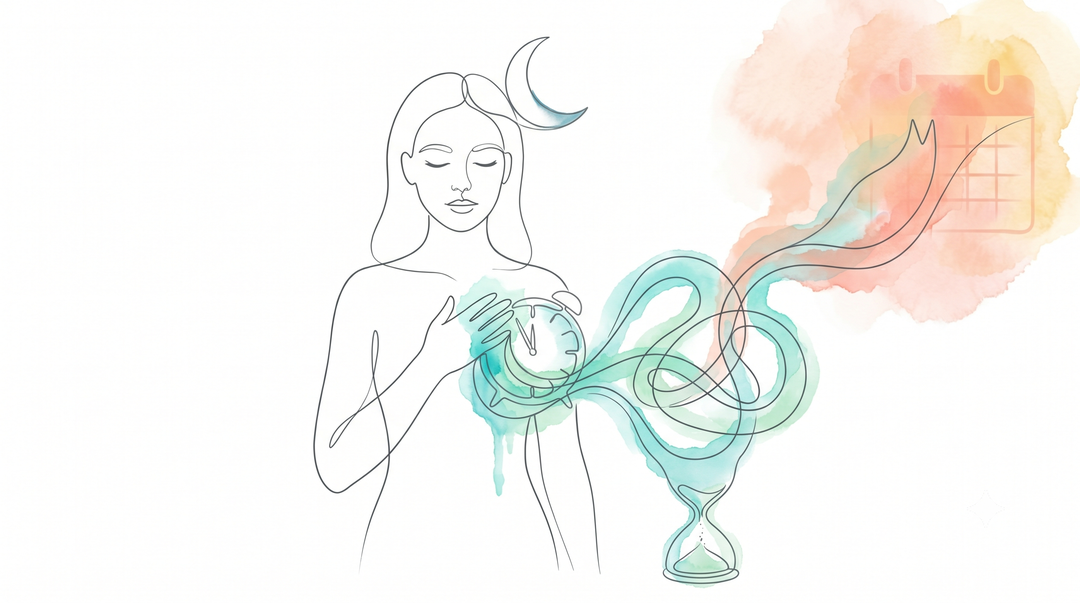
It's around six o'clock on a Sunday evening. Nothing bad has happened. Lunch was nice, the week hasn't even started, and yet something shifts in the air. Your chest tightens a little. You can't stay focused on the movie anymore. You get a strange urge to make time stand still, as if holding on to Sunday could push Monday back.
If that sounds familiar, take a breath: you're not being dramatic, you're not lazy, and you're definitely not the only one. This unease has a name (you've probably heard it called the Sunday scaries), it has a mechanism in the brain and, best of all, there's a way to break it.

LinkedIn has surveyed American workers about it: in 2018, 80% of the professionals surveyed said they experience the Sunday scaries. In a new round in 2023, with 2,000 people, the figure was 75%. And if you've ever watched a work group chat light up on a Sunday night, you didn't need a survey to tell you. Understanding what's behind it is already halfway to taking the edge off.
The shift: the problem isn't Monday. It's the Monday you imagine
Here's the idea that tends to turn common sense on its head: most of the time, the real Monday is lighter than the Monday you rehearse on Sunday night. The suffering doesn't come from the work itself. It comes from anticipating it.
There's a technical name for this: anticipatory anxiety. It's the kind of anxiety that fires in response to a future, imagined threat, not a danger that's happening right now. You're on the couch, safe, in your pajamas, and your body still reacts as if tomorrow's tough meeting were already in the room.
What's going on in your brain on a Sunday night
Let's look under the hood, without overcomplicating it. Three parts work together to produce that tightness.
1. The amygdala sounds the alarm. The amygdala is the brain's threat detector. It isn't great at telling a concrete danger from an imagined one. When it senses Monday approaching, with everything it stands for in terms of pressure and uncertainty, it sets off the alarm as if there were a real risk right in front of you.
2. Cortisol enters the scene. That alarm activates the so-called HPA axis (hypothalamus, pituitary and adrenal glands), which releases cortisol, the main stress hormone, into your bloodstream. That's what produces the physical sensations: a tight chest, a knot in your stomach, restlessness. Your body is literally getting ready to face something, even though you're sitting still.
3. The idle mind starts spinning scenarios. There's a network in the brain, the default mode network, that becomes active precisely when you're not focused on any outside task. And weekends are full of those idle moments. With nothing to hold its attention, this network starts to wander, and guess where it goes? To the to-do list, the unanswered email, the conversation you've been putting off, this month's targets.

And here's the cruel part: the brain's threat response tends to react more strongly to uncertainty than to a known problem. In a 2016 study from University College London, published in Nature Communications, volunteers' stress tracked how uncertain they were about whether an electric shock was coming, and it peaked when the odds were closest to a coin flip. Imagining what Monday might bring is often more distressing than Monday itself. "I don't know what's coming" weighs more than "I know exactly what I have to do."
Anticipatory anxiety is not the same as getting ready
A lot of people mix the two up and end up feeding the cycle while thinking they're being responsible. It's worth separating them:
| Anticipatory rumination | Mindful preparation |
| Circles around vague scenarios ("it's going to be awful") | Focuses on facts and concrete actions |
| Repeats the same thought without getting anywhere | Reaches a decision and stops |
| Happens at night, in the dark, with no plan | Happens with clarity: a list, a next step |
| Raises cortisol and costs you sleep | Reduces uncertainty and calms you down |
| "What if everything goes wrong tomorrow?" | "What's the first thing I'll do at 9 a.m.?" |
Notice this: the brain loves to pass itself off as productive. Ruminating about Monday feels like you're solving something, when really you're just spinning your wheels. Preparing is different: it turns the fog of "this is going to be hard" into one clear, finite step.
How to get through Sunday night: the EITA way
EITA (a Portuguese acronym for turning intelligence into self-awareness training) doesn't promise to make Monday disappear. It promises to take you off anxiety's autopilot and hand the controls back to you. Here are four simple moves for when the tightness shows up.
1. Name what you're feeling (and be specific)
The first step isn't to fix anything. It's to acknowledge it. "I feel bad" is too vague for your brain to do anything with. Try narrowing it down: is it fear of a specific task? Leftover exhaustion from last week? The sense that your free time went by way too fast? Putting a precise name on an emotion already lowers its intensity. Research on "affect labeling" shows that putting feelings into words calms the amygdala and helps the prefrontal cortex take back the wheel.
2. Separate facts from predictions
Much of Sunday's weight is made of predictions treated as facts. "This week is going to be chaos" isn't a fact; it's an anxious guess. Ask yourself: what do I actually know about tomorrow? Usually the honest answer is much smaller and more manageable than the cloud of doom your mind painted.
3. Trade the fog for one concrete step
As we saw, uncertainty is what sets off the alarm the most. So the best way to turn it down is to give shape to what's vague. You don't need to plan the whole week. Just decide the first thing you'll do on Monday morning. One defined next step. That closes the door the default mode network was using to wander off.
4. Give Sunday back to Sunday
Sunday night is still your time. Monday only starts when you wake up. Anchoring your attention in something present and enjoyable, a show, a long shower, a conversation, isn't escaping: it's cutting off rumination's fuel supply. You're not ignoring Monday. You're refusing to live it twice.
Sunday night is when no therapist's office is open. EITA Mentor is. She walks you through these four steps in a WhatsApp conversation, 24 hours a day, no appointment and no judgment, right when the tightness shows up.
Meet the virtual mentorTwo Sundays, two outcomes
The situations below are illustrative, created to explain the concept. They are not real people.
Situation 1: the Monday presentation. Megan has an important meeting at 10 a.m. on Monday. It's already 8 p.m. on Sunday and she can't relax. Her mind keeps replaying: "It's going to go wrong, I'm going to freeze, they're going to see I don't know what I'm doing."
On autopilot, she'd spend the night going over her slides with a knot in her stomach and sleep badly. On the EITA path, she pauses and names it: what she's feeling is fear of being exposed as incompetent. She separates fact from prediction: the fact is that she knows the material and has presented before; the rest is a disaster script. She sets one concrete step: review only the opening slide, once, and close the laptop. And she gives the evening back to Sunday. The next day, the meeting went the way meetings usually go: it was ordinary.
Situation 2: the "impossible" week. Ryan looks at the week ahead and feels like he can't handle it. There's so much on his plate that his whole Sunday gets tainted by a diffuse anxiety that isn't about anything in particular.
The real trigger wasn't a task; it was the feeling of having no control over the sheer volume. Once he names that, he realizes he doesn't need to solve the week on Sunday. He picks a single next step (on Monday morning, list his three real priorities before opening his email), and the fog starts to take shape. The week stayed full. But his Sunday went back to being his.
Dreading Sunday less is a skill, not luck
There's an annoying belief that some people "just don't get rattled" by Mondays, as if it were a fixed personality trait. Neuroscience disagrees. The brain is plastic: it reorganizes itself based on what you practice.
Every time, on a Sunday night, you name the emotion instead of ruminating, question the prediction instead of buying it as truth, and choose a concrete step instead of spinning your wheels, you strengthen the circuitry of the prefrontal cortex and weaken the automatic alarm. With repetition, Sunday stops being a weekly ambush and becomes simply what it is: the day before Monday. The mindful pause becomes your default, not the exception.
Frequently asked questions
Is it normal to feel anxious every Sunday?
Feeling some degree of discomfort as the weekend winds down is extremely common, given that most people report it. What deserves attention is when that anxiety is intense, regularly disrupts your sleep, or starts creeping into Saturday and even the rest of the week. At that point it's no longer just the Sunday scaries, and it's worth taking a closer look, ideally with professional support.
Why does anxiety show up more at night?
Because nighttime usually has the fewest tasks and the least outside stimulation, which is exactly when the default mode network is freest to wander through your unfinished business. With nothing occupying your attention, your mind fills the silence with predictions. It's no coincidence that Sunday rumination and trouble falling asleep go hand in hand.
Will changing jobs fix my Sunday anxiety?
Sometimes Sunday is signaling something real: a job that no longer fits you, a toxic environment, a boundary that needs to be set. It's worth listening to that honestly. But in most cases, the mechanism of anticipatory anxiety follows the person, not just the job title. Working on how you handle uncertainty tends to help in any scenario.
Does this replace therapy?
No. EITA Mentor is a tool for emotional support and self-awareness training, great for those everyday moments when the tightness hits and there's nobody to talk to. But it doesn't replace professional care. If your anxiety is intense, persistent or already getting in the way of your life, working with a psychologist or psychiatrist is irreplaceable. The virtual mentor works best as a complement to therapy, or as a first step for people who aren't in treatment yet.
Sources
- LinkedIn / Fast Company (2023). Sunday scaries research. fastcompany.com
- CBS Philadelphia (2018). 'Sunday Scaries': 80 percent of Americans worry about week ahead on Sunday, study reveals (2018 LinkedIn survey). cbsnews.com
- de Berker, A. O., et al. (2016). Computations of uncertainty mediate acute stress responses in humans. Nature Communications, 7, 10996. pmc.ncbi.nlm.nih.gov
- Lieberman, M. D., Eisenberger, N. I., Crockett, M. J., Tom, S. M., Pfeifer, J. H., & Way, B. M. (2007). Putting feelings into words: affect labeling disrupts amygdala activity in response to affective stimuli. Psychological Science, 18(5), 421-428. sanlab.psych.ucla.edu (PDF)
Anaclaudia Zani is a psychologist (CRP 06/128106, Brazil) and neuroscientist, creator of the EITA method and of EITA Mentor.