

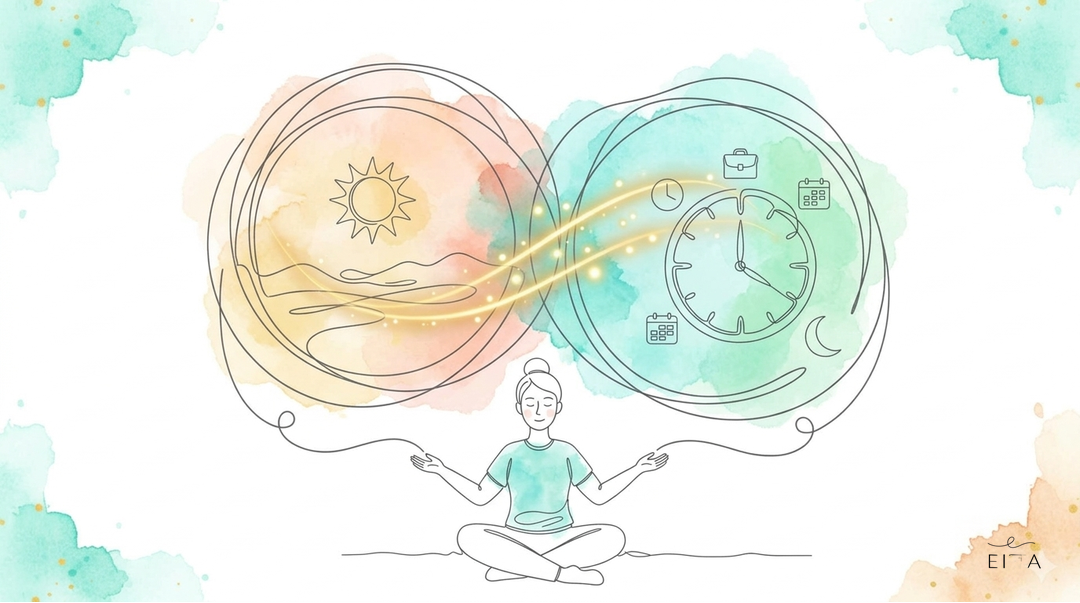
It's 12:40 a.m. on Friday night. The show had just one more episode, the house was quiet for the first time all day, and you decided to stay up. On Saturday you woke up at 10:20. On Sunday you fell asleep around 1 and got up at 10 again, a little groggy, a little pleased with yourself: two nights of decent sleep after a whole week of running a deficit.
Monday, 6:30 a.m. The alarm goes off and your body reacts as if someone had flipped on the lights in the middle of the night. Because, biologically, that's more or less what happened.
You didn't fly anywhere. You spent the weekend at home. But your internal clock spent two days in another time zone and got dragged back on Monday morning, with no layover and no warning.
This has had a name since 2006, and the name is pretty literal: social jet lag.
You count hours. Your body counts clock time
When someone says "I'll sleep in on Saturday to catch up," the math in their head is simple arithmetic: I came up five hours short during the week, so I'll sleep five extra on the weekend and we're even.
Your body doesn't keep a balance sheet. It works by phase, meaning where your day sits within the 24 hours. Sleeping from 1 a.m. to 10 a.m. is not the same as sleeping from 11 p.m. to 7 a.m. and taking a nap later. The durations are similar, the timing is different, and timing is what reorganizes your physiology.
That gap is exactly what Marc Wittmann, Jenny Dinich, Martha Merrow and Till Roenneberg named in 2006, in the journal Chronobiology International, when they described the mismatch between biological time and social time as a chronic form of jet lag. The group's big insight was to stop looking only at how many hours people sleep and start looking at when they sleep, on workdays and on days off.
How to calculate yours with back-of-the-napkin math
The measure is your sleep midpoint: the time that falls exactly halfway between when you fall asleep and when you wake up.
- Workday: asleep at 11:30 p.m., up at 6:30 a.m. The midpoint is 3 a.m.
- Day off: asleep at 1 a.m., up at 10 a.m. The midpoint is 5:30 a.m.
The difference between the two midpoints is your social jet lag. In this example, 2.5 hours. It's as if every Friday you boarded a flight to a time zone two and a half hours behind your own, then flew back on Monday morning and went straight into the 9 a.m. meeting.
Run your own numbers now, in your head. Most people are surprised by the result.

What's happening inside
Deep in your brain, in the hypothalamus, there's a cluster of neurons called the suprachiasmatic nucleus. Think of it as the conductor: it decides when your body temperature rises, when cortisol surges to get you out of bed, and when melatonin starts flowing to get you ready for sleep.
The conductor doesn't set the clock on its own. It sets it by light, mainly the morning light that reaches your eyes. That's why the time you wake up and get exposed to daylight has more say over your clock than the time you go to bed.
And here's the part almost nobody mentions: your body doesn't have just one clock. Your liver, gut, fat tissue and muscles all keep their own time, and they also take cues from food and activity. When you shift everything for two days and then shift it back on the third, those clocks don't fall back into line together. Some catch up fast, others lag. A 2025 review in BMJ Mental Health pulls together what we know about this desynchronization and what it means for mental health. That "out of it" feeling on Monday isn't you being dramatic: it's a whole orchestra playing the same piece at different tempos.
| Travel jet lag | Social jet lag | Sleep deprivation | |
|---|---|---|---|
| What changes | The local time zone | Your schedule, without going anywhere | How much you sleep |
| How often | A few times a year | Every week, all year long | Depends on your routine |
| Do you notice it? | Yes, and you have a name for it | Rarely; it just gets called "Monday" | Yes, as obvious tiredness |
| What fixes it | Time and daylight at your destination | Shrinking the gap between your two schedules | More sleep |
How big a deal is it, really?
Honesty matters here, because the internet loves to turn a modest finding into a catastrophe.
A 2025 systematic review in BMC Psychiatry, by Siwen Sun, Yupei Yang and colleagues, pooled eight studies covering 148,410 young people ages 10 to 24. Those with social jet lag of 2 hours or more had higher odds of depressive symptoms than those with less than 1 hour (OR 1.44, 95% confidence interval 1.18 to 1.77). Between 1 and 2 hours, the association didn't show up consistently.
That same year, another meta-analysis, by Lijuan Gao and colleagues in Acta Psychologica, combined 25 studies and 298,096 participants and found a real but small correlation between social jet lag and depressive symptoms, accounting for about 0.24% of the variation. The authors themselves write that the measure doesn't work as a diagnostic or prognostic marker.
In adults, a nationwide Japanese survey of 12,372 people, published in 2026 in Sleep Medicine, found an independent association between social jet lag of 2 hours or more and psychological distress, even after accounting for how long people slept.
Put the three together and the takeaway is this: social jet lag doesn't cause depression and isn't a diagnosis of anything. It's one variable among dozens, with a small effect across the population as a whole. The difference is that this variable is cheap to change. You don't need insurance, medication or extra free time to adjust a schedule. And when an effect is small on average, it's often large for the people at the far end of the curve, which is exactly who has a two- or three-hour gap every single week.
It isn't rare, either. In Brazil, the EPISONO cohort, which followed residents of the city of São Paulo, found that 14% of adults had social jet lag of 2 hours or more in 2007, and 10% in 2015, in a group whose average age was 42 at the start. Among Brazilian teenagers in the ERICA study, more than 80% had a gap of 1 hour or more.
How to shrink yours: the EITA way
The EITA method trains self-awareness before it trains technique. It works the same way with sleep timing: the problem is almost never a lack of discipline. It's a lack of data.
Step 1: Turn the feeling into a number
For one week, jot down just two things each day: what time you fell asleep and what time you got up. No judgment and no goals. On Sunday, work out your two midpoints and the difference between them. You go from "I've been so tired lately" to "I have a gap of 2 hours and 10 minutes," and those are two completely different conversations.
Step 2: Anchor your wake-up time, not your bedtime
Trying to fall asleep earlier on Sunday is the most common strategy and the most frustrating one, because sleep doesn't take orders. What you really control is when you get up. Pull your weekend wake-up time closer to your weekday one, with no more than about an hour of wiggle room. Your sleep will adjust on its own over the following days.
Step 3: Use light on purpose, not by accident
As soon as you wake up, get ten to fifteen minutes of natural light, ideally outdoors, even if the sky is overcast. At night, do the opposite: dim the lights at home during the last hour before bed. Morning light moves your clock earlier; evening light pushes it later. It's the most powerful lever you have, and it's free.
Step 4: Treat Sunday as a transition, not a goodbye
A good part of what weighs on you Sunday night is physiological, not emotional: you're asking your body to jump time zones by the next morning. Shift things 20 to 30 minutes earlier each day, starting on Saturday, instead of trying to fix it all at once.

Talking it through brings relief in the moment. When the pattern keeps repeating, understanding where it comes from is what changes it. At EITA Academy, EITA's training platform, the micro-course "A Fórmula da Eficiência" ("The Efficiency Formula"), by neuroscientist Marina Marzotto, uses six short lessons to show how emotions, mindset and mental shortcuts shape the way you spend your time, with exercises to do alongside EITA. The course is in Portuguese, and it comes as a gift with the annual plan.
Two everyday examples
The cases below are illustrative, created to explain the concept. They are not real people or accounts from clinical sessions.
Rob, 51, sales manager. On weekdays he's asleep by 11:30 p.m. and up at 6 a.m. On weekends he stays up late watching games and gets up at 11. His gap: 2 hours and 45 minutes. He'd been blaming his Monday irritability on his packed meeting schedule. After moving his Sunday wake-up time to 8:30 a.m. for three weeks, his complaint went from "I hate Mondays" to "Mondays are rough." It didn't turn into enthusiasm. It turned into a normal day.
Allison, 38, a nurse on rotating shifts. Her schedule changes because her contract says so, not because she chooses it, and there's no way to erase the mismatch. What changed was that she stopped fighting it: bright light right after waking, a dark room for daytime sleep, and fixed mealtimes no matter which shift she's on. The jet lag is still there. The self-judgment isn't.
It's a skill, not something you're born with
Nobody is born with a broken clock. Your circadian system is designed to adjust; that's literally its job. What it doesn't do well is adjust to a new rule every 48 hours.
Chronotype, the whole night owl versus early bird thing, has a biological component and shifts over the course of your life. You can't force a night owl to become a morning person, and that's not the goal anyway. The goal is to close the distance between the schedule your body wants and the schedule your life demands. Cutting the gap by thirty minutes is already a real change, and a change you can keep up is worth more than a total overhaul that lasts nine days.
Frequently asked questions
Is sleeping in on weekends bad for you?
It's not the sleeping in that matters, it's the size of the jump. A one-hour difference does no harm for most people. Two hours or more is where studies start to find links with depressive symptoms and psychological distress. If you're short on sleep, getting more of it is still necessary. Just try to add the hours at the start of the night rather than at the end of the morning.
I work shifts. Am I doomed?
No, but the game is different. If you work rotating shifts, you can't erase the mismatch, and blaming yourself for it only adds to the strain. What helps is stabilizing whatever is still in your control: mealtimes, bright light at the start of your "day," and real darkness when it's time to sleep, even if that's noon.
How is social jet lag different from insomnia?
With insomnia, you want to sleep and can't. With social jet lag, you sleep fine, just at the wrong time for your week. They're different problems with different solutions, and it's common to carry both at once without realizing they're two separate things.
Does this replace therapy?
No. Adjusting your schedule is routine hygiene, not treatment. EITA is self-awareness training and day-to-day support, and it doesn't replace psychological or psychiatric care. If your tiredness comes with persistent low mood, loss of interest in things you used to enjoy, or trouble keeping up with daily life, that calls for a professional evaluation, and no alarm-clock tweak is going to cover it. If you are in crisis or thinking about suicide, contact your local emergency number right away. In the US, call or text 988 (Suicide & Crisis Lifeline); in the UK and Ireland, call Samaritans on 116 123; in Brazil, call CVV on 188.
Sources
- Wittmann, M., Dinich, J., Merrow, M., & Roenneberg, T. (2006). Social jetlag: misalignment of biological and social time. Chronobiology International, 23(1-2), 497-509. tandfonline.com
- Sun, S., Yang, Y., Yu, F., He, Y., Luo, C., Zhang, M., Chen, H., & Tung, T. H. (2025). Social jetlag and depressive symptoms among young people: a systematic review and meta-analysis. BMC Psychiatry, 25, 664. link.springer.com
- Gao, L., Gao, J., & Zeng, Z. (2025). Social jet lag and mental health outcomes: A systematic review and meta-analysis. Acta Psychologica, 259, 105419. sciencedirect.com
- Associations of social jetlag with mental health, somatic symptoms, and work functioning in a nationwide Japanese survey: A population-based cross-sectional study (2026). Sleep Medicine. pubmed.ncbi.nlm.nih.gov
- Social jetlag in the city of São Paulo: A longitudinal study from the EPISONO cohort (2025). Sleep Medicine. pubmed.ncbi.nlm.nih.gov
- Martins, N. N. F., Mortatti, A. L., Schaan, B. D., & Cureau, F. V. (2025). Prevalence of social jetlag and associated factors in Brazilian adolescents: Results from a country-wide cross-sectional study. Sleep Health. pubmed.ncbi.nlm.nih.gov
- Circadian rhythms and mental health (2025). BMJ Mental Health. ncbi.nlm.nih.gov
Anaclaudia Zani is a psychologist (CRP 06/128106, Brazil) and neuroscientist, creator of the EITA method and of EITA Mentor.