

Why you sabotage your own goals, and what your brain has to do with it
Have you ever set a goal with all the conviction in the world (lose weight, change jobs, end a relationship that isn't working, go back to school, save money) and, a few days later, caught yourself doing exactly the opposite of what you'd planned?
If the answer is yes, you don't have a discipline problem. You have a brain doing exactly what it was programmed to do. The programming is just out of date.
Self-sabotage isn't a character flaw. It's a mechanism in the brain. And understanding how it works is the first step to switching it off.
What self-sabotage looks like from the brain's point of view
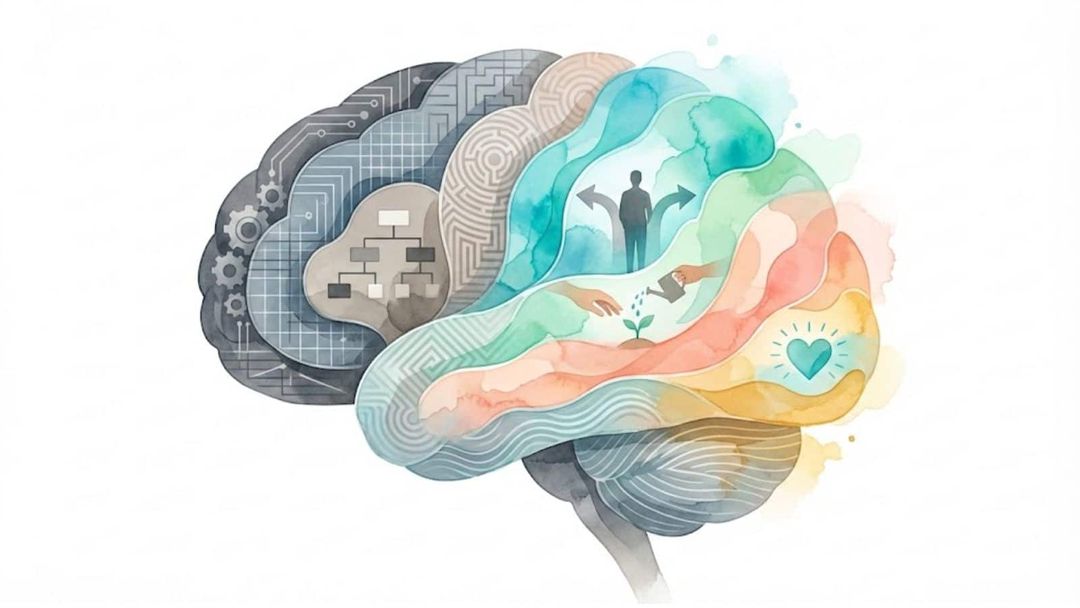
From a neuroscience perspective, self-sabotage can be understood as a tug-of-war between two brain systems that run at different speeds:
The immediate reward system
Driven by the nucleus accumbens and the brain's dopamine system, this system seeks quick gratification and avoids discomfort in the short term. It's powerful, fast and works below the level of awareness. It's what makes you pick up your phone when you should be studying, or eat what you didn't want to eat when you're stressed.
The prefrontal cortex: the planner
Responsible for rational thought, long-term planning and self-regulation, the prefrontal cortex is the part of the brain that sets your goals. The problem is that it's slower, burns more energy and tends to lose to the immediate reward system in a head-to-head contest, especially when you're tired, stressed or emotionally overloaded.
Why stress puts self-sabotage on overdrive
Stress raises cortisol and other chemical messengers, and the prefrontal cortex loses efficiency. In a 2009 review, neuroscientist Amy Arnsten of Yale University described the prefrontal cortex as the brain region most sensitive to the harmful effects of stress: even fairly mild, uncontrollable stress can cause a rapid loss of its abilities. Under perceived threat, the brain puts immediate survival ahead of long-term planning. That's why you make your worst decisions right when you most need clarity.
The most common self-sabotage patterns
Self-sabotage rarely looks like sabotage. It disguises itself as common sense, caution, humility or realism. These are the most frequent patterns:
Chronic procrastination
It isn't laziness. In a 2013 review, psychologists Fuschia Sirois and Timothy Pychyl described procrastination as, to a large extent, a way of repairing your mood in the short term: you put off the task to avoid the discomfort attached to it, whether that's the fear of getting it wrong, of being judged or of not being good enough.
Paralyzing perfectionism
Perfectionism grows from the same root as procrastination: fear. The inner logic goes like this: if I don't finish, nobody can judge me. If I don't hand it in, I can't fail. The result is a goal that never gets off the ground because it's “not ready yet.”
Sabotaging your own success
This is the most baffling one: someone achieves something important, like a promotion, a healthy relationship or a new project, and finds a way to wreck it or walk away from it. Why? Because success is unfamiliar territory too. And the brain prefers the familiar, even when the familiar is bad, over the unfamiliar, even when the unfamiliar is better.
Self-destructive self-talk
The voice that says “you can't do this,” “who do you think you are” or “this isn't for you” isn't your voice. It's a mental pattern installed over the course of your life, often in childhood. But because a thought can feel as solid as a fact, you end up acting as if that voice were right.
The role of mental patterns in self-sabotage
Neuroscientist Anaclaudia Zani, creator of the EITA method, explains that the brain runs on patterns: neural sequences that repeat automatically in response to certain triggers. These patterns take shape over a lifetime and get stored as automatic responses.
When you try to change a behavior without changing the mental pattern that holds it up, you're swimming against the current. The behavior changes for a few days and then comes back, because the underlying neural circuit hasn't changed.
That's why willpower alone doesn't work. It isn't a moral issue. It's biology.
How to break the cycle: strategies grounded in brain science
1. Make the goal smaller than seems necessary
The brain tends to sabotage big goals because its threat system reads radical change as danger. The fix isn't to have smaller goals. It's to break the big goal into actions so small that your defense system doesn't flag them as a threat. Two minutes of meditation every day builds more of a habit than an hour once a week, because habits grow out of repetition.
2. Name what you're feeling before you act
Before you give in to procrastination or the urge to quit, pause and ask: what am I feeling right now? Identifying the emotion (fear, shame, anxiety, boredom) brings the prefrontal cortex into play. In a 2007 brain-imaging study at UCLA, Matthew Lieberman and colleagues found that putting feelings into words increased activity in a region of the prefrontal cortex and dampened the amygdala's response to emotional images. Naming is what gives you back the ability to choose.
3. Separate the facts from the story
When your inner voice says “I'm not going to make it,” ask: is this a fact or an interpretation? What real evidence do I have to back it up? This kind of questioning is what cognitive behavioral therapy calls cognitive restructuring: replacing automatic narratives with evidence-based assessments.
4. Train self-awareness as a skill
Self-awareness (the ability to observe your own thoughts and emotions without fully identifying with them) is the most important skill for interrupting self-sabotage. And, like any skill, it develops through daily practice, not occasional insights.
When self-sabotage calls for professional help
Not all self-sabotage can be solved with techniques. When patterns run very deep, especially when they're rooted in trauma, complicated family dynamics, or anxiety or depressive disorders, psychological care is essential.
EITA Mentor was built for exactly this kind of everyday practice. Available on WhatsApp 24 hours a day, she helps you spot self-sabotage patterns, name the emotions that set them off and build more conscious responses. EITA is a tool for emotional support and training. It does not replace therapy. If you notice that self-sabotage patterns are significantly getting in the way of your life, see a psychologist or psychiatrist.
Frequently asked questions
Is self-sabotage conscious or unconscious?
Most of the time, unconscious. People genuinely don't notice they're sabotaging themselves; they believe the justifications they come up with. That's why self-awareness work matters so much: you can't change what you can't see.
Why do I sabotage things right when they're going well?
Because success is a change too. And the brain resists change, even positive change, when it contradicts the self-image you've built over your life. If deep down you don't believe you deserve success, your brain will create situations that confirm that belief.
How long does it take to change a self-sabotage pattern?
It depends on how deep the pattern runs and how consistent the practice is. Forget the 21-day rule: it traces back to a 1960 book by plastic surgeon Maxwell Maltz, who observed that his patients took about three weeks to get used to their new faces. That's an anecdote about adjusting to change, not research on habits. One of the most solid studies on the subject, led by Phillippa Lally and colleagues at University College London in 2010, followed 96 people and found a median of 66 days for a behavior to become automatic, with a range of 18 to 254 days. In other words, it depends a lot on the person and the habit.
Sources
- Lally, P., van Jaarsveld, C. H. M., Potts, H. W. W., & Wardle, J. (2010). How are habits formed: modelling habit formation in the real world. European Journal of Social Psychology, 40(6), 998-1009. onlinelibrary.wiley.com
- University College London, Behavioural Science and Health blog (2012). Busting the 21 days habit formation myth (on the origin of the 21-day figure in Maxwell Maltz's Psycho-Cybernetics, 1960). blogs.ucl.ac.uk
- Sirois, F., & Pychyl, T. (2013). Procrastination and the priority of short-term mood regulation: Consequences for future self. Social and Personality Psychology Compass, 7(2), 115-127. eprints.whiterose.ac.uk
- Arnsten, A. F. T. (2009). Stress signalling pathways that impair prefrontal cortex structure and function. Nature Reviews Neuroscience, 10(6), 410-422. pmc.ncbi.nlm.nih.gov
- Lieberman, M. D., Eisenberger, N. I., Crockett, M. J., Tom, S. M., Pfeifer, J. H., & Way, B. M. (2007). Putting feelings into words: Affect labeling disrupts amygdala activity in response to affective stimuli. Psychological Science, 18(5), 421-428. PubMed record
Anaclaudia Zani is a psychologist (CRP 06/128106, Brazil) and neuroscientist, creator of the EITA method and of EITA Mentor.