
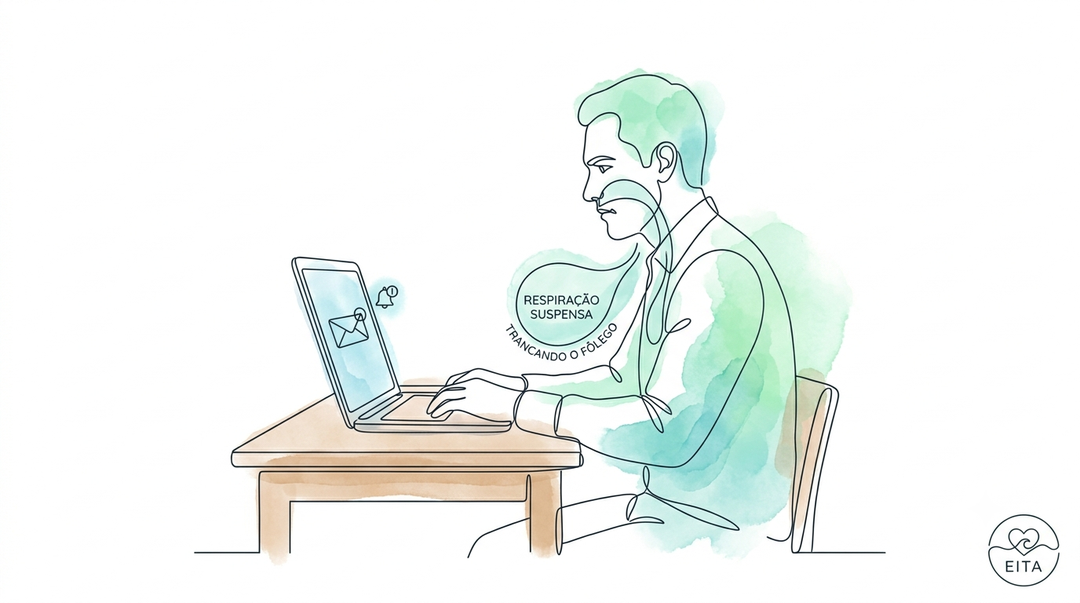
9:04 a.m. on a Monday. You open your inbox. Twenty-three unread, and one of them is from your boss, subject line "We need to talk." You click. And without asking your permission, your body does something curious: it stops breathing.
That's not a figure of speech. It's a pattern with a name, first described in the late 2000s, and it's probably happening to you right now as you read this on a screen: screen apnea, the tendency to hold your breath, or breathe in a shallow, irregular way, whenever you're facing emails, messages and notifications.
This article pushes back on a common assumption: you're not tired just because you work too much. A good chunk of your exhaustion may come from something far sillier and far more frequent: your body treats your inbox like a threat, over and over throughout the day, and changes your breathing before you get any say in the matter.
Where the name came from
Linda Stone, a tech veteran who worked at Apple and was an executive at Microsoft, noticed something odd in 2007. She was dealing with some health issues and had started doing breathing exercises, and yet, once she sat down at her computer and started on email, she caught herself holding her breath or breathing shallowly. Curious, she began observing other people: friends, friends of friends, former colleagues, anyone willing to sit at her computer and do email while a simple device tracked their heart rate. Her conclusion: about 80% of the people she observed held their breath or breathed shallowly in front of the screen. She named the pattern "email apnea," later broadened to "screen apnea."
In fairness, this wasn't a peer-reviewed scientific study. It was an informal observation. But she put a name to something that breathing research has since been approaching from other angles. And one detail from Stone's observations is worth its weight in gold: the only people who didn't hold their breath were a former military test pilot, a triathlete and professional performers, including dancers, singers and a cellist. Hang on to that detail. It comes back at the end.

What your screen has to do with your brainstem
When something new enters your field of perception, your body launches what physiologists call the orienting response: it briefly quiets its own internal activity to take in what's out there. A momentary hold on your breathing is part of that package. A 2002 study by researchers at Tilburg University in the Netherlands, published in the journal Psychophysiology, found that this brief inhibition of breathing is one of the built-in components of the orienting response. That made sense when the new thing in view might have been a predator. The trouble is that today the new thing shows up all day long, with a red badge and a ping.
Every notification is a small question your brain has to answer: is this a threat or not? An email from your boss, a "got a minute to talk?" text, a four-minute voice message with no context. For a social brain like ours, other people's judgment is serious business. The result: a micro-alert, a suspended breath, neck and shoulder muscles on standby. Multiply that across a full workday and you get a body that spends much of the day acting as if it were in hostile territory, while sitting in an office chair.
And there's a second, subtler layer: breathing and attention are coupled. A study from Trinity College Dublin, led by Michael Melnychuk and published in 2018 in the journal Psychophysiology, measured breathing, attention and a marker of activity in the locus coeruleus, the small brainstem structure that produces noradrenaline, a chemical messenger tied to alertness and focus. The finding: attention rises and falls with the breathing cycle, and participants who focused well on a demanding task showed greater synchronization between their breathing and their attention. Put simply, erratic breathing in front of a screen isn't just uncomfortable. It may also be feeding unsteady attention.
What you notice vs. what's actually going on
| What you notice | What's going on underneath |
| Stiff shoulders and a clenched jaw by the end of the day | The accessory breathing muscles in your neck and shoulders working overtime to keep up short, shallow chest breathing |
| Exhaustion out of all proportion to a day that "wasn't even that bad" | Breathing micro-alerts piling up since the morning |
| That huge, involuntary sigh when you close your laptop | Your body paying off an air debt you didn't know you had |
| "Let me take a deep breath before I open this conversation" | Your nervous system has already filed that contact under "threat" |
If you saw yourself in at least two rows of that table, keep reading for the practical part.
How to get your breathing unstuck: training in 4 steps
The EITA method (Elevar a Inteligência a Treino de Autopercepção, Portuguese for roughly "turning intelligence into self-awareness training") starts from a simple principle: you can't regulate what you don't notice. Applied to screen apnea, the training looks like this:
Step 1: Set up awareness alarms
You won't remember to check your breathing "every so often." Nobody does. It works better to tie the check to triggers that already exist: every time you open your email, every time you pick up your phone after a meeting, every time you see a red notification badge. There's just one question: am I breathing right now, or am I holding my breath? Three seconds. No judgment, just taking stock.
Step 2: Name what came along with the held breath
A held breath rarely shows up alone. It comes with anticipation ("what does he want?"), with self-reproach ("I should have answered yesterday"), with fear of being judged. Naming the emotion precisely drags the process out of autopilot and onto the table where decisions get made. "I'm nervous about how this client will respond" is something you can work with. A vague knot in your chest isn't.
Step 3: Question the size of the threat
Your body treated the email like a predator. It's your job to double-check that call: what exactly can this message do to me, here, right now? The vast majority of the time, the honest answer is "nothing a conversation can't fix." This isn't positive thinking. It's an audit: the alarm went off, so you check whether there's actually a fire.
Step 4: Give the air back with a long exhale
Here the science has a recent, encouraging finding. A randomized study from Stanford University, led by Melis Balban and published in 2023 in the journal Cell Reports Medicine, compared three breathing techniques with mindfulness meditation in 111 participants who practiced 5 minutes a day for a month. The technique that came out on top for improving mood and lowering breathing rate was cyclic sighing: two inhales through the nose (one long one, then a shorter one on top of it) followed by a slow, complete exhale through the mouth. It's basically the conscious version of the sigh your body already lets out on its own when you close your laptop. The difference is that you don't wait until 6 p.m. to pay off the debt.

Two training scenarios
The characters below are illustrative, created for this article. They are not real people or accounts from clinical sessions.
Rick, 47, sales manager in Chicago. He noticed he let out a huge sigh every time he closed his laptop, and decided to treat it as a clue instead of a release valve. He set up his anchor at the moment he opened his email: one long exhale before clicking the first unread message. He discovered he held his breath mostly with messages from senior leadership, named the pattern ("fear of being caught falling short"), and the Step 3 audit became routine. The emails still come. His body just stopped treating them like an ambush.
Denise, 41, attorney in Boston. Her trigger was a client's four-minute voice message with no context. Just seeing the audio bar made her chest tighten. Her training: name it ("apprehension about not knowing how big the problem is"), question it ("in 15 years of practicing law, how many of these messages were actually a catastrophe?") and listen to the message after a full exhale, not before. The detail that surprised her: the quality of her replies improved, which makes sense for a brain that's no longer making decisions in alarm mode.
If you'd like this kind of training with guidance, EITA Mentor walks you through exactly this process in WhatsApp conversations, 24 hours a day. And yes, we know: EITA lives on the same device that sets off your screen apnea. That's on purpose. Self-awareness is best trained in the habitat where the pattern happens, not in a quiet room far from real life.
Breathing well is a skill, not a gift
Go back to that detail from Linda Stone's observations: the people who didn't hold their breath in front of a screen were a test pilot, a triathlete, singers, dancers, a cellist. What they have in common isn't lucky genetics. It's that all of them had learned, as part of their training, to keep breathing well while doing something demanding, because their work requires it. Through repetition, they built a breathing pattern that doesn't fall apart in the face of a stressor.
It's the same principle of neuroplasticity behind any kind of self-awareness training: the brain reorganizes its circuits in response to what you practice regularly. And breathing has a rare advantage: it runs on autopilot, but it also comes with manual controls. You can't decide how you digest or how fast your heart beats, but you can decide your next exhale. Every time you use those controls on purpose, you teach your alarm system that a screen isn't a predator. With enough repetition, the body learns.
Frequently asked questions
Is screen apnea the same as sleep apnea?
No. Sleep apnea is a medical condition involving involuntary pauses in breathing during sleep, and it needs to be evaluated by a health professional. Screen apnea is a behavioral pattern in response to digital stimuli while you're awake. If you snore, wake up tired or have ever woken up gasping for air, see a doctor: these are different things that call for different care.
Do I need to drastically cut back on screens to fix this?
Cutting back on excessive screen time can help in other ways, but the key issue here isn't the screen. It's the automatic pattern that kicks in when you're in front of it. A person can spend 8 hours a day at a computer and breathe well, like the professionals Stone observed. The goal of the training is noticing the pattern, not running from the stimulus.
Can five minutes of breathing a day really make a difference?
That's exactly what the Stanford study measured: 5 minutes of cyclic sighing a day, for one month, improved participants' mood and lowered their resting breathing rate, with an edge over mindfulness meditation at the same dose. In other words, it doesn't take long sessions. It takes doing it regularly.
Does this replace therapy?
No. Breathing and self-awareness training is support for everyday life, not treatment. For diagnosed disorders, recurring anxiety attacks or intense distress, care from a psychologist or psychiatrist is irreplaceable, and EITA works best as a complement, not a substitute. If you are in crisis or thinking about suicide, contact your local emergency number right away. In the US, call or text 988 (Suicide & Crisis Lifeline); in the UK and Ireland, call Samaritans on 116 123; in Brazil, call CVV on 188.
Sources
- Stone, L. (2014). Are You Breathing? Do You Have Email Apnea? lindastone.net
- Stekelenburg, J. J., & van Boxtel, A. (2002). Pericranial muscular, respiratory, and heart rate components of the orienting response. Psychophysiology, 39(6), 707-722. Tilburg University record
- Melnychuk, M. C., Dockree, P. M., O'Connell, R. G., Murphy, P. R., Balsters, J. H., & Robertson, I. H. (2018). Coupling of respiration and attention via the locus coeruleus: Effects of meditation and pranayama. Psychophysiology, 55(9), e13091. Summary on ScienceDaily
- Balban, M. Y., Neri, E., Kogon, M. M., Weed, L., Nouriani, B., Jo, B., Holl, G., Zeitzer, J. M., Spiegel, D., & Huberman, A. D. (2023). Brief structured respiration practices enhance mood and reduce physiological arousal. Cell Reports Medicine, 4(1), 100895. Open-access full text (PMC)
- Stanford Medicine (2023). "Cyclic sighing" can help breathe away anxiety. med.stanford.edu
- NPR, Body Electric (2024). Screen time causes shallow breathing. Here's how to fix screen apnea. npr.org
Anaclaudia Zani is a psychologist (CRP 06/128106, Brazil) and neuroscientist, creator of the EITA method and of EITA Mentor.