

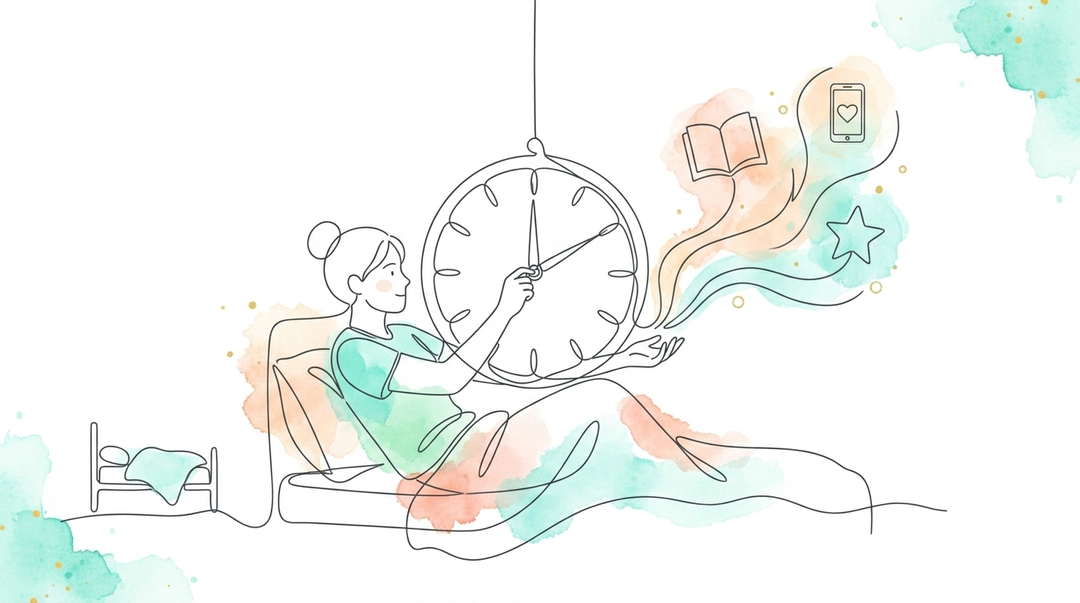
It's 12:40 a.m. Your body is wrecked, your eyes are burning, and the alarm is going off early tomorrow. You know all this. And yet there you are, thumb flicking up the screen, one more video, one more episode, one more scroll through the feed. It's not insomnia. It's not that sleep won't come. Deep down, you're putting it off on purpose.
If that sounds familiar, relax: it has a name. Researchers call it revenge bedtime procrastination. And no, you're not simply someone with no discipline. There's a very specific mechanism behind it, and it says more about your day than about your willpower.
The provocative idea behind this article is simple: the problem is almost never sleep. It's what happened in the sixteen hours before it.
Where the strange name comes from
The idea of putting off bedtime was first described by researchers at Utrecht University, in the Netherlands, who in 2014 coined the term bedtime procrastination for going to bed later than you intended, with no outside reason for it. But it was in China that it picked up its “revenge” twist.
The phrase there is bàofùxìng áoyè, which roughly translates as “retaliatory staying up late.” It described workers stuck on the “996” schedule (9 a.m. to 9 p.m., six days a week) who stayed up into the small hours not because they couldn’t sleep, but because that was the only window of the day when life felt like their own. The idea reached English speakers in June 2020, when journalist Daphne K. Lee wrote about it on Twitter. Night became an act of quiet protest. Payback we collect from a day that was never ours.
Notice the word: revenge. Revenge against whom? Against the job that swallowed the whole day, the messages that never stopped, the to-do list that never empties. Sleep becomes the casualty of a score-settling that, in the end, is with ourselves.

What’s going on in your brain
Here’s where it gets interesting. Revenge bedtime procrastination isn’t laziness or rebellion for its own sake. It’s a predictable lapse in self-control, the thing that tends to feel thinnest at the end of a long day.
The prefrontal cortex, the region just behind your forehead, is what holds your deliberate decisions together: planning, resisting impulses, remembering that going to sleep now is better for you. By nightfall, after a full day of deciding, holding back and giving in, it can feel like a phone battery in the red. Scientists still debate how literally to take that “willpower battery” image: a 2018 daily diary study that followed 108 employees through a work week didn’t find that more drained evenings led to more bedtime procrastination, and pointed instead to the mismatch between people’s body clocks and their schedules. But the broader link with self-control holds up: in the 2014 Utrecht study, people who scored lower on self-regulation reported more bedtime procrastination.
When self-control is running low, the reward system, driven by dopamine, takes the wheel. And what does that system love? Rewards that are immediate, easy and effortless. The infinite feed, the next season, the thirty-second video that turns into two hours. All of it delivers small doses of pleasure on demand, right when you’re least able to say no.
Add a third ingredient: the need for autonomy. Self-determination theory, one of the most influential frameworks in the psychology of motivation, treats autonomy (the sense that your actions are your own) as a basic psychological need, and its authors compare these needs to nutrients a person can’t thrive without. When the whole day has been dictated by other people, your brain is left with an autonomy debt. And the middle of the night presents itself as the most convenient ATM for withdrawing that payback. The result is a combo: a worn-out prefrontal cortex, dopamine in charge and a hunger for “my time” demanding to be fed. Your bed doesn’t stand a chance.
This isn’t insomnia. And it isn’t nighttime rumination.
It’s worth drawing a clear line between three things that often get lumped together, because each one is handled differently. Mixing them up means solving the wrong problem.
| Revenge bedtime procrastination | Insomnia | Nighttime rumination |
| You could sleep, but you choose not to | You want to sleep and can’t | You want to sleep, but your mind won’t shut off |
| Driver: winning back time and autonomy | Driver: a problem with sleep itself | Driver: thoughts and worries on a loop |
| Comes with a screen in hand and instant pleasure | Comes with frustration and the clock glowing | Comes with a racing mind in the dark |
| The fix starts during the day, not at night | May call for a clinical sleep evaluation | The fix involves sorting out your thoughts |
Notice: with revenge procrastination, sleep is available. You’re not lying in bed suffering. You’re sitting on the couch, awake by choice. It’s a behavior, not a symptom. And the good news is that behavior can be trained.
Why “more discipline” doesn’t work
The usual advice is “put the phone down and go to sleep.” That makes about as much sense as telling a hungry person “just don’t eat.” You’re not putting off sleep because you’re weak. You’re putting it off because, in that moment, the night is the only thing that feels like yours.
Going after the symptom (the screen, the hour) without looking at the cause (a day with no breathing room) is like mopping the floor with the faucet still running. People who only try to “force” a bedtime usually fall into a guilt cycle: they stay up, feel bad, sleep too little, wake up worse, have an even more suffocating day and, at night, feel an even stronger need for revenge. The cycle feeds itself.
To break out of it, the key isn’t more control in the heat of the moment. It’s handing yourself back pieces of autonomy throughout the day, so the night doesn’t have to become a battlefield. And that’s where a little method comes in.
How to break the cycle: the EITA method
EITA (Elevar a Inteligência a Treino de Autopercepção, Portuguese for turning intelligence into self-awareness training) is the foundation of EITA Mentor. Applied to this particular habit, it works in four moves.
1. Name what the late night is trying to buy
Next time you catch yourself putting off bed, ask a question instead of judging yourself: what am I looking for here? It’s almost never the video itself. It’s mental rest, it’s quiet, it’s the feeling that some part of the day was yours. Naming the real need (“I want some time with nobody asking me for anything”) already takes some of the force out of the impulse, because it turns an automatic behavior into a conscious choice.
2. Move some autonomy back into the middle of the day
If your only window of freedom is the middle of the night, the problem is how little freedom you have the rest of the day. Small islands of time that are yours, spread throughout the day, shrink the debt that charges interest at night: fifteen minutes of coffee with no screen, a short walk on your own, a lunch break that’s actually a break. It doesn’t have to be much. It has to be yours, and before 11 p.m.
3. Create a “break that’s yours” earlier, with an end time
Night isn’t the villain. Evening downtime isn’t the problem. The problem is downtime with no brakes, which rolls on into the small hours because it never had a set start or finish. Schedule a moment of deliberate pleasure, with a start time and an end time: thirty minutes of something you enjoy, then bed. When pleasure has a frame, it satisfies. When it’s endless, it just postpones.
4. Swap guilt for curiosity
Every time you label yourself as having “no discipline,” you reinforce the cycle. Trade the verdict for an investigation: “what kind of day leaves me most tempted to steal time from the night?” The answers become data. And data change the next day far more than any internal lecture.
This is exactly where EITA Mentor helps. At 12:40 a.m., when you’re about to start another episode, you can open WhatsApp and have a two-minute conversation that helps you name what you’re looking for and decide consciously instead of on autopilot. She’s available 24 hours a day, including in the middle of the night, exactly when self-control is running on empty.
Talking it through brings relief in the moment. When the pattern keeps coming back, understanding where it comes from is what changes it: at EITA Academy, EITA’s training area (courses in Portuguese), the micro-course “A Fórmula da Eficiência” (The Efficiency Formula), by neuroscientist Marina Marzotto, shows in six short lessons how emotions, mindset and mental shortcuts shape the way you use your time, with exercises to do alongside EITA. It comes as a gift with the annual plan.
Meet EITATwo examples of how this becomes practice
The cases below are illustrative, created to show the method in common situations. They are not real people or accounts from clinical sessions.
Case 1: the mom who only exists once the house is asleep. Megan works all day, picks up the kids, makes dinner and puts everyone to bed. By the time she finally sits down, it’s 11:30 p.m. That’s when the binge-watching starts, and it runs until 2 a.m., even with a meeting at 8. Her revenge is clear: the whole day belonged to other people, and the small hours are the first time that’s hers alone. The turnaround didn’t come from “going to bed earlier.” It came from carving out twenty minutes just for herself in the late afternoon and setting one episode (one, with an ending) before bed. The need still got met. Sleep stopped footing the bill.
Case 2: the remote worker with no boundaries. Dan works from home, and his workday never really ends: a message at 8 p.m., an email at 9. With no transition between work and rest, the only way his brain finds to “close out the day” is to stay up doing nothing at 1 a.m. The fix was a ritual: an explicit end to work at 7 p.m., with a physical gesture (closing the laptop, stepping outside for ten minutes). With a clear boundary, the middle of the night stopped being the only free territory.

Going to bed on time is a skill, not a gift
There’s a lazy belief that some people “just can” switch off and fall asleep, as if it were a personality trait. Neuroscience disagrees. The brain is plastic: it reorganizes itself around what you repeat.
Every night you meet the real need earlier, instead of collecting your revenge at 2 a.m., you weaken the impulse circuit a little and strengthen the one for planned rest. It isn’t magic, and it doesn’t happen overnight. It’s training. And like all training, what counts isn’t the intensity of one heroic day; it’s the regularity of the small ones. The person who sleeps well today, in most cases, wasn’t born that way. They built it, one repetition at a time.
Frequently asked questions
Is revenge bedtime procrastination a disorder?
No. It’s a behavior pattern described by psychology, not a clinical diagnosis. It becomes a concern when it’s frequent and starts costing you: chronic tiredness, slipping performance, irritability, getting sick. In those cases, it’s worth getting help. But most of the time, it’s a sign that your day is asking for more breathing room, not that something is wrong with you.
Will cutting out screens at night fix it on its own?
It helps, but it’s rarely enough. The screen is the instrument, not the cause. If you take away the phone but don’t give your day any room for autonomy, the need is still there and looks for another outlet. The more lasting path is to deal with the cause (a day with no breaks), not just the symptom (the device in your hand).
How does EITA Mentor help with this?
In a few minutes of conversation on WhatsApp, she does what’s hard to do alone at 12:40 a.m.: she helps you notice what you’re really looking for, name the need and decide consciously instead of on autopilot. Because she’s available 24 hours a day, she reaches you right when self-control has already run out. Over time, it’s self-awareness training that changes the way you close out your days.
Does this replace therapy?
No. EITA Mentor is a tool for emotional support and self-awareness training. It does not replace professional care. If your sleep loss is intense or persistent, or comes with deep sadness, disabling anxiety or distress that gets in the way of your life, care from a psychologist, psychiatrist or sleep physician is irreplaceable. EITA works best as a complement, or as a first step for people who aren’t in care yet.
Sources
- Kroese, F. M., De Ridder, D. T. D., Evers, C., & Adriaanse, M. A. (2014). Bedtime procrastination: introducing a new area of procrastination. Frontiers in Psychology, 5, 611. frontiersin.org
- Liang, L.-H. (2020, November 26). The psychology behind “revenge bedtime procrastination.” BBC Worklife. bbc.com
- Kühnel, J., Syrek, C. J., & Dreher, A. (2018). Why don’t you go to bed on time? A daily diary study on the relationships between chronotype, self-control resources and the phenomenon of bedtime procrastination. Frontiers in Psychology, 9, 77. frontiersin.org
- Ryan, R. M., & Deci, E. L. (2000). Self-determination theory and the facilitation of intrinsic motivation, social development, and well-being. American Psychologist, 55(1), 68-78. selfdeterminationtheory.org (PDF)
Anaclaudia Zani is a psychologist (CRP 06/128106, Brazil) and neuroscientist, creator of the EITA method and of EITA Mentor.