

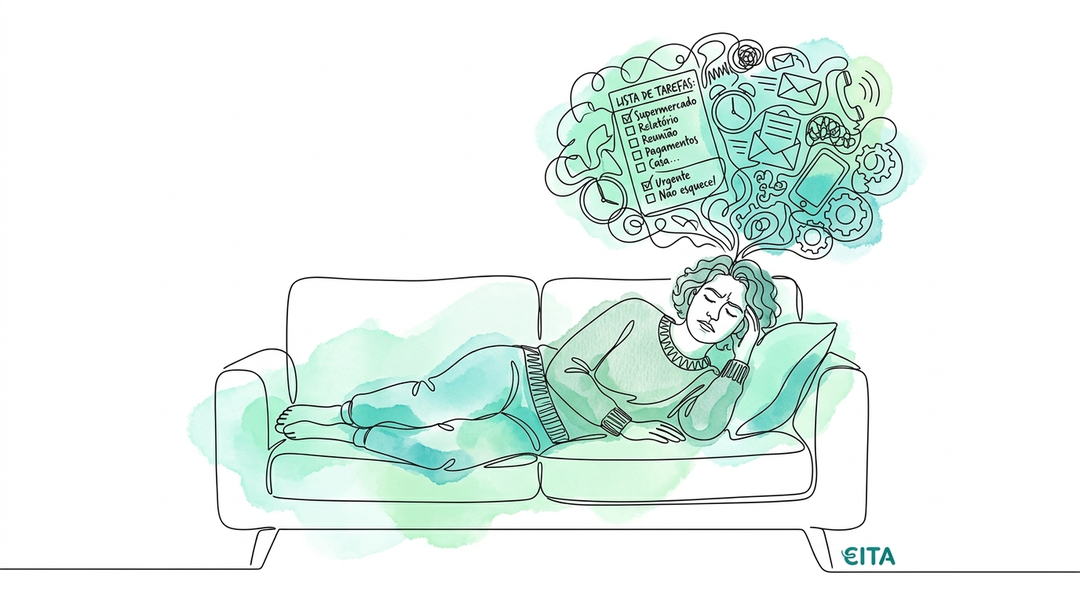
Saturday, 3 p.m. You finally sink into the couch. The house is in order, nobody needs you for the next ninety minutes, and your show is paused right where you left off. You hit play.
And then it shows up. That quiet, perfectly polite little voice that never yells or swears: "You could be getting ahead on that thing."
You keep watching. You finish the episode. You get up off the couch. And you're no more rested than when you sat down.
The math that never adds up
The automatic diagnosis is always the same: I didn't rest enough. If ninety minutes didn't do it, the problem must be the dose. You needed a whole afternoon, a weekend, a real vacation. Except the dose has been the same for years and the math never works out: you take the vacation and come back feeling like nothing happened.
There's a better explanation, and it's uncomfortable because you won't find it on your calendar: it's not rest you're missing, it's the guilt canceling out the rest you already get. The time off happened. Its benefit is what got canceled along the way.
What the research showed (and what it debunked)
In 2021, Gabriela Tonietto (Rutgers Business School), Selin Malkoc and Rebecca Walker Reczek (Ohio State) and Michael Norton (Harvard Business School) published four studies with 1,310 participants in the Journal of Experimental Social Psychology on one specific belief: that leisure is a waste of time.
Three findings matter here.
First: people who hold this belief enjoy the leisure they actually take less. It's not that they rest less. They rest and get less out of it.
Second: the belief goes hand in hand with lower reported happiness and with more depression, anxiety and stress. And the link isn't flimsy: in Study 2, the correlation with anxiety was the strongest of the bunch.
Third, and this is the one that breaks conventional wisdom: when the researchers induced the opposite belief, telling participants that leisure is productive, enjoyment did not go up. Inducing "leisure is wasteful" dragged enjoyment down. Inducing "leisure is productive" gave nothing back. In Study 4 they went further and framed wastefulness as something good, even necessary. Enjoyment dropped just the same.
In other words, the way out isn't convincing yourself that rest pays off. That doesn't work. The way out is to stop putting your rest on trial.
Why your brain charges a toll
The mechanism the authors propose has two parts, and both are very concrete.
The first is the perceived opportunity cost of time. If you believe that hour on the couch produces nothing, part of your attention stays parked on everything that hour could be producing. You're on the couch and on your to-do list at the same time. Your body showed up for the rest; your attention never arrived.
The second is a drop in immersion. Enjoyment depends on being inside the experience, and nobody gets inside an experience that's being audited in real time. That's why the same afternoon off restores one person and evaporates for another.

Terminal rest and instrumental rest
Instrumental leisure serves some other goal: you run to get in shape, meditate to be sharper on Monday, read to stay current. Terminal leisure exists for its own sake: lounging around, watching a silly show, chatting with no agenda, doing nothing at all.
The finding is precise: the belief that leisure is wasteful undermines enjoyment of terminal leisure. With instrumental leisure, the effect all but disappears. That makes sense: when the activity comes with a receipt, your inner court has nothing to complain about.
The problem is that, in the same research, enjoying terminal leisure was the stronger predictor of well-being, especially happiness and depression. And that's exactly the side guilt eats first.
| Instrumental rest | Terminal rest |
| Has to produce something: health, focus, discipline | Doesn't have to produce anything |
| Survives guilt because it comes with a ready-made excuse | Is the first thing cut when your schedule gets tight |
| Running, goal-driven meditation, a class, useful reading | Lounging, a silly show, chatting about nothing, staring at the ceiling |
| You can explain it to other people | You catch yourself explaining it to yourself |
| Helps some | Matters more for your well-being |
And no, this isn't a luxury problem for people with time to spare
In Brazil, the national social security agency (INSS) received 3.5 million requests for medical leave in 2024, and more than 472,000 leaves were granted for mental disorders, according to the country's Ministry of Social Security. That's a 68% increase over 2023. These aren't lazy people. They're people who worked until they broke, often taking breaks along the way without being able to enjoy a minute of them.
Rest isn't your brain switched off
Guilt runs on a silent assumption: that while you're not producing, nothing is happening.
Neuroscience took that apart in 2001, when Marcus Raichle and colleagues described in PNAS what they called a default mode of brain function. Rest isn't the absence of activity. It's when a different network steps in, the default mode network, which stays relatively quiet while your attention is locked on the outside world.
In 2012, Mary Helen Immordino-Yang, Joanna Christodoulou and Vanessa Singh pulled this research together in a paper whose title saves a lot of explaining: Rest Is Not Idleness, published in Perspectives on Psychological Science. The authors show that the regions active during wakeful rest are the same ones involved in retrieving personal memories, imagining the future and processing social and moral emotions.
Translated to your Saturday afternoon: while you think you're wasting time, your brain is doing exactly the work of organizing who you are, what has happened to you and where you're headed. That work has no deliverable. It isn't optional either.
How to train this in practice (the EITA method)
EITA is a Portuguese acronym for Elevar a Inteligência a Treino de Autopercepção, roughly "turning intelligence into self-awareness training." This isn't about resting more. It's about noticing, in real time, who's doing the talking when you sit down on the couch.
1. Catch the sentence
Guilt rarely introduces itself as guilt. It shows up dressed as productivity: "I'll just knock out one little thing," "I'll relax later," "this will only take a second." The next time you sit down to do nothing, pay attention to the first sentence that pops into your head. Write it down word for word. Don't argue with it yet. Just see it.
2. Name the cost, not the behavior
Instead of "I'm lazy," try: "I'm trying to rest and charging myself a toll for it." Naming the mechanism moves the conversation out of the territory of character and back into the territory of practice. You can't change your character on a Saturday afternoon. Your practice, you can.
3. Protect one terminal window a week
One window. A short one. Thirty minutes is enough. There's only one rule: during that time, nothing is allowed to have a purpose. The walk that doubles as exercise doesn't count, and neither does the book that doubles as professional development. If you can justify it, it doesn't count.
4. Don't negotiate with the belief, change the subject
Remember the finding that kills the shortcut: convincing yourself that "rest is productive" didn't bring the enjoyment back in the experiment. So don't build a defense. When the sentence shows up, acknowledge it ("there it is again") and bring your attention back to something sensory: the temperature of the air, the sounds in the background, the weight of your body on the couch. You're not winning the argument. You're walking out of it.
Two examples
The examples below are illustrative. They are not real people or accounts from actual sessions.
Megan, 47, operations manager. She set aside Sunday afternoon to read fiction. She got through four pages and switched to a management podcast "that's more useful." Once she started writing down the sentence that showed up (always the same one: "this isn't getting you anywhere"), she noticed the switch always happened in the first ten minutes. So she made herself a single deal: the first ten minutes are non-negotiable. After that, the book held her on its own.
Rob, 52, dentist. He said he could only relax on vacation. Looking more closely, he figured out why: on vacation, guilt lost its argument, because rest was "authorized" there. Day to day there was no authorization at all, so he filled his evenings with useful tasks and went to bed exhausted without ever having stopped. The change was almost laughably small: forty minutes on Thursday evening with no purpose whatsoever, blocked on his calendar like any other appointment.
When the pressure never lets up
Noticing the sentence is easy on paper and hard at 9 p.m. on a Tuesday, when you're tired and your mind is moving faster than you are. That's why EITA Mentor exists: a virtual mentor trained in Anaclaudia Zani's methodology, available 24/7 on WhatsApp, Telegram and the web, to help you name what's happening while it's happening. It's not content to read later. It's a conversation in the very moment guilt sits down on the couch next to you.
Talking it through brings relief in the moment. When the pattern keeps repeating, understanding where it comes from is what changes things: at EITA Academy, EITA's training platform, the micro-course "Os nove sabotadores" (The Nine Saboteurs, in Portuguese), by neuroscientist Marina Marzotto, shows where your inner critic comes from and how to recognize each saboteur, with exercises to do alongside EITA.

This is a skill, not a temperament
Some people describe their guilt as if it were eye color: "that's just how I am, I can't sit still." But nobody is born thinking that lounging around is wrong. It's learned, usually at home, usually early, usually from people who learned it too. And what's learned can be relearned. Automatic judgments loosen their grip with repetition, and repetition here doesn't mean heroic effort: it means noticing the sentence, once, then again, then again. For this kind of change, showing up often beats going hard.
And here's some relief: the goal isn't to start loving rest. It's to stop demanding a return on it. On this particular point, indifference counts as progress.
Frequently asked questions
Does this replace therapy?
No. EITA Mentor is everyday self-awareness training and doesn't replace professional psychological or psychiatric care. If the guilt comes with persistent low mood, insomnia, a general loss of pleasure or thoughts of death, that calls for a clinical evaluation, not a technique. If you are in crisis or thinking about suicide, contact your local emergency number right away. In the US, call or text 988 (Suicide & Crisis Lifeline); in the UK and Ireland, call Samaritans on 116 123; in Brazil, call CVV on 188.
Is rest guilt the same thing as burnout?
No, but the two are connected. Burnout is an occupational syndrome marked by exhaustion, mental distance from your job and reduced effectiveness. Rest guilt is a belief that keeps recovery from happening. It doesn't cause burnout on its own, but it removes one of the main brakes against it.
If instrumental leisure holds up better, why not stick to it?
Because the effect they measured was on enjoyment, not on recovery. Exercise and meditation are still great, and they hold up better against guilt because they come with a built-in justification. But a life where every free hour has to pay off is a life with no space where you aren't being evaluated. And you need that space.
How long does it take to change this?
There's no honest timeline to give. The first noticeable change is usually small: you notice the sentence, and it loses a bit of its authority just by being noticed. The rest comes slowly, with repetition.
Sources
- Tonietto, G. N., Malkoc, S. A., Reczek, R. W., & Norton, M. I. (2021). Viewing leisure as wasteful undermines enjoyment. Journal of Experimental Social Psychology, 97, 104198. business.rutgers.edu (PDF)
- Rutgers University (2021). Believing Leisure Is Wasteful Reduces Happiness. rutgers.edu
- Raichle, M. E., MacLeod, A. M., Snyder, A. Z., Powers, W. J., Gusnard, D. A., & Shulman, G. L. (2001). A default mode of brain function. Proceedings of the National Academy of Sciences (PNAS), 98(2), 676-682. pnas.org
- Immordino-Yang, M. H., Christodoulou, J. A., & Singh, V. (2012). Rest Is Not Idleness: Implications of the Brain's Default Mode for Human Development and Education. Perspectives on Psychological Science, 7(4), 352-364. journals.sagepub.com
- Jornal da USP (April 2, 2025). Afastamento do trabalho por transtornos mentais cresce 68% no Brasil. Data from Brazil's Ministry of Social Security. jornal.usp.br (in Portuguese)
Anaclaudia Zani is a psychologist (CRP 06/128106, Brazil) and neuroscientist, creator of the EITA method and of EITA Mentor.