

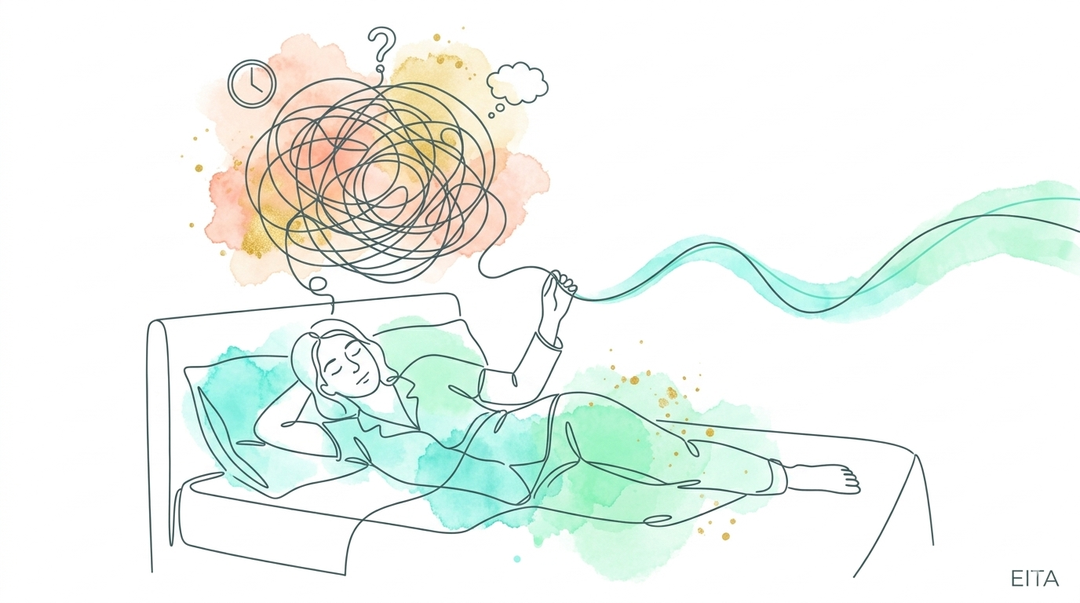
It's 2:47 a.m. Your body is exhausted, the pillow is just right, the room is dark. And yet your mind has decided that now, of all times, is the moment to replay a conversation from three years ago, rehearse tomorrow's meeting and remind you about a bill that's due next week.
If you recognize the scene, you're not alone. And it may not even be insomnia, exactly. You're dealing with something neuroscience has a name for: nighttime rumination.

Here's the part almost nobody tells you. The problem is rarely "thinking too much." It's thinking in circles and getting nowhere. There's a big difference between reflecting and ruminating, and at night, the brain is an expert at confusing the two.
What nighttime rumination is
To ruminate is to chew on the same thought over and over without coming up with any solution. It's the mind spinning the same gear with nothing to grip. And when it happens at bedtime, it comes with a cruel twist: at three in the morning, there's nothing you can do about any of it except suffer.
It isn't a lack of willpower. It's the way the brain is built. And, like almost everything in the brain, it can be trained.
Why your mind speeds up right when you lie down
During the day, your brain is busy. Tasks, conversations, screens and decisions keep the so-called executive network active: the focus circuit, in charge of solving the concrete problems in front of you.
When you lie down and turn off the light, that circuit winds down. And another network steps in: the default mode network, which the brain switches on when nothing outside is demanding its attention. It's the network of self-referential thought, of "what if," "I should have" and "tomorrow I need to." Brain-imaging research has tied it to rumination, especially in depression. In other words, it's the network where rumination lives.
Add a second factor: fatigue. The prefrontal cortex, which handles reasoning, sense of proportion and impulse control, is also what keeps the amygdala, the brain's threat detector, in check. When you're short on sleep, that grip loosens. In a 2007 brain-imaging study by researchers at UC Berkeley and Harvard Medical School, people kept awake for about 35 hours showed a far more reactive amygdala when viewing upsetting images, along with a weaker link between the amygdala and the prefrontal cortex. That helps explain why the same problem that seemed manageable at 3 p.m. turns into a catastrophe at 3 a.m. The situation didn't get worse. At that hour, your brain has lost the translator that kept things in proportion.
Reflecting isn't the same as ruminating
This is the distinction that changes everything, and the one almost nobody makes:
| Reflecting | Ruminating |
| Moves toward a conclusion | Circles around the same point |
| Asks "what can I do?" | Asks "why did this happen to me?" |
| Has an end point | Never ends, and starts over on its own |
| Lowers anxiety by bringing clarity | Raises anxiety by feeding fear |
Reflecting is productive. Ruminating only feels productive. It gives you the sense that you're "working it out," when really you're just digging the same hole deeper. The first step out is recognizing which of the two you're doing.
Why "just stop thinking" never works
Try, right now, not to think about a white bear. You just did, didn't you?
That little experiment has a name in psychology: ironic process. The harder you order your brain to stop thinking about something, the more you keep it lit up, because to check whether you've "stopped," the brain first has to bring the thought back. (It comes from a classic 1987 study by psychologist Daniel Wegner, in which people who had tried to suppress the thought of a white bear later thought about it more than people who had been told to think about it from the start.) That's why "clear your mind" is the worst possible advice for someone who ruminates at night. The way out isn't blocking the thought. It's processing it.
How to interrupt nighttime rumination: the 4 steps of the EITA Method
EITA (a Portuguese acronym for Elevar a Inteligência a Treino de Autopercepção, roughly "turning intelligence into self-awareness training") is the foundation of EITA Mentor. The same four steps that help you sort through an emotion during the day work just as well, maybe even better, against a racing mind in the small hours.
Step 1: Name what's spinning
The first question isn't "how do I make this stop?" It's: what exactly is in my head right now? Ruminative thoughts live in a fog, a vague pile of worry. The moment you name what's there ("I'm chewing on tomorrow's meeting," "I'm scared I can't handle it"), the thought comes off autopilot and takes on an outline. And anything with an outline is always smaller than something without one.
Step 2: Find the real trigger
The thought that shows up is almost never the one that actually hurts. Are you chewing on your boss's email, or on the fear that you're not good enough? Are you reliving the argument, or the feeling of not being understood? Rumination loves to fixate on surface details so it never has to touch the wound underneath. Asking "what about this is really bothering me?" is what finally slows the wheel down.
Step 3: Question the 3 a.m. narrative
Remember: at 3 a.m., your sense of proportion is offline. So treat any dramatic conclusion as suspect. Ask yourself:
• Is this a fact, or a story I'm telling myself?
• Would I think about this exactly the same way at two in the afternoon?
• Is there anything I can do about this now, this very minute?
If the answer to the last question is no (and at night it almost always is), your brain needs to hear it loud and clear: there's nothing you can do right now, so there's no reason to decide anything right now.
Step 4: Park the thought (on purpose)
Deep down, rumination is the brain afraid of forgetting something important. So give it a concrete guarantee. Keep a notepad by the bed and write down, in a single line, what you're chewing on, along with a time the next day to deal with it. "Tomorrow, 9 a.m.: sort out the meeting." It's not avoidance. It's a commitment. You're not ignoring the problem; you're booking an appointment for it. And the brain, knowing it won't get lost, finally lets go.
The difference between lying awake all night and drifting back to sleep lives right there: in the conscious pause between a thought and your reaction to it.
How this works in practice
Situation 1: Tomorrow's meeting
It's 1 a.m. You can't stop rehearsing what you're going to say in the presentation.
Rumination: your mind runs the script for the tenth time, anticipating everything that could go wrong.
The method: Name it (performance anxiety). Find the real trigger (fear of being judged by your colleagues). Question the narrative (I've given dozens of presentations and have no evidence this one will go wrong). Park it ("Tomorrow, 7:30 a.m.: review the first three slides"). Then let your body rest, which, by the way, is what will help the presentation most.
Situation 2: The comment that stuck
Someone said something during the day, and now that everything is quiet, the line keeps playing on a loop.
The method: Name it (hurt and irritation). Find the real trigger (I felt disrespected). Question the narrative (maybe they didn't even mean it that way, and I'm reading it in the dark, in more ways than one). Park it ("Tomorrow I'll decide whether it's worth talking to them"). The wheel loses momentum not because the issue went away, but because it stopped being urgent at three in the morning.
EITA Mentor walks you through these four steps in conversations on WhatsApp, 24 hours a day, including the middle of the night, exactly when the mind tends to race and there's no one else awake to talk to. She doesn't hand you ready-made answers. She asks the right questions so you can step off the thought loop yourself and find your way back to sleep.
Slowing your mind down is a skill, not luck
Some people believe certain people "just sleep well" while others "have always had a busy mind," as if it were fate. Neuroscience disagrees.
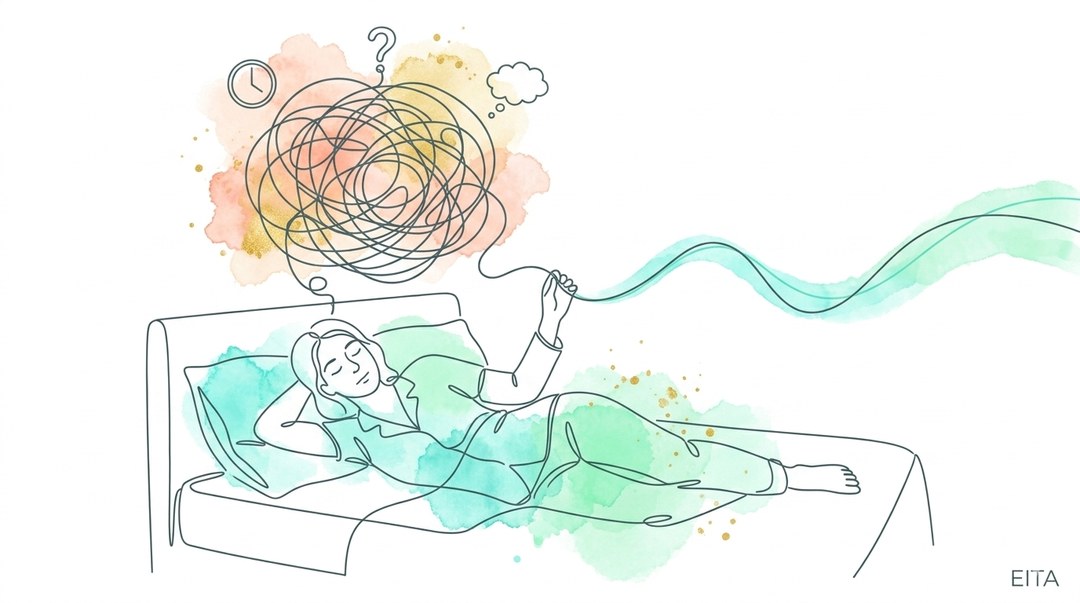
The brain is plastic. It reorganizes itself around what you repeat. Every night that you name, question and park a thought instead of spinning in it, you're practicing regulation instead of rumination, and the brain gets better at whatever it practices. With time, the conscious pause stops being the exception and becomes your mind's default response when the lights go out.
It's not about never having a thought at night again. It's about not being held hostage by it.
Frequently asked questions
Is nighttime rumination the same as insomnia?
No, although the two often go together. Insomnia is difficulty falling asleep or staying asleep, and a mind that won't stop churning is one of its classic drivers: one of the best-known cognitive models of insomnia puts worry and rumination at its center. You can be physically exhausted and still lie awake because your mind hasn't slowed down. Working on rumination is often the most direct route to better sleep for people who "can't switch off."
How long does it take for my mind to stop racing at night?
There's no fixed timeline, and it varies from person to person. What matters is consistency, not intensity. Applying the four steps every time the wheel starts turning, even if it only takes five minutes, does more than any isolated heroic effort.
Can I talk to the virtual mentor in the middle of the night?
Yes, that's exactly what she's there for. EITA Mentor is available 24 hours a day on WhatsApp, including the small hours, when rumination tends to be at its worst and no one else is awake. She guides you through the process conversationally, adapting to the state you're in at that moment.
Does this process replace therapy?
No. The virtual mentor is a tool for emotional support and self-awareness training. For chronic insomnia, anxiety disorders or intense psychological distress, care from a psychologist or psychiatrist is irreplaceable. The virtual mentor works best as a complement to therapy, or as a resource for people who aren't in treatment yet and are looking for more balance day to day.
Sources
- Raichle, M. E., MacLeod, A. M., Snyder, A. Z., Powers, W. J., Gusnard, D. A., & Shulman, G. L. (2001). A default mode of brain function. Proceedings of the National Academy of Sciences, 98(2), 676-682. doi.org
- Hamilton, J. P., Farmer, M., Fogelman, P., & Gotlib, I. H. (2015). Depressive rumination, the default-mode network, and the dark matter of clinical neuroscience. Biological Psychiatry, 78(4), 224-230. pmc.ncbi.nlm.nih.gov
- Yoo, S.-S., Gujar, N., Hu, P., Jolesz, F. A., & Walker, M. P. (2007). The human emotional brain without sleep: a prefrontal amygdala disconnect. Current Biology, 17(20), R877-R878. pubmed.ncbi.nlm.nih.gov
- University of California, Berkeley (2007). Sleep loss linked to psychiatric disorders. ScienceDaily. sciencedaily.com
- Wegner, D. M., Schneider, D. J., Carter, S. R., & White, T. L. (1987). Paradoxical effects of thought suppression. Journal of Personality and Social Psychology, 53(1), 5-13. pubmed.ncbi.nlm.nih.gov
- Harvey, A. G. (2002). A cognitive model of insomnia. Behaviour Research and Therapy, 40(8), 869-893. pubmed.ncbi.nlm.nih.gov
Anaclaudia Zani is a psychologist (CRP 06/128106, Brazil) and neuroscientist, creator of the EITA method and of EITA Mentor.