

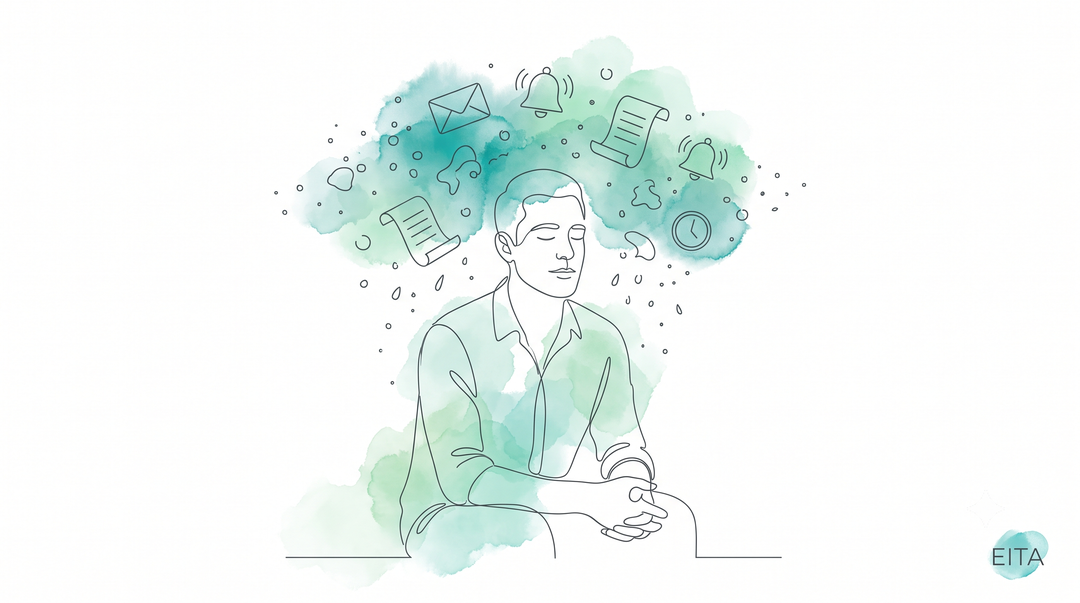
Rick didn't get into a fight with anyone. He didn't lose his job or get any terrible news. It was an ordinary day: the alarm that went off too early, the line at the coffee shop, three meetings that could have been emails, the car that didn't start on the first try, the message from school about the parent-teacher conference, the bill that was due today. None of these things, on its own, is a big deal. And yet by 9 p.m. he was exhausted, irritable and had no idea why.
If that day sounds familiar, we need to talk about a word almost nobody uses: microstress.
Most of us grew up believing that stress comes from the big events: grief, divorce, getting laid off, illness. And it does. But the tab that wears most people down isn't made of one giant event. It's made of the quiet sum of dozens of small frictions that slip by unnoticed, one at a time, until the day your body simply tells you it can't keep going.
What microstress is (and why it fools your brain)
Microstress is the name for the small everyday frictions that trigger your body's stress response in low but constant doses. Each one lasts a few seconds. The problem isn't the dose, it's the frequency: there are so many over the course of a day that your nervous system almost never gets back to rest.
To understand why this wears you down, we need to talk about a concept from neuroscience called allostasis. Allostasis is your body's ability to adapt to a demand: your heart speeds up, cortisol rises, your attention narrows, and then, once the threat passes, everything returns to baseline. It's a brilliant system, built for short spikes followed by recovery.
Microstress breaks exactly the recovery part. When small triggers come one after another with no break in between, the hypothalamic-pituitary-adrenal axis (the well-known HPA axis, which controls the release of cortisol) stays switched on at low intensity all the time. The technical term for that accumulated wear and tear is allostatic load, proposed in 1993 by neuroscientists Bruce McEwen and Eliot Stellar, building on the concept of allostasis introduced in 1988 by Peter Sterling and Joseph Eyer. It's the physiological bill for years of adapting your body to demands that never let up.
And that bill gets charged to specific places. Chronically high cortisol affects three brain regions that have come up here before: the amygdala (which becomes overreactive, leaving you on a hair trigger), the hippocampus (involved in memory, which takes a beating), and the prefrontal cortex (the seat of reasoning and self-control, which loses efficiency right when you need it most). In plain terms: the more microstress piles up, the more reactive, forgetful and impulsive your brain becomes. It's not a character flaw. It's biochemistry.
Acute stress vs. chronic microstress
The mistake that makes a lot of people sick is believing stress only counts when it's big and visible. Here's the difference:
| Acute stress | Chronic microstress |
| One big, recognizable event | Dozens of small frictions a day |
| You know exactly what happened | You don't even notice it happened |
| Your body reacts and then recovers | Your body almost never gets back to rest |
| Easy to name and explain | Invisible, so you blame yourself for feeling bad |
| “I had a terrible day” | “I don't know what's wrong, I just have no energy” |
Acute stress, as hard as it is, has one thing going for it: it's honest. You know what knocked you down, and you can give yourself time to respond. Microstress is sneaky because it leaves no trace. Since nothing serious happened, you conclude that the problem is you: that you're fragile, lazy or overreacting. And the one piece of information that actually mattered disappears.
How to stop the tab from running: the EITA method applied to microstress
EITA (a Portuguese acronym for turning intelligence into self-awareness training) starts from a simple idea: what you don't notice, you can't regulate. Against microstress, the training works in four moves.
1. Make the invisible visible
The first step is learning to notice micro-frictions as they happen, instead of discovering them as exhaustion at the end of the day. It's catching your shoulders creeping up when the email lands, your jaw clenching in line, your breathing getting shallow in the meeting. You won't eliminate these triggers; life comes with lines and bills. But naming each one takes autopilot out of the driver's seat.
2. Name the dose, not just the day
Instead of wrapping up the night with a vague “it was a bad day,” the practice is to tell the layers apart: “I felt rushed this morning, frustrated in the 10 o'clock meeting, worried about the bill this afternoon.” It sounds like a small thing, but naming what you feel with precision reduces amygdala activity, as Lieberman and colleagues showed in 2007 in Psychological Science. Swapping “I'm wrecked” for three specific names already turns down the internal volume.
3. Build in micro-recoveries
If the problem is the lack of breaks between spikes, the fix isn't a week of vacation six months from now. It's tiny pauses spread across the day: three slow breaths before you open the next tab, thirty seconds of silence between one meeting and the next, a short walk to the window. Each micro-pause gives your HPA axis a chance to get back to baseline. It's recovery in doses, to offset stress in doses.
4. Clear the tab before bed
Allostatic load builds up when the day ends without being processed. Setting aside five minutes to review what weighed on you, name it and let it go keeps today's microstress from rolling over as debt into tomorrow. It's the emotional equivalent of not going to bed with dishes in the sink.
Two ordinary days, two different endings
The cases below are illustrative, built to show the method in everyday situations. They are not real people or accounts from clinical sessions.
Rick, 47, sales manager
His day is the one from the start of this article. Without the training, Rick gets home irritable, argues over nothing, sleeps badly and wakes up already running behind. With the training, he notices at 11 a.m. that he's racked up three frictions and hasn't even had lunch. He names each one, takes a breathing break before the next meeting and, at night, sets aside five minutes to close out the day. The tiredness doesn't disappear. But he stops snapping at the people he loves over a bill.
Claire, 39, architect and mom of two
Claire's routine is a string of micro-decisions: what to make for dinner, which meeting to reschedule, who's picking up the kids, the client who sent a curt reply. None of them is a crisis. Added together, they turn into fatigue and a constant feeling of running late on her own life. In the training, she learns to spot when the tab is climbing and to slip micro-recoveries in between tasks, before she hits her limit. The change isn't doing less. It's no longer ending every day in the red.
This is where EITA Mentor comes in. She talks with you on WhatsApp, available 24 hours a day, at the exact moment the day is weighing on you, not weeks later in an office. She doesn't hand you ready-made answers: she asks the questions that help you see the tab before it comes due. Self-awareness training that fits into the schedule of someone with no time to spare.
I want to talk to EITA on WhatsApp
Managing microstress is a skill, not a personality trait
There's a belief as common as it is wrong: that some people are “just born calm,” as if calm were a fixed personality trait. Neuroscience disagrees.
The brain is plastic: it reorganizes itself in response to what you practice. Every time you notice a micro-friction and process it instead of letting it pile up, you strengthen circuits in the prefrontal cortex and teach your stress system to return to rest faster. With repetition, what takes effort today becomes an automatic response. The “naturally balanced” person is almost always someone who, knowingly or not, has been practicing this for years.
As Anaclaudia Zani puts it, intelligence is a problem-solving skill, and like any skill, it improves with practice. EITA was created to be that practice.
Frequently asked questions
How do I know if my tiredness is microstress and not something else?
A classic clue is tiredness with no obvious cause: you're exhausted, but you can't point to a big event that explains it. If that feeling comes with a short fuse, sleep that doesn't leave you rested and a sense of always playing catch-up, microstress is usually part of the picture. Still, persistent fatigue can also have physical or medical causes, so it's worth checking with a health professional.
Can I eliminate microstress from my life?
No, and that isn't even the goal. Lines, traffic, bills and the unexpected are part of any adult life. The aim isn't a life without friction; it's building up your capacity to recover between frictions so the tab doesn't stay open. You can't control how many triggers show up, but you can control how long your body spends on high alert.
How long does it take to feel a difference?
It depends on consistency, not intensity. And forget the 21-day rule: it comes from an anecdotal observation by a plastic surgeon in the 1960s, not from research. The most solid study on the subject, led by Phillippa Lally and colleagues at University College London in 2010, followed 96 people and found a median of 66 days for a behavior to become automatic, with a range of 18 to 254 days. In other words, it varies a lot from person to person and habit to habit. Five minutes a day of paying attention to your own sensations will do more for you than one heroic attempt to relax on the weekend.
Does this replace therapy?
No. EITA Mentor is a tool for emotional support and self-awareness training, not a treatment. For diagnosed disorders, anxiety or depression, trauma or intense psychological distress, care from a psychologist or psychiatrist is irreplaceable. EITA works best as a complement to therapy, or as a first source of day-to-day support for people who aren't in treatment yet. If you are in crisis or thinking about suicide, or about hurting yourself, contact your local emergency number right away. In the US, call or text 988 (Suicide & Crisis Lifeline); in the UK and Ireland, call Samaritans on 116 123; in Brazil, call CVV on 188.
Sources
- McEwen, B. S., & Stellar, E. (1993). Stress and the individual: mechanisms leading to disease. Archives of Internal Medicine, 153(18), 2093-2101. pubmed.ncbi.nlm.nih.gov
- McEwen, B. S. (1998). Stress, adaptation, and disease: allostasis and allostatic load. Annals of the New York Academy of Sciences, 840, 33-44 (credits the concept of allostasis to Sterling and Eyer, 1988). pubmed.ncbi.nlm.nih.gov
- Lieberman, M. D., Eisenberger, N. I., Crockett, M. J., Tom, S. M., Pfeifer, J. H., & Way, B. M. (2007). Putting feelings into words: affect labeling disrupts amygdala activity in response to affective stimuli. Psychological Science, 18(5), 421-428. sanlab.psych.ucla.edu (PDF)
- Lally, P., van Jaarsveld, C. H. M., Potts, H. W. W., & Wardle, J. (2010). How are habits formed: modelling habit formation in the real world. European Journal of Social Psychology, 40(6), 998-1009. onlinelibrary.wiley.com
- Busting the 21 days habit formation myth (2012). UCL Research Department of Behavioural Science and Health blog (on the origin of the 21-day figure in plastic surgeon Maxwell Maltz's 1960 book). blogs.ucl.ac.uk
Anaclaudia Zani is a psychologist (CRP 06/128106, Brazil) and neuroscientist, creator of the EITA method and of EITA Mentor.