

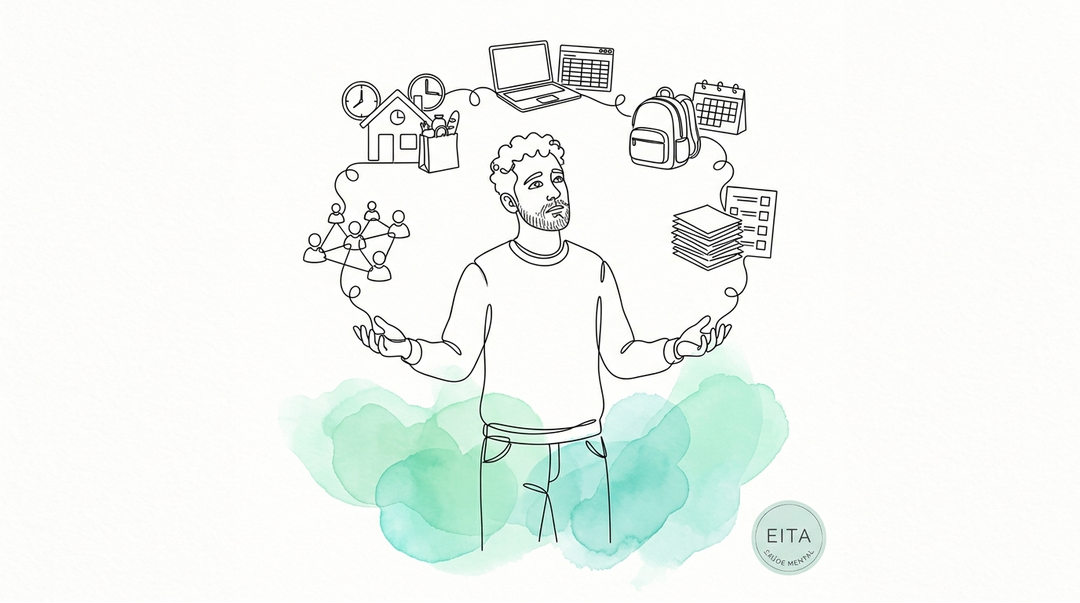
11:30 p.m. Roger turned off the light twenty minutes ago. His body is still, the day is over, nobody needs anything from him. And yet his mind opens a tab: is Mom's doctor's appointment Thursday or Friday? He closes that one, and another opens: the HOA payment is due tomorrow. Close it, and another opens: that email that has to go out before nine.
He hasn't done any of these things. He's only remembered that they exist. And he wakes up tired anyway.
If that sounds familiar, what you're carrying has a name in the research literature: mental load, also called cognitive labor. It's the invisible job of being the person who anticipates, decides and keeps an eye on everything so that nothing falls through the cracks.
The uncomfortable truth: it's not what you do that weighs the most, it's what you carry
We usually measure the burden of home and work in hours of doing. Who does the laundry, who handles school pickup, who answers the client. It's the obvious tally, and it's real: according to IBGE, Brazil's national statistics agency, in 2022 Brazilian women spent an average of 21.3 hours a week on housework and caring for others, compared with 11.7 hours for men.
But that tally only measures the time spent doing. And a recent finding reframes the whole problem.
In 2024, Elizabeth Aviv, Darby Saxbe and colleagues at the University of Southern California published a study of 322 mothers in the journal Archives of Women's Mental Health that did something rare: across 30 household tasks, it separated who plans from who executes. Who decides what needs to get done, and who actually does it.
The result is the kind of thing that changes a conversation between partners. Handling most of the physical execution was not linked to more depressive symptoms, more stress or more exhaustion. Handling most of the planning was linked to all of them: depression, stress, personal burnout, worse overall mental health and lower relationship quality.
Two honest caveats, because they matter. The study is cross-sectional, which means it shows an association and doesn't prove cause. And the sample is made up of American mothers with high levels of education and income, which limits how far the findings generalize. Even so, it's one of the first quantitative measurements of something psychology had only described qualitatively, and the pattern lines up with the rest of the literature.
The four invisible moves
In 2019, sociologist Allison Daminger, then at Harvard University, published a study in the American Sociological Review based on 70 in-depth interviews with members of 35 couples. She broke mental load down into four distinct operations, and this is where things get interesting.
| Operation | How it shows up in your day | Who usually ends up with it |
|---|---|---|
| Anticipate | Noticing that the milk will run out by Thursday, that the kids have outgrown their sneakers, that the contract expires in 40 days | Disproportionately women, in Daminger's sample |
| Identify | Gathering the options: which pediatrician takes your insurance, which three dates work for everyone | More shared, but still unequal |
| Decide | Choosing among the options on the table | Roughly even between men and women |
| Monitor | Checking that it actually happened, following up, adjusting when it went sideways | Disproportionately women |
Look at how that's set up. The most visible step, the one that looks most like power, the one that makes for a conversation at the dinner table, is exactly the one couples share well: deciding. The two invisible ends, anticipating and monitoring, land on one person.
That's why “just tell me what to do and I'll do it” fixes so little. It offers help with the doing and hands back, as a bonus, one more management task to the person who was already managing everything.

Why it's so draining: your brain charges rent on every intention you store
This is where the mechanism comes in, and it's more concrete than it sounds.
Remembering to do something in the future has its own name in cognitive psychology: prospective memory. It's different from remembering the past. It means keeping an intention alive before it turns into action (“when I pass the pharmacy, pick up Mom's prescription”) and holding on to it until the right moment arrives.
The detail that matters is the cost. In the lab, researchers measure what's called the prospective memory cost: when people carry a pending intention while doing something else, their performance on the task at hand gets worse. Not because they're scatterbrained, but because part of the attention system stays on call, checking whether the moment to act has arrived. You're not doing the task. You're paying for it.
Now multiply that by thirty open intentions at once. That's the bill for mental load.
And there's a second mechanism, an even more useful one. In 2011, E. J. Masicampo and Roy Baumeister, then at Florida State University, published a series of experiments on unfulfilled goals in the Journal of Personality and Social Psychology. Open goals triggered intrusive thoughts during a reading task that had nothing to do with them, made words related to the goal more accessible in the mind, and hurt performance on an anagram test.
So far, bad news. The good news comes next: when participants were asked to make a specific plan for that pending goal, the interference disappeared. They hadn't done anything yet. They had only decided when, where and how. And the effect tracked how seriously they meant it: the people who went on to carry out their plans were the ones who stopped having intrusive thoughts.
In real-life terms: the brain lets go of whatever already has a set place. Whatever is left loose stays switched on.
How to lighten the load: four moves from the EITA method
The EITA method, created by Anaclaudia Zani, starts from a simple idea: self-awareness isn't passive introspection, it's hands-on training. Applied to mental load, it becomes a four-step sequence.
1. Empty the buffer, no filter
Before you organize, dump everything out. Write or say everything that's open, in whatever order it comes, including the trivial stuff (replace the hallway light bulb) and the big stuff (decide whether to change jobs). The rule is not to judge the size of anything at this stage. Most people are surprised by the volume, and the surprise itself is information: you were holding all of this on your own, without even keeping count.
2. Give it a destination, not just a place in line
This is the Masicampo step. A list isn't enough. Each item needs a specific destination: when, where, with whom, or the explicit decision that it isn't happening this month. “Call the insurance company” keeps weighing on you. “Call the insurance company Tuesday morning, before the first meeting” stops weighing on you. And yes, “this can wait until November” is a valid destination too, as long as it's a decision and not a postponement by default.

3. Hand off the monitoring, not just the doing
This is the step almost nobody takes, and it's the one Daminger's research suggests matters most. Real delegation isn't “take Theo to the dentist Friday at 3 p.m.” That's outsourcing the hands and keeping the head. Delegating is “Theo's dentist is on you now: find out when his checkup is due, book it, keep track of the date.” You hand over the whole task, with both invisible ends included.
It costs more at first, because the other person will do it differently from the way you would. And here's the honest question worth asking: is the standard you're defending really about quality, or is it just your standard?
4. Check what's still sitting with you
After you've emptied, assigned and handed off, something is left. Almost always. And what's left tends to be the part that says the most about you: the guilt of not anticipating, the fear that someone will drop the ball, the feeling that without you the whole structure collapses. That's the raw material of self-awareness training. It isn't the list that's wearing you out. It's what you believe will happen if you let go.
Two practical examples
The cases below are illustrative, created to explain the concept. They are not real people or accounts from clinical practice.
Roger, 47, operations manager in Denver. He splits the housework “fifty-fifty” with his wife and can't understand why he reaches December completely drained. When he empties the buffer, he finds that his half is almost all execution, and that his list of things he anticipates has fourteen work items and two from home. His wife's is the reverse. Nobody was lying. They were both counting only the visible part.
Megan, 41, dentist in Columbus. She's always saying “it's faster if I just do it myself.” When she gives each item a destination, she realizes that eight of the week's eleven items had no real deadline, only emotional urgency. Three became tasks with a set time. Five moved to the following month. Three disappeared, because nobody had asked for them; she had simply taken them on.
If you need to unload all of this somewhere at eleven at night
EITA Mentor exists partly because of this. She's available 24 hours a day on WhatsApp, which means you can empty the buffer when it fills up, not next week. And unlike a notes app, she asks questions back: what exactly is open here, when does this need a destination, what's yours and what did you take on without anyone asking.
Talking it out brings relief in the moment. When the pattern keeps coming back, understanding where it comes from is what brings change: at EITA Academy, EITA's learning area, the micro-course “A Fórmula da Eficiência” (The Efficiency Formula), by neuroscientist Marina Marzotto, shows in six short lessons why switching between tasks is so tiring and how to organize your week, with exercises to do alongside EITA. It comes as a gift with the annual plan. The courses are in Portuguese.
See EITA Mentor's plans and find out how self-awareness training works in everyday life.
Handling mental load is a skill, not a gift
There's a comfortable story that some people are “born organized” and others aren't. It's convenient for anyone who doesn't want to learn and cruel to anyone who already carries too much.
The adult brain keeps its neuroplasticity: circuits tied to executive control, planning and emotional regulation reorganize with repeated practice. Nobody is born knowing how to turn a vague worry into a plan with a set time. It's trained, the way any other skill is trained, through repetition and with someone asking you the right question back.
And it's worth saying the obvious thing that statistics sometimes hide: mental load isn't a gender issue, it's an arrangement issue. The University of Bath and University of Melbourne study of 3,000 mothers and fathers in the United States, published in the Journal of Marriage and Family, found mothers handling 71% of mental load tasks. It also found that single fathers carried significantly more than partnered fathers. Whoever is on their own carries all of it, regardless of gender.
Frequently asked questions
Does making a list solve mental load?
It helps, but on its own it doesn't solve it. A thirty-item list with no destinations is just your anxiety in bullet points. What Masicampo and Baumeister's research suggests is that relief comes from the specific plan, with a when and a where, not from the inventory. A list without a plan can even make things worse, because now you have thirty visible reminders instead of thirty vague ones.
Is mental load the same thing as being overloaded with work?
Not exactly. Being overloaded means having too many tasks for the time you have. Mental load means being the server everyone else's to-do list runs on, even when your own calendar is light. You can have few tasks and a heavy mental load, which is why it slips past time-use surveys: it runs in the background while you're doing something else.
What if the other person just won't take it on?
Then the problem has left the territory of organization and entered the territory of the relationship, and that's a different conversation. It's worth starting by making the load visible, because a real share of the conflict comes from invisible work being invisible even to the person doing it. After that, if the division is still stuck, couples therapy tends to be a more effective route than a shared spreadsheet.
Does this replace therapy?
No. EITA Mentor is training in self-awareness and emotional organization, and it does not replace psychological or psychiatric care. If the exhaustion comes with a loss of pleasure in things, significant changes in sleep or appetite, or if it lasts for weeks without improving, see a professional. If you are in crisis or thinking about suicide, contact your local emergency number right away. In the US, call or text 988 (Suicide & Crisis Lifeline); in the UK and Ireland, call Samaritans on 116 123; in Brazil, call CVV on 188.
Sources
- Aviv, E., Waizman, Y., Kim, E., Liu, J., Rodsky, E., & Saxbe, D. (2024). Cognitive household labor: gender disparities and consequences for maternal mental health and wellbeing. Archives of Women's Mental Health, 28, 5-14.
- Daminger, A. (2019). The Cognitive Dimension of Household Labor. American Sociological Review, 84(4), 609-633.
- Weeks, A. C., & colleagues (2025). A typology of US parents' mental loads: Core and episodic cognitive labor. Journal of Marriage and Family. University of Bath press release: Mothers bear the brunt of the 'mental load'.
- Masicampo, E. J., & Baumeister, R. F. (2011). Consider it done! Plan making can eliminate the cognitive effects of unfulfilled goals. Journal of Personality and Social Psychology, 101(4), 667-683.
- IBGE, PNAD Contínua 2022 (Brazil's continuous national household survey). Em 2022, mulheres dedicaram 9,6 horas por semana a mais do que os homens aos afazeres domésticos ou ao cuidado de pessoas (in Portuguese).
- Memory and Complex Learning Lab, Washington University in St. Louis. Prospective Memory (overview of the attentional cost of holding on to intentions).
Anaclaudia Zani is a psychologist (CRP 06/128106, Brazil) and neuroscientist, creator of the EITA method and of EITA Mentor.