
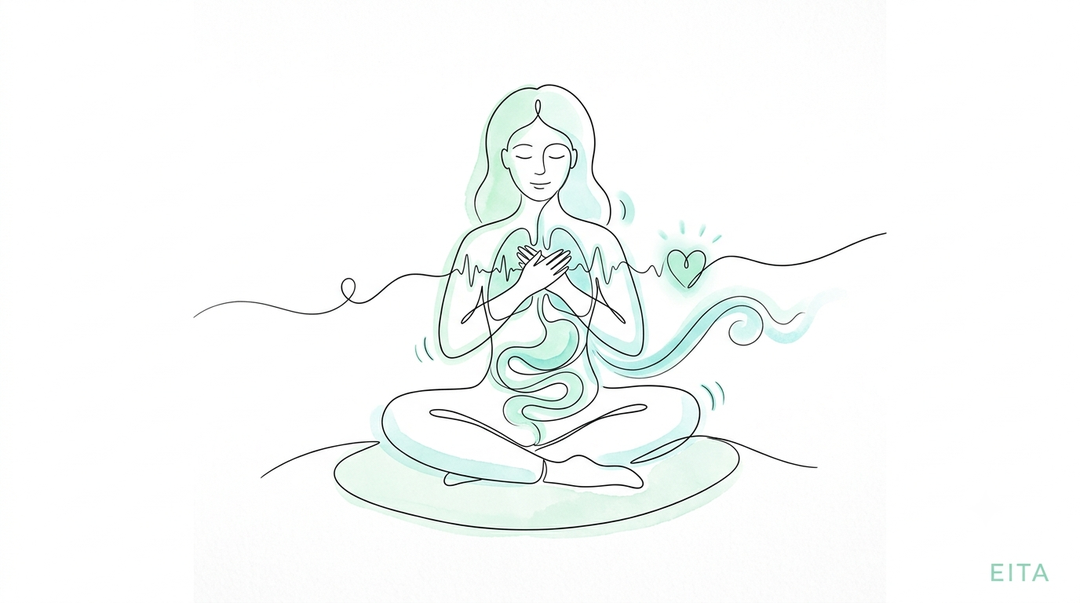
You're sitting in an ordinary meeting. Out of nowhere, your heart speeds up, your breathing gets shallow and heat rises in your chest. Before any conscious thought, your body has already reached its verdict: something is wrong here. Only then does the interpretation arrive ("I'm going to be sick," "I'm going to freeze in front of everyone"), and the anxiety that was a whisper becomes a shout.
Who hasn't felt their body shift into overdrive without quite knowing why? Or glanced at their watch, seen 110 beats per minute while sitting perfectly still, and panicked over the number alone?
Conventional wisdom swears that anxiety starts in the head, in thoughts and worries. But research on interoception has been telling a different, slightly uncomfortable story: a lot of the time, the alarm goes off in the body first, and the mind shows up afterward to put a name on what was already happening. The sense that reads your body from the inside has a name: interoception. And it can be either the switch that calms your anxiety or the one that sets it on fire.
What interoception is
Interoception is the ability to perceive your body's internal signals: your heartbeat, your breathing, hunger, thirst, tension in your shoulders, temperature, those butterflies in your stomach. It's sometimes called the "sixth sense," alongside the five we learn about in school. The difference is that it points inward, not outward. Sight shows you the world. Interoception shows you yourself.
The brain region most closely tied to this process is the insula (more precisely, the insular cortex), a structure tucked away between the brain's lobes that works like a receiving center for signals from the body. It takes in information from the heart, the lungs and the gut and turns all of it into a conscious feeling, an "I feel like this." It's no surprise, then, that the insula is involved in pain perception, mood, decision-making and threat detection.
But the brain isn't a passive camera that simply records whatever comes in. It's more like someone who's constantly placing bets. The idea behind predictive coding is that the brain is always guessing what the body should be feeling and comparing that guess with the signal that actually arrives. When the prediction matches the signal, all is well. When it doesn't, a warning light comes on. That's exactly where the problem lives (and the solution, too).
How interoception calms anxiety or fans the flames
Researchers who study anxiety, depression and eating disorders keep finding a common thread: when the brain's reading of internal signals drifts out of calibration, distress goes up. And it happens in two almost opposite ways.
The first is too much interoception. The person feels their own heart with unusual clarity, notices every beat, every shallow breath, and the brain translates that noise as danger. A slight rise in heart rate during a social conversation becomes "I'm having an attack." The body sends a neutral signal, the mind reads it as a catastrophe, and the anxiety response feeds itself within seconds.
The second is the opposite: interoception that's half switched off. The person loses touch with their body, doesn't notice tension building, ignores hunger, doesn't register fatigue, until one day everything blows up at once. It's the body speaking a language the mind has forgotten how to hear.
Notice the subtle point that changes everything: the problem is almost never the signal itself. It's how the brain interprets it. A racing heart can mean fear, but it can also mean excitement. Short breath can be panic, or it can just mean you ran up a flight of stairs. At its core, training interoception means learning to read these signals with more accuracy and less drama.
| Dysregulated interoception | Trained interoception |
| Feels the heart race and instantly concludes "everything is going to go wrong" | Feels the heart race and asks "what is my body trying to tell me?" |
| The body's signal becomes an automatic panic trigger | The body's signal becomes information for making clear decisions |
| Either hyperfocused on the body or completely disconnected from it | Calibrated attention: notices without getting scared |
| The anxiety feeds on itself | The wave rises, gets recognized and gradually loses strength |
How to train interoception in practice: the EITA approach
EITA is a Portuguese acronym for Elevar a Inteligência a Treino de Autopercepção, roughly "turning intelligence into self-awareness training." And in practical terms, self-awareness is almost a synonym for interoception: noticing what's going on inside and making sense of it without becoming a hostage to the sensation. The training happens in simple steps you can repeat every time your body shifts into overdrive.
Step 1: Notice the signal before you react to it
Before you interpret anything, just notice what's happening in your body, in concrete words: "my chest is tight," "my hands went cold," "my heart is racing." It sounds like very little, but naming the physical sensation already takes some of the fright out of it. Putting an experience into words recruits the more deliberate parts of the brain and gives the part that was only reacting a breather. (In a 2007 brain-imaging study at UCLA led by Matthew Lieberman, putting feelings into words dampened the amygdala's response and engaged a region of the prefrontal cortex.)
Step 2: Separate the sensation from the story
Here's the real trick. "Racing heart" is a piece of data. "I'm going to embarrass myself and everyone will notice" is a story your mind wrote on top of the data. They're different things. The sensation is real, but the narrative is only a hypothesis, and not always the most likely one. Once you pull the two apart, your body stops being proof that something terrible is about to happen.
Step 3: Recalibrate with your breath
Breathing is the most accessible remote control for your nervous system. A simple way to use it: breathe in for a count of four, then let the air out slowly for a count of six. Slow breathing with a long exhale like this engages the vagus nerve, one of the body's main brakes on the stress response, and gives the brain new information with which to update its bet on danger. You're not faking calm. You're handing your brain a real signal that it's safe to lower its guard.

Step 4: Give the signal the right interpretation
With your body a little calmer, reread the signal. "My heart sped up because this matters to me, not because I'm in danger." Repeated many times, that rereading gradually teaches your brain to predict more accurately. Over time, the same heartbeat that used to set off panic gets read as what it almost always was: energy, not threat.
Two everyday examples of interoception
Before a big presentation. Your hands go cold, your heart pounds, your mouth goes dry. The old reading: "I'm freezing up, this is going to be a disaster." The trained reading: "My body is getting me ready. This is adrenaline, and adrenaline is fuel." The signal is identical. What changes is the story you tell about it, and that story changes the rest of your morning.
At the end of a heavy day. You're irritated with everyone, out of patience, convinced the problem is the world. If you pause and listen to your body, you might discover that you barely ate lunch, your shoulders are up around your ears and you haven't had any water since ten in the morning. It's not the world. It's your body asking for maintenance. Interoception keeps you from picking a fight with someone you love over a hunger nobody noticed.
EITA Mentor was built precisely so this training can happen the moment your body shifts into overdrive, not just afterward, once it has passed. On WhatsApp, 24 hours a day, she talks with you right in the middle of that tightness in your chest: she helps you name the sensation, separate the signal from the story and recalibrate your breathing. These aren't canned answers. They're the right questions to help you reconnect with your own body.
Interoception is a skill, not the luck of the draw
Maybe the best news from current neuroscience is this: interoception can be trained. Thanks to neuroplasticity, the brain's ability to reorganize itself through experience, the way you read your body responds to practice. In a large study by researchers at the Max Planck Institute for Human Cognitive and Brain Sciences in Leipzig, Germany, nine months of contemplative training, including breathing meditation and body scans, produced steady (if modest) gains in how accurately participants could perceive their own heartbeat.
In other words, nobody is doomed to live in fear of their own body. People with anxiety don't have a factory defect: they have a poorly calibrated alarm, and alarms can be adjusted. Just as nobody learns to ride a bike by reading about bikes, self-awareness doesn't come from understanding the theory alone. It comes from practice, ideally with someone by your side in the moments when the wave rises.
Frequently asked questions
Is interoception the same thing as intuition?
Not exactly, but the two talk to each other. Interoception is the raw material: the body's signals reaching the brain. Intuition tends to be the quick reading we make of those signals, sometimes without realizing it. Well-calibrated interoception tends to make intuition more reliable, because you learn to tell a genuine "this is bad for me" from a passing scare.
Is feeling your body intensely always a bad thing?
No. Feeling your body is good and necessary. The problem isn't how intensely you perceive it, but the frightened interpretation of what you perceive. Someone with good interoception can feel everything clearly and still stay calm, because they know how to read what it means. The goal isn't to feel less. It's to understand better.
Can I train this on my own, or do I need help?
You can start on your own, with breathing and the practice of naming sensations. But like any training, it gets easier and faster with support, especially in the heat of the moment, when we tend to believe the catastrophic story. Having someone (or something) ask the right questions at the right time speeds up the learning considerably.
Does this replace therapy?
No. Training interoception is care that adds to professional treatment, not care that replaces it. EITA Mentor and the EITA method are emotional support and self-awareness training, not clinical treatment. If you live with intense anxiety, frequent anxiety attacks or distress that gets in the way of your life, see a psychologist or psychiatrist. If you are in crisis or thinking about suicide, contact your local emergency number right away. In the US, call or text 988 (Suicide & Crisis Lifeline); in the UK and Ireland, call Samaritans on 116 123; in Brazil, call CVV on 188.
Sources
- Craig, A. D. (2009). How do you feel--now? The anterior insula and human awareness. Nature Reviews Neuroscience, 10(1), 59-70. pubmed.ncbi.nlm.nih.gov
- Paulus, M. P., & Stein, M. B. (2010). Interoception in anxiety and depression. Brain Structure and Function, 214(5-6), 451-463. pmc.ncbi.nlm.nih.gov
- Khalsa, S. S., et al. (2018). Interoception and mental health: a roadmap. Biological Psychiatry: Cognitive Neuroscience and Neuroimaging, 3(6), 501-513. doi.org
- Lieberman, M. D., Eisenberger, N. I., Crockett, M. J., Tom, S. M., Pfeifer, J. H., & Way, B. M. (2007). Putting feelings into words: affect labeling disrupts amygdala activity in response to affective stimuli. Psychological Science, 18(5), 421-428. pubmed.ncbi.nlm.nih.gov
- Laborde, S., et al. (2022). Effects of voluntary slow breathing on heart rate and heart rate variability: a systematic review and a meta-analysis. Neuroscience & Biobehavioral Reviews, 138, 104711. doi.org
- Bornemann, B., & Singer, T. (2017). Taking time to feel our body: steady increases in heartbeat perception accuracy and decreases in alexithymia over 9 months of contemplative mental training. Psychophysiology, 54(3), 469-482. pubmed.ncbi.nlm.nih.gov
Anaclaudia Zani is a psychologist (CRP 06/128106, Brazil) and neuroscientist, creator of the EITA method and of EITA Mentor.