
Saturday, 4:20 p.m. You finally tackle the box at the back of the closet. Inside: a notebook from 2015, an ID badge from a company that no longer exists, and a ticket stub from a band you swore you would listen to forever. You laugh out loud at the handwriting, at the certainties, at that person who had such strong opinions about things that don't even cross your mind anymore.
Half an hour later, your phone buzzes. It's the invitation you've been putting off answering: lead the new team at work, with a monthly presentation to senior leadership. You type almost without thinking: “Thanks, but that's not really me. I know myself.”
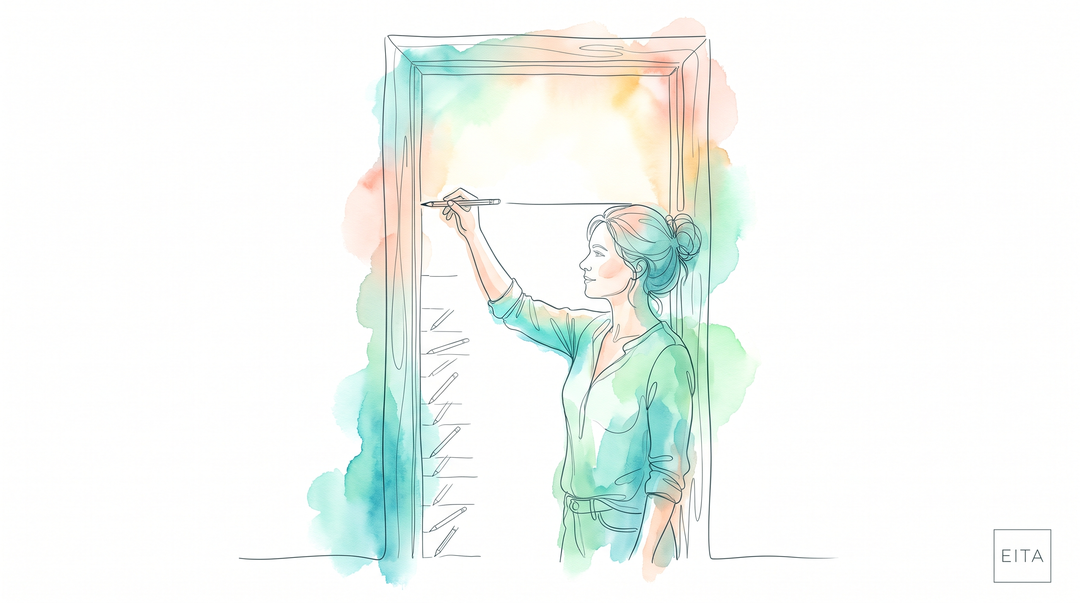
Notice the sequence. In thirty minutes, you admitted you've changed a lot over the past decade and then made a call about the next one as if nothing about you will ever change again. The person in the box was a work in progress. The person today, apparently, is finished.
There's a name for this: the end of history illusion
In 2013, Jordi Quoidbach (of Belgium's National Fund for Scientific Research and Harvard University), Daniel Gilbert (Harvard) and Timothy Wilson (University of Virginia) published a paper in the journal Science based on more than 19,000 people aged 18 to 68. They measured personality, values and preferences, then asked some participants how much they had changed over the past ten years and asked others to predict how much they would change over the next ten.
The comparison was clever: the forecast of someone who was, say, 40 was set side by side with the report of someone who was already 50 and had just lived through that same decade. Young adults, middle-aged adults and older adults all did the same thing: they believed they had changed a lot in the past and would change relatively little from here on. The authors named the phenomenon the end of history illusion and summed it up this way: history, it seems, is always ending today.
A natural question is whether the mistake lies in memory, with people exaggerating how much they've changed. The researchers checked. They compared their numbers with data from 3,808 American adults who took a personality test twice, in 1995-1996 and again in 2004-2006. The personality change participants reported about their past was almost identical in size to the change that was actually measured. It was the forecast that missed.
The detail almost nobody mentions: the price of the concert ticket
In the fourth study, 170 adults said how much they would pay today to see their current favorite band play a concert ten years from now. Another group said how much they would pay to see, the following week, the band that had been their favorite ten years earlier. The first group's average was $129. The second group's was $80. People would pay 61% more for a taste that may not even be there by the time the show comes around.
Why does the mind do this? The authors say plainly that their data don't reveal the cause, but they point to two possibilities. The first: most people find their own personality attractive, their values admirable and their tastes sensible, and once they've arrived at that state, they're reluctant to imagine changing. The second is subtler. Remembering means reconstructing something that already exists; imagining the future means building from scratch, and building is usually harder. Because we tend to draw conclusions from how easily we can remember or imagine something, the difficulty of picturing change turns into the impression that change is unlikely.
Put another way: the past has a photo album. The future only has today's snapshot.

And the bias shows up early. In 2024, a team at the University of Toronto found the same pattern in 256 children aged 4 to 11: they accepted that they used to be different, but didn't expect to change from then on. In a third study, with 83 children, the illusion vanished when the question was about other people. When it comes to others, we picture the future with no trouble at all.
How you look at your own life
| Looking back | Looking ahead |
| You remember in detail what changed: tastes, friendships, opinions, work | All you have to project from is today's snapshot |
| “I was so different back then” | “Now I know who I am” |
| Memory gets the size of the change right | The forecast falls short of what usually happens |
| You'd pay $80 for the taste you had ten years ago | You'd pay $129 for today's taste, ten years from now |
How big this really is, minus the hype
The pattern held in every study in the paper and at every age the authors were able to analyze. But there are four things these numbers don't tell you.
The first is who answered. In the largest studies, participants came in through the website of a French TV show about happiness, without pay, and about 80% were women. These were people who chose to take part, not a random sample of the population.
The second is age. For values and preferences, the illusion was smaller among older participants, but it was still there in the 50-and-over group. For personality, its size didn't change from one decade to the next. Nobody is immune just because they've turned 45.
The third is culture. In 2022, Brian Haas of the University of Georgia and Kazufumi Omura of Yamagata University compared Americans and Japanese people and found a bigger gap between past and future among the Americans, explained in part by self-esteem and by how clear each person was about who they were. The effect is real, but its size depends on where you measure it.
The fourth changes how you read the whole thing. In 2016, Andreas Steimer of Heidelberg University and André Mata of ISPA in Lisbon showed across six studies that people see their own weaknesses as more changeable than their strengths: they expect the strengths to stay and the weaknesses to improve. In other words, the illusion isn't pessimism. It's your mind protecting the version of you it likes.
Keeping the story open: the EITA way
The EITA method trains the shift from an automatic reaction to a conscious process. Applied to the moment when you're about to decide something on behalf of the person you'll become, the path has four steps.
Step 1: Do the math on the last decade first
Before you answer “that's not really me,” list three things about yourself that changed over the past ten years and that you would have bet would never change: a taste, an opinion, a friendship, a fear. Memory is the part that gets it right. Use the part that gets it right to correct the part that gets it wrong.
Step 2: Swap “I'm like this” for “I've been like this since”
“I'm not a public speaker” becomes “I've avoided public speaking since that presentation in 2019.” The sentence is still true, but now it has a date. And anything with a start date can have another date later on.
Step 3: Ask who's going to live with the decision
Every long-term choice is made by who you are today and lived by who you'll become. When a decision is hard to undo, choose the version that leaves a door open: a six-month trial run instead of a final yes, lending instead of selling, “not now” instead of “never.”

Step 4: Set a review date
A decision about who you are deserves an expiration date. Write down when you'll ask yourself again: in six months, in a year. It isn't indecision. It's admitting that the person answering a year from now won't be exactly the one answering today.
EITA Mentor walks you through this process on WhatsApp, 24 hours a day, including Sunday at 11:40 p.m., when the “that's not really me” message is already typed and your thumb is hovering over send. She doesn't decide for you: she does the math on the last decade with you, helps you put a date on “I'm like this” and asks who's going to live with the answer.
Talking it out brings relief in the moment. When the pattern keeps coming back, understanding where it comes from is what brings change: at EITA Academy, EITA's learning area, the program “Minha Mente, Minhas Regras” (My Mind, My Rules), by neuroscientist Marina Marzotto, covers the inner saboteurs, emotions and the change matrix across 23 lessons, with exercises to do alongside EITA. The courses are in Portuguese.
Two everyday examples
The cases below are illustrative, created to explain the concept. They are not real people or accounts from clinical practice.
Claire, 51, accountant. She was asked to train the firm's interns and was about to say no: “I don't have the patience to teach.” In Step 1, she remembered that ten years earlier she had also sworn she would never drive on the highway, and now she makes a highway drive to see clients every week. She agreed to a six-month trial. At the end of it, she asked to keep going.
Mark, 44, store manager. He had the listing for his guitar ready to post: “Music is behind me. I'm not that guy anymore.” In Step 3, he swapped the sale for a loan to his nephew. Eight months later, at a family party, he borrowed the guitar back for an afternoon and went home already looking for a teacher.
This is a skill, not a gift
People who make good long-term decisions don't own a crystal ball. They've learned to distrust the feeling that they're done. At first, doing the math on the last decade before every “I know myself” feels like overkill and slows your answer down. With practice, “for now” starts showing up on its own at the end of your sentences about yourself.
And there's a hidden reward: when you stop treating the present as the final version, the person you are today gets lighter. You don't have to get everything right forever. You just have to make a good choice for now and leave room for whoever comes next.
Frequently asked questions
Is the end of history illusion the same as hopelessness or depression?
No. The end of history illusion is a forecasting bias that showed up on average across the people studied, including those who were doing well, and, as the 2016 study shows, it comes with optimism about one's own weaknesses. Hopelessness is something else: the conviction that nothing will get better, often alongside persistent sadness and a loss of interest in things. If that's what you're feeling, it's worth getting an evaluation from a psychologist or psychiatrist.
So I'll change no matter what, and there's no point in deciding anything?
No. The study says change is usually bigger than we predict, not that it's random or that today's choices don't count. The idea is to decide knowing that the person who will live with the decision will be a little different, and to favor paths that person can adjust.
Does this replace therapy?
No. EITA is self-awareness training and day-to-day support, and it does not replace psychological or psychiatric care. If the feeling of being stuck with who you are is weighing on your life, or if you're dealing with intense, persistent distress, see a professional. If you are in crisis or thinking about suicide, contact your local emergency number right away. In the US, call or text 988 (Suicide & Crisis Lifeline); in the UK and Ireland, call Samaritans on 116 123; in Brazil, call CVV on 188.
Sources
- Quoidbach, J., Gilbert, D. T., & Wilson, T. D. (2013). The end of history illusion. Science, 339(6115), 96-98. PubMed record
- Haas, B. W., & Omura, K. (2022). Cultural differences in susceptibility to the end of history illusion. Personality and Social Psychology Bulletin, 48(9), 1331-1348. PubMed record
- Steimer, A., & Mata, A. (2016). Motivated implicit theories of personality: My weaknesses will go away, but my strengths are here to stay. Personality and Social Psychology Bulletin, 42(4), 415-429. PubMed record
- Sacchi, A., Sah, J., Finlay, M., & Starmans, C. (2024). Forever young: The end of history illusion in children. Cognition, 250, 105867. PubMed record
Anaclaudia Zani is a psychologist (CRP 06/128106, Brazil) and neuroscientist, creator of the EITA method and of EITA Mentor.