
The EITA method: the science behind the virtual mentor
In 2014, neuroscientist Anaclaudia Zani's husband had a stroke. Overnight, the family lost its main source of income. Anaclaudia, who already had years of research in neuroscience and human development behind her, found herself facing a choice: go under, or turn the crisis into a laboratory.
She chose the second. And what came out of that process wasn't just a personal comeback. It was a methodology that now sits at the heart of EITA, a Brazilian emotiontech company.
What the EITA method is
EITA stands for Elevar a Inteligência a Treino de Autopercepção, Portuguese for roughly "turning intelligence into self-awareness training." It's a cognitive method of human development created by Anaclaudia Zani, grounded in applied neuroscience and cognitive behavioral psychology.
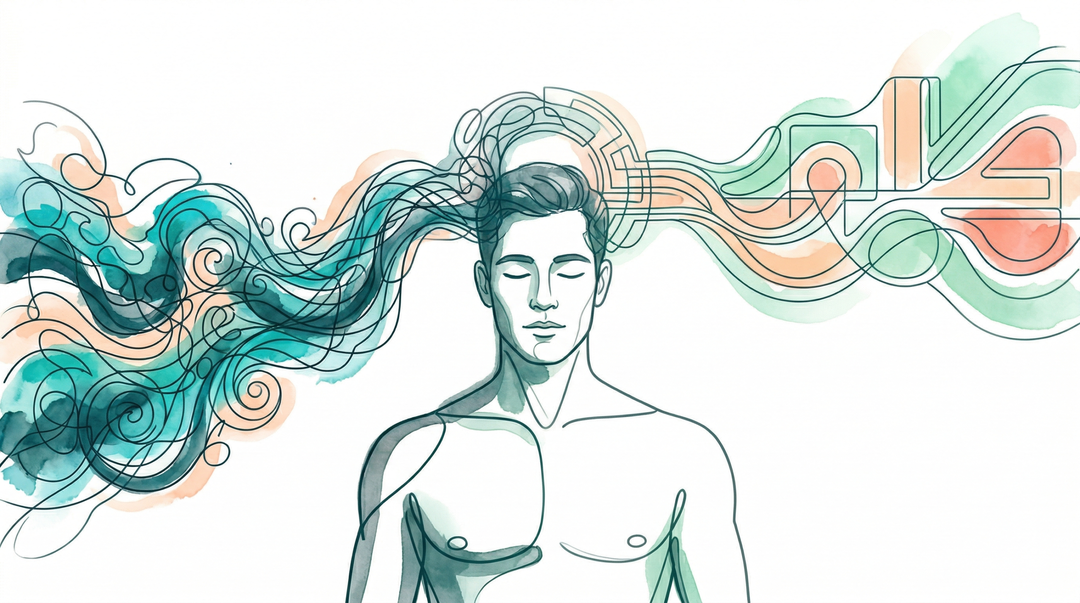
The method starts from one central principle: intelligence isn't a fixed capacity, it's a trainable skill. And like any skill, it gets better with systematic practice.
More specifically, EITA works on the skill of thinking emotions through: identifying what you're feeling, understanding why you're feeling it and turning that awareness into effective action instead of an impulsive reaction.
How EITA works in practice
The method works in four interlocking steps.
1. Naming the emotion
The starting point is always the same question: What am I feeling right now? Not "how am I doing" in a general sense, but which specific emotion is present at this moment.
In a now-classic 2007 study published in Psychological Science, Matthew Lieberman and his team at UCLA showed that naming an emotion (affect labeling) reduces activity in the amygdala and increases activity in the right ventrolateral prefrontal cortex. In practical terms: simply putting a feeling into words already changes how your brain responds to it.
2. Understanding the trigger
Once the emotion has a name, EITA invites you to look into the event that set it off, without judgment and without rushing to fix anything. This step trains self-awareness: the ability to observe yourself with curiosity rather than self-criticism.
3. Cognitive analysis
Here the method applies techniques from cognitive therapy to question the story the emotion has created. The central question is: is this interpretation a fact, or is it a projection of my emotional state? This is the moment when reasoning takes the place of reacting.
4. Reorganization and action
With the emotion named, the trigger identified and the story questioned, you're in a position to choose a conscious response instead of an automatic reaction. That's the "freedom" EITA offers: the freedom to choose how to act, even in the middle of emotional turbulence.
From the consulting room to WhatsApp: how EITA became a virtual mentor
For years, Anaclaudia applied EITA in one-on-one sessions with executives and athletes. The results were consistent, but access was limited, and she could see that the demand for emotional support was far greater than any private practice could ever meet.
Brazil has more than 600,000 registered psychologists, according to the registry of the Federal Council of Psychology (CFP). At the same time, according to a 2018 report released by ANAMT, Brazil's national association of occupational medicine, about 30% of Brazilian workers have symptoms of burnout. The math doesn't add up.
In 2024, EITA was relaunched as an emotiontech company built for scale. That's when the virtual mentor was developed: an AI trained on the method, available 24 hours a day on WhatsApp, able to guide users through the method's four steps in a conversational, empathetic and personalized way.
Conversations with EITA work in English. The method's courses and written materials are in Portuguese.
Frequently asked questions
Is the EITA method scientifically validated?
It's worth being honest here. The mechanisms EITA trains have solid scientific grounding: naming emotions reduces amygdala activity and recruits the prefrontal cortex, as Lieberman and colleagues showed in 2007 in Psychological Science. The method itself, as a complete package, is a practical application of these findings combined with its creator's clinical experience, not a protocol that has been put through a clinical trial of its own. Nothing here replaces treatment.
Do I need to be in therapy to use EITA through the virtual mentor?
The virtual mentor is a tool for emotional support and mental training: it does not replace therapy. But it can be used as a complement to therapy, or on its own by people looking for more emotional balance in everyday life.
What sets EITA apart from other coaching or mindfulness methods?
EITA doesn't ask you to empty your mind or passively accept your feelings. It proposes an active process of understanding and reorganizing, with measurable progress. Anaclaudia developed a results-measurement system that makes it possible to track a user's progress over time.
Sources
- Lieberman, M. D., Eisenberger, N. I., Crockett, M. J., Tom, S. M., Pfeifer, J. H., & Way, B. M. (2007). Putting feelings into words: affect labeling disrupts amygdala activity in response to affective stimuli. Psychological Science, 18(5), 421-428. sanlab.psych.ucla.edu (PDF) · PubMed record
- Conselho Federal de Psicologia (Brazil's Federal Council of Psychology). A psicologia em números [Psychology in numbers]. cfp.org.br (in Portuguese)
- ANAMT (2018). 30% dos trabalhadores brasileiros sofrem com a síndrome de burnout [30% of Brazilian workers suffer from burnout syndrome]. anamt.org.br (in Portuguese)
Anaclaudia Zani is a psychologist (CRP 06/128106, Brazil) and neuroscientist, creator of the EITA method and of EITA Mentor.