

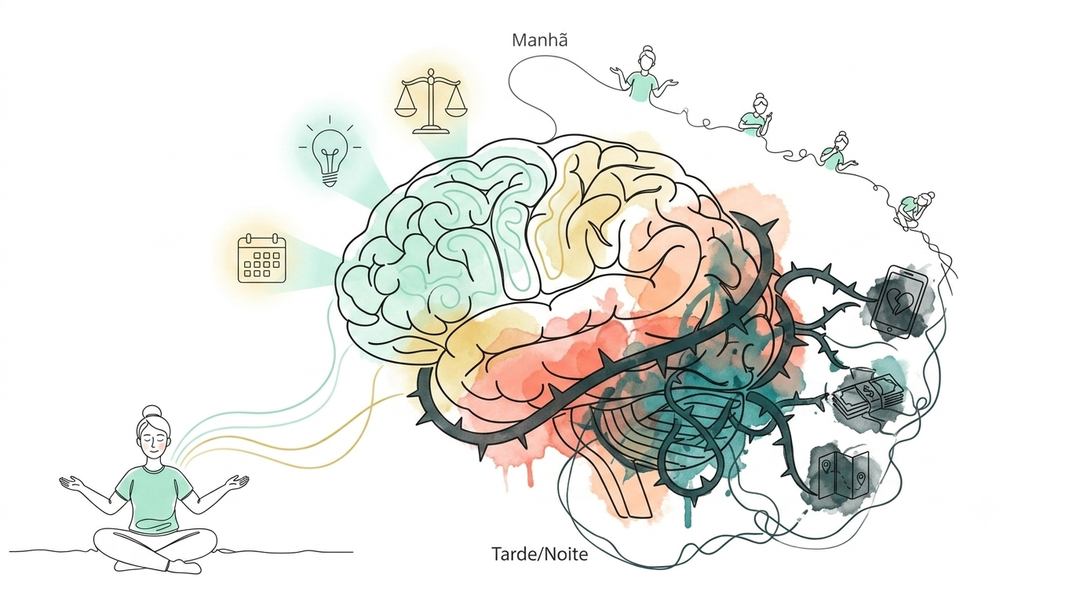
In the morning you're one person. At night, you're someone else. In the morning you pass on the pastry, answer the tough email, order the salad, keep your cool. Then 7 p.m. rolls around and, out of nowhere, you order the pizza, buy something you didn't need, snap at someone over nothing and drop everything to scroll your feed. Which leaves one question: where does your willpower go when the sun sets?
Good news: it didn't disappear because you're weak. It got used up. And that has a name: decision fatigue. The idea at the heart of this article may sting a little: the quality of your choices depends not only on who you are, but on how many decisions you've already made before that one. Choosing is tiring. And a tired brain chooses badly.
What decision fatigue is
Decision fatigue is the gradual drop in the quality of your choices after a long string of decisions. It doesn't matter whether they're big (accepting a job offer) or tiny (which checkout line, what to say in the group chat, what to wear). Each one draws a little from the same tank. And the tank isn't bottomless.
The detail almost nobody notices is the size of the bill. Nobody has a reliable count of how many decisions a person makes in a day, but add up the conscious choices, the micro-decisions at work and everything that needs deciding at home, and you can see why, by late afternoon, the system starts sending out an SOS.
What happens in the brain
This is where neuroscience weighs in. The prefrontal cortex, the region just behind your forehead, is the seat of judgment: comparing options, weighing consequences, resisting impulses. It's demanding to run, and when you lean on it hard for a long stretch, things start to jam.
A study published in 2022 in the journal Current Biology, led by Antonius Wiehler and Mathias Pessiglione at the Paris Brain Institute, found a buildup of glutamate in the lateral prefrontal cortex over a full day of mental work, but only in the people who tackled the harder tasks. Those participants also started to favor options that paid off sooner and took less effort. The authors' hypothesis: as glutamate accumulates, the brain makes it more costly to use this region, so self-control becomes harder to summon. And what happens when the part of you in charge of judgment steps back? The pull of the immediate, the easy and the effortless takes over. In other words, the end of the day nudges you toward more impulsive choices not out of laziness, but through a kind of built-in brake.
That helps explain why tough decisions can feel impossible at night, why it's so much easier to hit "buy" after a long day and why silly arguments blow up over dinner, not over breakfast. It's not a character flaw. It's brain chemistry asking for a break.

Decision fatigue isn't physical tiredness. And it isn't burnout.
It's worth separating three things that often get mixed up, because each one calls for a different kind of care.
| Decision fatigue | Physical tiredness | Burnout |
| Worn out from choosing; eases with breaks and a well-planned day | Your body asking for rest; gets better with sleep and downtime | Chronic, work-related exhaustion; calls for structural change |
| Builds up over a single day | Shows up after physical effort | Sets in over weeks or months |
| Signs: impulsiveness, procrastinating, "whatever" | Signs: sleepiness, aches, a heavy body | Signs: cynicism, detachment, a sense of emptiness |
| Fix: cut down on decisions and organize them | Fix: rest your body | Fix: professional care and a rethink of your routine |
Notice that decision fatigue is the quietest of the three. It doesn't announce itself with pain or a crisis. It just quietly lowers the quality of what you decide. And because you don't notice it, you tend to blame yourself for it.
How to outsmart decision fatigue: the EITA method approach
EITA (Elevar a Inteligência a Treino de Autopercepção, Portuguese for roughly "turning intelligence into self-awareness training") is the foundation of EITA Mentor. Applied to this topic, it works in four moves.
1. Notice when the tank is running low
The shift starts with self-awareness. Instead of scolding yourself ("why can't I focus?"), observe: "what time is it, and how many decisions have I already made today?" Recognizing the state changes everything, because an important decision made on fumes tends to be a worse decision. Sometimes the smartest choice is not to choose right now.
2. Cut down on the decisions that don't matter
The trick isn't more willpower. It's fewer trivial choices. Standardize what you can: lay out your clothes the night before, set a weekly menu, put your bills on autopay, create simple rules ("no money decisions after 9 p.m."). Every micro-choice you eliminate is energy saved for what really counts.
3. Put the decisions that matter in your peak hours
Since this kind of fatigue builds as the day wears on, your judgment tends to be freshest before the decisions start piling up. Use that: schedule difficult conversations, planning and high-stakes choices for when the tank is full. Save late afternoon for what's routine and reversible.
4. Refuel for real
Real breaks, food, water, sleep and a screen-free breather aren't luxuries: they're maintenance for the organ that makes your decisions. A short walk, ten minutes of quiet or an actual meal is a better bet than pushing through on fumes. A brain that decides well is a brain that's cared for, not one that's wrung out.
This is where EITA Mentor comes in. On those late afternoons when everything feels too big to decide, you can open WhatsApp and, in a few minutes of conversation, sort through your options, separate what's urgent from what only looks urgent, and figure out whether this is really the moment to decide. It's available 24 hours a day, precisely for the moments when your judgment is running on reserve.
Get to know EITATwo examples of how this works in practice
The cases below are illustrative, built to show the method in common situations. They are not real people or accounts from clinical sessions.
Example 1: the manager whose days always ended badly. Beth spent the whole day making decisions for her team. By the time she got home, any simple question ("what should we have for dinner?") short-circuited her, and she always made her big personal decisions late at night, exhausted, and then regretted them. The turning point wasn't working less. It was moving the big personal choices to Saturday morning and walling off her evenings from any decision that could wait. Her regrets dropped off sharply.
Example 2: the dad at the end of the workday. Ryan noticed it was always after 6 p.m. that he lost his patience with his kids over little things. It wasn't a lack of love: it was an exhausted prefrontal cortex with nothing left to rein in the impulse. The fix was a small ritual: ten minutes of transition between work and home, with a glass of water, a snack and no screens. With the tank partly refilled, family evenings took on a different tone.

Deciding well is a skill, not a gift
There's a lazy belief that some people are "just decisive," as if it were something you're born with. Neuroscience paints a different picture. The brain is plastic: it reorganizes itself around what you repeat.
Every time you notice fatigue creeping in and protect an important decision instead of making it on autopilot, you strengthen a better circuit. It's not about superhuman willpower. It's about designing your day so you waste less judgment on things that don't matter and save the best of yourself for what does. And like any skill, it gets better with practice and consistency, not with one-day heroics.
Frequently asked questions
Is decision fatigue the same as laziness?
No. Laziness is a lack of desire to act. Decision fatigue is the depletion of a specific mental resource, judgment, after heavy use. The person wants to decide well and can't, because the "fuel" for weighing options is running low. Treating it as laziness only breeds guilt and makes the cycle worse.
Will caffeine or sugar fix it?
A quick lift, at most. They may make you feel more alert for a while, but they don't shrink the number of decisions on your plate or give your judgment a real break. What actually helps is structural: cutting down on trivial decisions, respecting your brain's peak hours and taking real breaks. It's management, not stimulation.
How does EITA Mentor help with this?
In a few minutes of conversation on WhatsApp, it does what's hard to do alone when your tank is low: it helps you organize your options, separate the urgent from what can wait and figure out whether this is really the time to decide. Because it's available 24 hours a day, it reaches you right at the end of the day, when your judgment is at its most fragile. Over time, it becomes self-awareness training that changes how you handle your choices.
Does this replace therapy?
No. EITA Mentor is a tool for emotional support and self-awareness training. It does not replace professional care. If your trouble making decisions comes with intense anxiety, persistent sadness, paralysis or distress that gets in the way of your life, care from a psychologist or psychiatrist is irreplaceable. EITA works best as a complement, or as a first step for people who aren't seeing anyone yet.
Sources
- Wiehler, A., Branzoli, F., Adanyeguh, I., Mochel, F., & Pessiglione, M. (2022). A neuro-metabolic account of why daylong cognitive work alters the control of economic decisions. Current Biology, 32(16). cell.com
Anaclaudia Zani is a psychologist (CRP 06/128106, Brazil) and neuroscientist, creator of the EITA method and of EITA Mentor.