

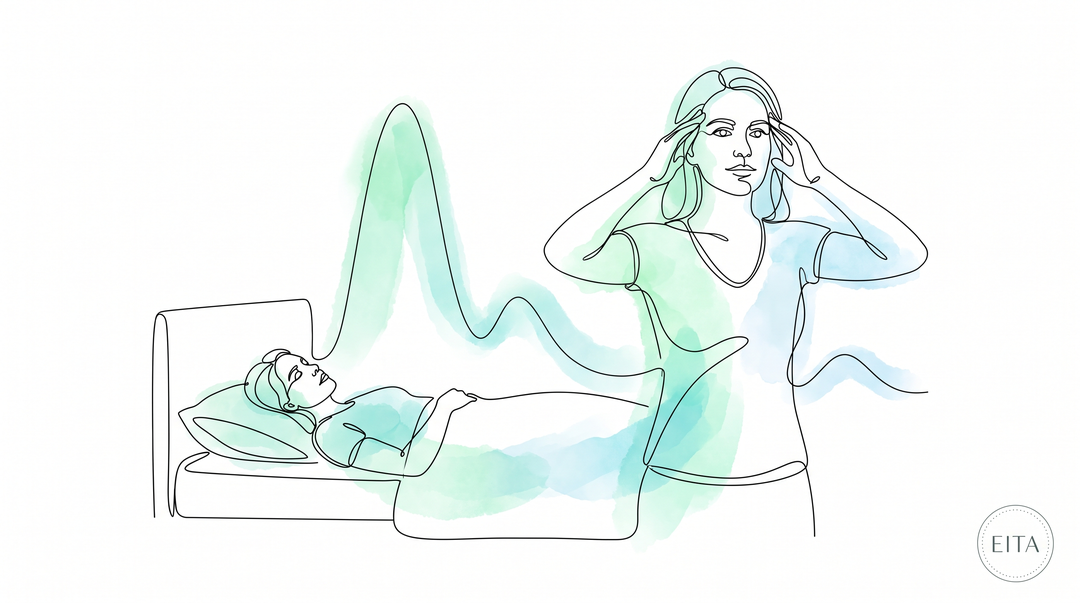
6:20 a.m. The alarm hasn't even gone off, you open your eyes and your body is already in overdrive: tight chest, clenched jaw, that vague rush of someone running late for something. The problem is that nothing has happened. Nobody called, no message came in, the day hasn't even started. And still you wake up feeling like you're already behind.
The conclusion almost everyone draws from this is the same: "I'm way too anxious, this isn't normal." That conclusion is wrong, and the mistake is costly. Because what happens in your body in the first forty-five minutes after you wake up has a name, a curve and a body of research behind it, and it isn't a defect. It's one of the most predictable hormonal events in human physiology.

What the cortisol awakening response is
It's called the cortisol awakening response (CAR, in the research literature). It's the rapid, pronounced rise in cortisol that happens in the first 30 to 45 minutes after you open your eyes. According to a review by Tobias Stalder and colleagues published in Endocrine Reviews in 2025, that rise ranges from 50% to 156% above the level at the moment you woke up. That's no small detail: it's the peak of the entire day. From mid-morning on, cortisol only goes down, bottoming out around bedtime.
In other words, the moment you have the most cortisol circulating is exactly when the least has happened. It isn't a response to your boss, your bills or traffic. It comes before all of that.
Here's a detail that changes the picture: cortisol in saliva only starts to rise about ten minutes after you wake up. That heavy, disoriented feeling in your first minute out of sleep isn't cortisol. By the time the peak arrives, you're already on your feet.
The idea that goes against common sense
Here's the part almost nobody talks about. If morning cortisol were the villain behind anxiety, you'd expect the most worn-out people to have the biggest spikes. The opposite happens.
A meta-analysis led by Ian Boggero and colleagues, published in Biological Psychology in 2017, pooled 709 findings from 212 studies. The pattern that showed up consistently was this: fatigue, exhaustion and burnout are associated with a smaller response, not a bigger one. People running on empty don't wake up revved. They wake up flat.
And there's a second finding, even more counterintuitive. Daniel Powell and Wolff Schlotz, of the University of Southampton, followed 23 adults over two workdays, collecting saliva on waking and at 30 and 45 minutes, plus six stress and mood check-ins over the course of each day (PLoS ONE, 2012). On days when the morning rise was bigger, people reacted to the day's hassles with less distress. The same stress hurt less. The authors were upfront about the other side: the hypothesis they set out to test, that anticipating a hard day raises the peak, didn't hold up in that sample.
Put the two together and the picture flips. That 6:20 a.m. rush looks a lot less like a fire alarm and a lot more like a tank being filled before a road trip. The discomfort is real. It's the meaning you give it that's usually off.
| What your body does | The automatic reading | What the research describes |
|---|---|---|
| Racing heart and body on alert twenty minutes after waking | "I'm anxious, today is going to go wrong" | The expected cortisol peak, 30 to 45 minutes after waking |
| Waking up before the alarm on the morning of a dreaded meeting | "I can't even sleep properly anymore" | In experiments, telling people the night before that they'll face difficult tasks raises the response |
| Monday morning feels much worse than Saturday morning | "I hate my job" | A bigger response on workdays than on days off has been a repeated finding since 2004 |
| Waking up with no charge at all, dragging, and staying that way all day | "At least I woke up calm today" | A blunted response is the pattern a meta-analysis linked to fatigue and burnout |
One caveat that honesty requires: the effects are small, and the response varies a lot from one day to the next in the same person. As Stalder and colleagues put it, how it shows up on a given day depends more on the situation than on a stable trait. No single morning says anything about you. What tells you something is the pattern over weeks.
Why your body does this
The conductor is the suprachiasmatic nucleus, a cluster of neurons in the hypothalamus that works as the body's master clock. It sets itself by light, through cells in the retina that send light information straight to that nucleus. That's why the morning response is sensitive to brightness: the more light in the minutes after you wake up, the bigger the response, with the strongest effect for short-wavelength light (the bluish light of morning).
But it isn't only about light. A significant response shows up even in complete darkness. The act of waking up itself switches on alertness circuits in the brain and changes how sensitive the adrenal gland is to the signal coming from above. Light and waking are two levers, and the second one works on its own.
Two brain regions come into play. The hippocampus, which is involved in memory, seems to be necessary to mount this response: people whose hippocampus is compromised don't produce it properly. And the prefrontal cortex, which comes back online when you wake up, helps control this hormonal axis. Translation: the peak is organized by the same brain machinery that stores what happened yesterday and projects what's coming today.
Hence the idea researchers call the anticipation hypothesis. In experimental studies, telling people before bed that they'd face difficult, competitive tasks the next day produced a bigger response the following morning. In preschoolers, giving them a small task to do right after waking had the same effect. The 2025 review's conclusion is careful: the most convincing evidence comes precisely from this experimental work, and it suggests that what's already loaded in your mind the moment you wake up influences the size of the wave.
That's why these forty-five minutes aren't just a routine detail. They're the window in which your body is literally setting up your day.
What to do with this window: the EITA method applied to your morning
1. Name it before you explain it
The first thing the brain does with a strong sensation is look for a cause. If you wake up revved and there's no explanation handy, it finds one: the meeting, the bill, your kid, your marriage. And then you start believing the explanation you just made up. Self-awareness training starts before that, with a descriptive sentence that has no plot: "My body is revved up and it's 6:30." Period. You haven't denied the sensation. You've just refused to sign off on the first theory that showed up.
2. Give the clock the information it's waiting for
Light and movement in the first few minutes aren't generic wellness advice. They're the data input the suprachiasmatic nucleus uses to set itself. Opening the curtains before you open your phone changes which signal arrives first.

3. Set the agenda for those 45 minutes
If your mind is already loaded when you wake up, the practical question is: loaded with what? When you check your email before brushing your teeth, you've handed that decision to the most anxious sender in your inbox. Switching the order costs nothing and gives the choice back to you.
4. Close with a direction sentence
Before you leave the bedroom, say one sentence about what the day actually asks of you: "Today what matters is sending the proposal and picking up my mom at six." It isn't optimism; it's focus. The energy is already in your body. All that's left is telling it where to go.
Two examples of how this plays out
The two cases below are illustrative. They are not real people or accounts from clinical sessions.
Mark, 47, sales manager in Denver. He wakes up every day at 5:50 a.m. with a tight chest and has decided he's developed anxiety. He started checking his phone while still in bed to "get it over with," and what he found there made sense of the rush: there was always something wrong. The loop closed on its own. When he started naming the sensation before looking for someone to blame, and put off his phone for twenty minutes, the rush was still there. What changed was that it stopped coming with a story attached.
Sylvia, 52, teacher in Columbus. The opposite case. For months she's been waking up with no charge at all, dragging herself to the coffee maker, and she takes it as a sign that she's finally calm. Except she also has no energy for the rest of the day, and no desire to see anyone. Persistent flatness calls for a professional evaluation, not a tweak to your routine. Calm and apathy are different things, and the body usually knows the difference before we do.
Where EITA fits into this window
The practical problem with all of this is timing. Nobody calls their therapist at 6:20 a.m. to say "I woke up revved again." EITA Mentor works on WhatsApp 24 hours a day, and it's exactly in these small moments with no audience that she makes a difference: she helps you describe the sensation before your brain invents a cause, and turn that 6:30 a.m. buzz into a direction sentence for the day. It's self-awareness training repeated at the hour when it matters, not a monthly conversation about what already happened.
Talking it out helps in the moment. When the pattern keeps repeating, understanding where it comes from is what brings change: at EITA Academy, EITA's training area, the course "Ansiedade? Não, Obrigado!" ("Anxiety? No, Thanks!"), by Anaclaudia Zani, neuroscientist, creator of the EITA method, lays out the diagnosis, the plan and the action for everyday anxiety in short lessons, with materials to practice with EITA. The courses are in Portuguese.
This is a skill, not a gift
None of this depends on temperament. You're not going to learn to have less cortisol in the morning, and you shouldn't want to. What you learn is how to read it: separating what your body is doing from what your mind says it means. It's a fine-grained distinction, the same kind you train in any perceptual skill, and it gets better with repetition because the adult brain keeps reorganizing its connections around what it practices.
The key detail is that the repetition has to happen in the right context. Understanding the cortisol response by reading an article in the afternoon is information. Recognizing it at 6:20 a.m., with your heart pounding, is training. Only the second one changes anything.
Frequently asked questions
Does waking up revved mean I have anxiety?
Not on its own. The cortisol rise in the first 30 to 45 minutes happens in healthy people every day, and it's the normal peak of the cycle. What deserves attention isn't the rush by itself, but the bigger picture: distress that doesn't let up, problems at work or in your relationships, weeks of poor sleep, losing interest in things. That's when the conversation should be with a professional.
Should I get a cortisol test to measure this?
This measurement is used in research, not for self-assessment. The expert consensus guidelines published by Stalder and colleagues (2016) call for sampling at the exact moment of waking and for objective verification of the time, because a delay of just a few minutes already skews the result. On top of that, the response swings a lot from day to day in the same person. A one-off test tells you nothing useful. If there's a clinical concern, it's a doctor who orders and interprets the test.
Will hitting snooze or sleeping in make my mornings better?
Getting enough sleep matters for lots of reasons, but don't expect it to erase the morning rise, because the rise isn't a sign of tiredness. In a well-designed sleep lab study, mildly to moderately restricting sleep for seven nights didn't change this response. Waking up earlier, on the other hand, tends to produce a bigger rise, which helps explain why Monday feels different from Sunday.
Does this replace therapy?
No. EITA Mentor is an emotional support and self-awareness training tool, and it doesn't replace professional care. For diagnosed disorders, intense psychological distress or persistent symptoms, working with a psychologist or psychiatrist is irreplaceable. EITA works best as a complement to treatment, or as a resource for people who aren't in care yet. If you are in crisis or thinking about suicide, contact your local emergency number right away. In the US, call or text 988 (Suicide & Crisis Lifeline); in the UK and Ireland, call Samaritans on 116 123; in Brazil, call CVV on 188.
Sources
- Stalder, T., Oster, H., Abelson, J. L., Huthsteiner, K., Klucken, T., & Clow, A. (2025). Cortisol Awakening Response: Regulation and Functional Significance. Endocrine Reviews, 46(1), 43-59. academic.oup.com
- Powell, D. J., & Schlotz, W. (2012). Daily Life Stress and the Cortisol Awakening Response: Testing the Anticipation Hypothesis. PLoS ONE, 7(12), e52067. journals.plos.org
- Boggero, I. A., Hostinar, C. E., Haak, E. A., Murphy, M. L. M., & Segerstrom, S. C. (2017). Psychosocial functioning and the cortisol awakening response: Meta-analysis, P-curve analysis, and evaluation of the evidential value in existing studies. Biological Psychology, 129, 207-230. escholarship.org (PDF)
- Stalder, T., Kirschbaum, C., Kudielka, B. M., et al. (2016). Assessment of the cortisol awakening response: Expert consensus guidelines. Psychoneuroendocrinology, 63, 414-432. pubmed.ncbi.nlm.nih.gov
- Schlotz, W., Hellhammer, J., Schulz, P., & Stone, A. A. (2004). Perceived work overload and chronic worrying predict weekend-weekday differences in the cortisol awakening response. Psychosomatic Medicine, 66(2), 207-214. pubmed.ncbi.nlm.nih.gov
Anaclaudia Zani is a psychologist (CRP 06/128106, Brazil) and neuroscientist, creator of the EITA method and of EITA Mentor.