
You wake up tired. You go to work tired. You come home tired. And when someone asks how you're doing, the automatic answer is ‘fine,’ because explaining what you're actually feeling seems like more work than it's worth.
This isn't just being tired. It's your nervous system sending out an SOS.
Burnout is widespread. In Brazil, figures released in 2018 by the National Association of Occupational Medicine (ANAMT) put it at about 30% of the country's workers.
But what's really going on in your brain when you hit an emotional wall? And what does neuroscience say about finding your way out?
What burnout actually is
Burnout isn't weakness. It isn't drama. It isn't a lack of faith or willpower.
In May 2019, the World Health Organization included burnout in the ICD-11 as an occupational phenomenon, code QD85. Note the detail a lot of people get wrong: the WHO doesn't classify it as a medical condition, but as a factor that leads people to seek health services. The ICD-11 took effect on January 1, 2022.
The WHO defines it as the result of chronic workplace stress that hasn't been successfully managed. It shows up in three main dimensions:
- Exhaustion: a feeling of extreme physical and emotional depletion
- Mental distance: growing cynicism or indifference toward your job
- Reduced efficacy: feeling less capable and less effective at work
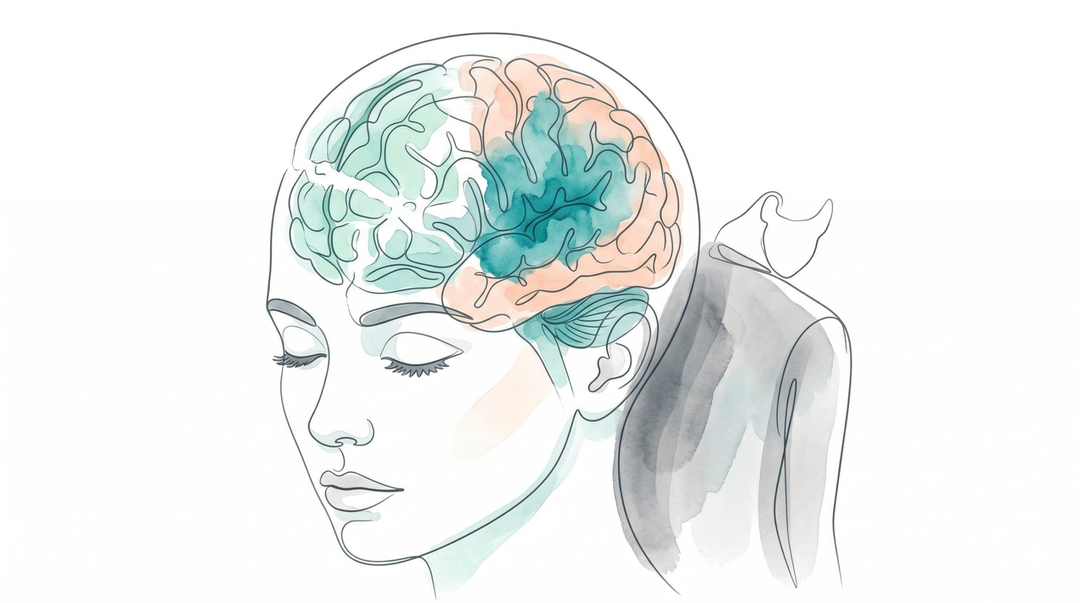
From the brain's point of view, here's what happens: when stress becomes chronic, the prefrontal cortex (the area responsible for decision-making, planning and emotional regulation) loses efficiency. Meanwhile, the amygdala, which processes fear and threat, gains the upper hand: research on stress shows that the same chemistry that weakens the prefrontal cortex strengthens the amygdala's emotional responses. The result? You react more and think less. You feel more and process less.
How to spot the early symptoms
Burnout rarely shows up all at once. It builds in layers. These are the signs that come before it:
Physical symptoms
- Constant fatigue, even after a night's sleep
- Frequent headaches and muscle tension
- Digestive problems with no physical cause
- Insomnia or unrefreshing sleep
- Lowered immunity (catching colds and the flu often)
Emotional and cognitive symptoms
- A feeling that nothing you do is ever enough
- Getting overly irritated by small things
- Trouble concentrating and forgetfulness
- No motivation for things you used to enjoy
- A sense of emptiness or distance from people
Behavioral symptoms
- More and more procrastination
- Pulling away from people at work
- Leaning more on alcohol, caffeine or other substances
- Neglecting meals, exercise and sleep
If several of these sound familiar, it's time to stop and listen to what your nervous system is telling you.
What neuroscience says about recovery
The good news is that the brain is plastic. Neuroplasticity, the brain's ability to reorganize itself and form new connections, doesn't disappear with burnout. But it needs the right conditions to do its job.
1. Name what you're feeling
In a 2007 study in Psychological Science, Matthew Lieberman and colleagues at UCLA showed that naming an emotion (affect labeling) reduces the amygdala's response and increases activity in the right ventrolateral prefrontal cortex. In practical terms: putting a name to what you feel already lightens the emotional load.
Instead of ‘I feel awful,’ try: ‘I'm exhausted because I was ignored in an important meeting and I feel like my effort doesn't count.’ That kind of specificity is where emotional regulation starts.
2. Restore the basics before anything else
A depleted brain can't heal itself through productivity. It needs sleep, movement and food, in that order. Sleep is when the brain's glymphatic system steps up its cleanup of the metabolic waste that builds up while you're awake (in mice, this clearance ran much faster during sleep than during wakefulness). Without enough sleep, cognitive recovery stalls.
3. Break the rumination loop
Rumination (getting stuck replaying the same negative thoughts) is one of burnout's biggest allies. A simple way to interrupt it is active redirection: when you notice you're ruminating, change your surroundings or your activity right away, for at least two minutes.
4. Re-engage gradually, with meaning
Going back to work after burnout can't happen at the same pace and under the same conditions that caused the collapse. Start with smaller tasks that give you a sense of control and meaning, so you reactivate the brain's reward system (dopamine) without overloading the prefrontal cortex again.
| 💬 Emotional training for everyday life EITA Mentor was developed by neuroscientist Anaclaudia Zani for exactly this gap: emotional support between therapy sessions, in the middle of everyday life. Available on WhatsApp, the AI is trained on the EITA method to help you name emotions, organize your thoughts and build practical strategies for the challenges you face at work. |
Burnout or depression: know the difference
Burnout and depression can coexist, but they aren't the same thing. The main difference is context: burnout is directly tied to work and tends to improve with time away from it. Depression seeps into every area of life. If your symptoms persist even after rest, see a psychiatrist or psychologist.
Frequently asked questions about burnout
How long does it take to recover from burnout?
It depends on how severe it is and how much support you have. Mild cases can improve within weeks with changes in habits. More severe cases may take months of professional care. There's no standard timeline, and trying to recover ‘too fast’ often leads to relapse.
Can you burn out even if you love what you do?
Yes. Loving your work doesn't make you immune. When your job is a big part of who you are, as it often is for doctors, teachers and activists, it's easy to give more of yourself than the situation can sustain.
Can EITA Mentor help with burnout?
EITA Mentor doesn't replace professional treatment in serious cases. But it is a practical tool for everyday support: it helps you organize your thoughts, applies emotional regulation techniques and builds awareness of the patterns that feed exhaustion.
Sources
- ANAMT (2018). 30% dos trabalhadores brasileiros sofrem com a síndrome de burnout. anamt.org.br (in Portuguese)
- Jornal da USP (October 30, 2023). Síndrome de burnout acomete 30% dos trabalhadores brasileiros. Report on the ANAMT estimate. jornal.usp.br (in Portuguese)
- World Health Organization (2019). Burn-out an "occupational phenomenon": International Classification of Diseases. who.int
- World Health Organization. ICD-11 entry QD85, Burnout. icd.who.int
- World Health Organization. ICD-11 Implementation (FAQ: ICD-11 came into effect on January 1, 2022). who.int
- Arnsten, A. F. T. (2009). Stress signalling pathways that impair prefrontal cortex structure and function. Nature Reviews Neuroscience, 10(6), 410-422. PubMed record
- Lieberman, M. D. et al. (2007). Putting feelings into words. Psychological Science, 18(5), 421-428. sanlab.psych.ucla.edu (PDF) · PubMed record
- Xie, L., Kang, H., Xu, Q., et al. (2013). Sleep drives metabolite clearance from the adult brain. Science, 342(6156), 373-377. Full text (open access)
Anaclaudia Zani is a psychologist (CRP 06/128106, Brazil) and neuroscientist, creator of the EITA method and of EITA Mentor.