

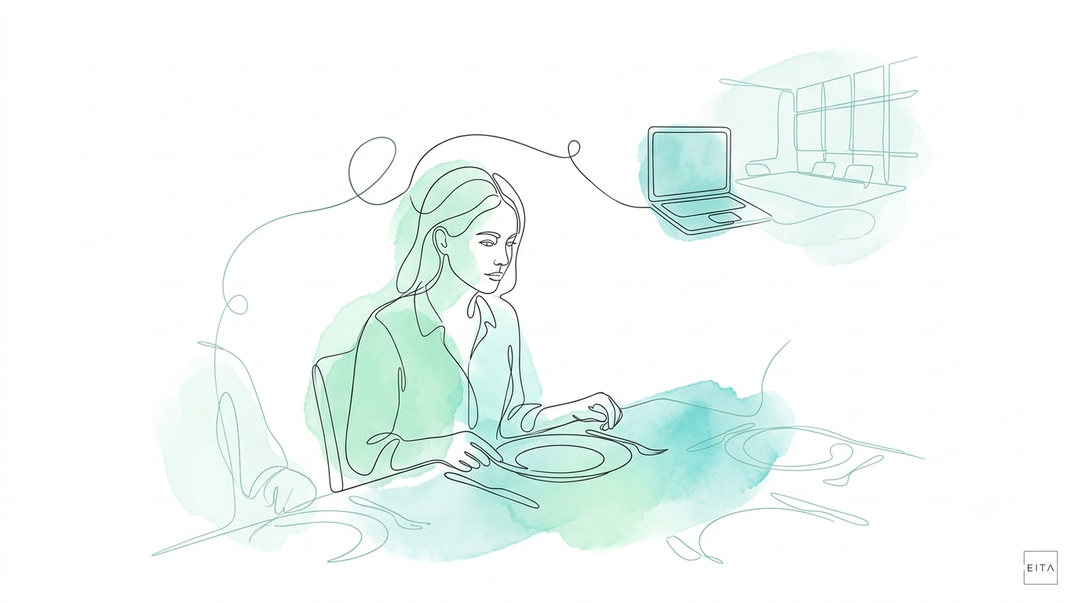
It's 7:40 p.m. Claire has already shut down her laptop, caught the train and made it home. She's sitting at the table, her son telling her something about school, her plate going cold in front of her. And she's there. Physically there.
But part of her is still in the 5 p.m. meeting. In that half-finished comment from her boss. In that "let's talk tomorrow" left hanging in the air.
She listens to her son. She answers in the right places. She smiles at the right moments. And half an hour later, she can't remember a word he said.
The most common reading of this is harsh: I'm distracted, I'm checked out, I'm a bad mom. Neuroscience has an explanation that's far less cruel and far more useful. It's called attention residue.
The idea that flips common sense: the problem isn't too little attention, it's attention left behind
We tend to treat distraction as an absence: a lack of focus, a lack of presence, a lack of willpower. The finding that changes the game says the opposite.
In 2009, researcher Sophie Leroy, then at the University of Minnesota's Carlson School of Management and now dean of the School of Business at the University of Washington Bothell, published a study in the journal Organizational Behavior and Human Decision Processes with a title any working adult could have written: "Why is it so hard to do my work?" She had participants switch tasks under different conditions and measured how well they performed on the next one.
The result: people who switched while leaving the previous task unfinished did worse on the new one. Not because they had zoned out. Because a slice of their attention was still tied to the earlier task, running in the background, using up resources.
Leroy named that slice attention residue: the piece of your mind that stays behind while the rest of you walks out the door.
In other words, you don't have too little attention. You have too much of it parked somewhere else. That's a different problem, and the difference completely changes what to do about it.

What's happening in the brain (no fluff)
Two pieces explain the phenomenon well.
The first is the prefrontal cortex, the region just behind your forehead that handles executive control: deciding what comes into focus and what goes out, holding information in working memory, filtering out distractions. Its capacity is limited. When part of that capacity is reserved for an open task, there's less left for whatever is in front of you. It's not a metaphor; it's a budget.
The second is the default mode network, a set of areas that includes the medial prefrontal cortex and the posterior cingulate cortex. It's the network that takes over when you're not focused on anything external: it produces daydreaming, spontaneous planning and, in its sour version, rumination. Brain-imaging studies consistently link rumination to heightened activity in this network when top-down regulation from the prefrontal cortex loosens its grip.
Put the two together: an emotionally charged, unfinished task keeps the prefrontal cortex partly occupied and feeds the default mode network fresh material to reprocess. The family dinner is the stage. The 5 p.m. meeting has the mic.
Attention residue isn't the same as rumination
People mix the two up all the time, and it gets in the way, because each one calls for a different response.
| Attention residue | Rumination |
| Comes from an open task, an issue with no resolution | Comes from emotional content that repeats on a loop |
| Lasts minutes to a few hours and fades once the task is closed | Can last days or weeks, even after the issue is settled |
| Your mind is on "loose ends" | Your mind is on "what if" and "why me" |
| Gets better with a concrete plan and closing the loop | Gets better with emotional regulation and, sometimes, professional support |
| Feels like: I'm distracted | Feels like: I'm stuck |
One can turn into the other. Attention residue that never gets resolved, day after day, is prime fertilizer for nighttime rumination. That's why it pays to deal with residue while it's still just residue.
Four signs you're carrying residue
It isn't subtle once you know what to look for.
You reread the same message three times and nothing sinks in. You answer on autopilot in personal conversations, with those generic phrases that fit any context. You get home exhausted without having done anything physical, because the effort went into executive control. And you have spikes of irritation that are out of proportion: your partner's simple question about what's for dinner lands like a demand, because your prefrontal cortex has a packed calendar and no bandwidth left to soften your reply.
The EITA method applied to residue: closing the loop in four steps
EITA stands for Elevar a Inteligência a Treino de Autopercepção, Portuguese for turning intelligence into self-awareness training. The logic here is simple: you don't have to finish the task for your brain to let it go. You need to give it a recognizable ending.
1. Notice that something stayed behind
Before any technique, name it. At the end of the workday, ask one question: "What's still open in my head right now?" This isn't about the task list in your project tool. It's about what's taking up mental space. Often it isn't Friday's deadline. It's a ten-second comment someone made in a meeting.
2. Name it precisely
"I'm stressed" closes nothing. "I'm bothered because Ryan questioned my numbers in front of everyone and I didn't respond" closes a lot. In a 2007 brain-imaging study published in Psychological Science, Matthew Lieberman and colleagues at UCLA showed that putting feelings into words (what they called affect labeling) reduced the amygdala's response to emotional images and increased activity in the right ventrolateral prefrontal cortex. Naming is a neurological maneuver, not a poetry exercise.
3. Give it a concrete next step
Here's the part almost nobody does. Your brain lets go of a loose end once it gets a when and a how. Writing "talk to Ryan" isn't enough. Write: "Tomorrow, 9 a.m., I'll message him and ask for ten minutes." An intention with a set time takes the task off watch duty.
4. Mark the transition physically

Your brain uses context to separate chapters. When work and home happen in the same room, the marker disappears. Create one: a five-minute walk before you go inside, changing clothes, washing your face, a specific song on the way home. It seems too small to work. Being small is exactly what makes it something you can repeat every day.
Two examples of what this looks like in practice
The two cases below are illustrative, built to show the method in common situations. They are not real people or accounts from clinical sessions.
Greg, 51, sales director in Denver. He'd come home and spend the whole dinner answering in one-word replies. His wife thought he was upset with her. He thought he was just tired. Once he started asking himself the question at 6:50 p.m., he found that what stayed open was almost always the same thing: the Wednesday pipeline meeting, where he never had the numbers at hand. He gave it a concrete next step: Tuesdays at 4 p.m., half an hour blocked off to review the numbers. Wednesday dinners changed before the pipeline did.
Rachel, 38, attorney in Chicago, working from home. No commute, no transition: she'd close the laptop at 7 p.m. and by 7:02 she was serving dinner. She created a seven-minute ritual: she writes down her three loose ends in a notebook, each with a time for the next day, closes the notebook, puts it in a drawer and heads downstairs to take the dog out. The notebook is literal: the act of closing it and putting it away is the signal. Within three weeks, she said she could remember again what her daughter told her at dinner.
Where EITA comes in
Attention residue has a cruel sense of timing: it shows up exactly when no one is around to listen. At 7:40 p.m., at 11 p.m., in the small hours of a Sunday. You can't call your therapist, and stewing on it alone is the shortest route from loose end to rumination.
EITA Mentor was built for exactly that gap. She lives on WhatsApp, available 24 hours a day, and walks you through naming it precisely and giving it a concrete next step, one conversation at a time. You show up saying "I don't know what's wrong with me today" and leave with the loose end named and a plan with a set time. It takes five to ten minutes. It's self-awareness training applied at the exact point where it rescues your evening.
Talking it through brings relief in the moment. When the pattern keeps coming back, understanding where it comes from is what changes it: at EITA Academy, EITA's training area (courses in Portuguese), the micro-course "A Fórmula da Eficiência" (The Efficiency Formula), by neuroscientist Marina Marzotto, explains in six short lessons why switching between tasks is so draining and how to organize your week, with exercises to do alongside EITA. It comes as a gift with the annual plan.
Explore EITA Mentor's plans and start closing your loops before they close down your evening.
This is a skill, not temperament
There's a stubborn belief that some people simply "know how to switch off" and others don't. As if it were a personality trait, inherited and fixed.
Neuroplasticity says otherwise. Executive control circuits get stronger with repeated use, just like any other circuit. What you call "she just knows how to switch off" is almost always a set of routines that person built, sometimes without realizing it: she makes a note before leaving, she changes clothes, she has a commute.
Habit research points the same way. In a study published in 2010, Phillippa Lally and colleagues at University College London followed people as they took on one new daily behavior: it typically took about 66 days before the behavior felt automatic, with wide variation from person to person, and missing a single day here and there barely made a difference. What matters isn't the intensity of the practice; it's the regularity. Seven minutes every workday beat an entire afternoon of soul-searching once a month.
Frequently asked questions
How long does attention residue last?
It depends on the emotional weight and on how open the task was left. The most quoted number comes from field research by Gloria Mark, a professor at the University of California, Irvine: as she described it in a 2006 interview, people took about 23 minutes, on average, to get back to their original task after an interruption. Precision matters here: what she measured was the time until people resumed the task, with about two other tasks in between, not the time until their focus was back at full strength. An emotionally loaded loose end with no resolution, on the other hand, can follow you all night, and that's the one worth handling on purpose.
Couldn't I just finish the task before I leave?
Sure, if that were possible. In real adult life, with long commutes, kids and other people's calendars, most loose ends don't close the same day. Leroy's later research offers practical good news: in a 2018 study with Theresa Glomb, a quick "ready-to-resume" plan, jotting down where you left off and what comes next before you switch, reduced attention residue and improved performance on the next task. A plan with a set time does much of the work that finishing would.
Is this related to meditation and mindfulness?
They're related, but they're not the same thing. Contemplative practices train you to notice where your attention went and bring it back, which helps. Working on attention residue is more surgical: it identifies which specific loose end is taking up space and gives it somewhere to go. The two work well together, and neither one requires you to sit cross-legged for forty minutes.
Does this replace therapy?
No. EITA Mentor is a tool for emotional support and self-awareness training, not a treatment. For diagnosed disorders, anxiety or depression, trauma or intense psychological distress, care from a psychologist or psychiatrist is irreplaceable. EITA works best as a complement to therapy, or as a first source of support for people who aren't in care yet. If you are in crisis or thinking about suicide, contact your local emergency number right away. In the US, call or text 988 (Suicide & Crisis Lifeline); in the UK and Ireland, call Samaritans on 116 123; in Brazil, call CVV on 188.
One last thing
The next time you realize you missed half the conversation at dinner, try swapping the judgment for a question. Instead of "this is ridiculous, I can't pay attention to anyone," try "what stayed open today?"
Same scene, different reading. And the second reading, besides being kinder, is the only one that points to a way out.
Sources
- Leroy, S. (2009). Why is it so hard to do my work? The challenge of attention residue when switching between work tasks. Organizational Behavior and Human Decision Processes, 109(2), 168-181. sciencedirect.com
- Leroy, S. Attention Residue. Researcher's page at the University of Washington Bothell. uwb.edu
- Leroy, S., & Glomb, T. M. (2018). Tasks interrupted: how anticipating time pressure on resumption of an interrupted task causes attention residue and low performance on interrupting tasks and how a "ready-to-resume" plan mitigates the effects. Organization Science, 29(3), 380-397. econpapers.repec.org
- Lieberman, M. D., Eisenberger, N. I., Crockett, M. J., Tom, S. M., Pfeifer, J. H., & Way, B. M. (2007). Putting feelings into words: affect labeling disrupts amygdala activity in response to affective stimuli. Psychological Science, 18(5), 421-428. sanlab.psych.ucla.edu (PDF), PubMed record
- Zhou, H.-X., Chen, X., Shen, Y.-Q., Li, L., Chen, N.-X., Zhu, Z.-C., Castellanos, F. X., & Yan, C.-G. (2020). Rumination and the default mode network: meta-analysis of brain imaging studies and implications for depression. NeuroImage, 206, 116287. sciencedirect.com
- Mark, G., Gudith, D., & Klocke, U. (2008). The cost of interrupted work: more speed and stress. CHI '08: Proceedings of the SIGCHI Conference on Human Factors in Computing Systems. ics.uci.edu (PDF)
- Robison, J. (2006). Too many interruptions at work? Interview with Gloria Mark. Gallup Business Journal. news.gallup.com
- Lally, P., van Jaarsveld, C. H. M., Potts, H. W. W., & Wardle, J. (2010). How are habits formed: modelling habit formation in the real world. European Journal of Social Psychology, 40(6), 998-1009. doi.org, summary by the British Psychological Society
Anaclaudia Zani is a psychologist (CRP 06/128106, Brazil) and neuroscientist, creator of the EITA method and of EITA Mentor.