
Someone asks you, “What are you feeling?” and the honest answer would be: no clue. There's a tightness in your chest, a strange kind of tired, an urge to disappear. But whether it's anger, sadness, fear or just hunger? That's asking a lot.
If that sounds familiar, you're not a cold or “checked-out” person. There's a technical name for this difficulty identifying what you feel and putting it into words. It's called alexithymia, from the Greek for, literally, “no words for emotions.”
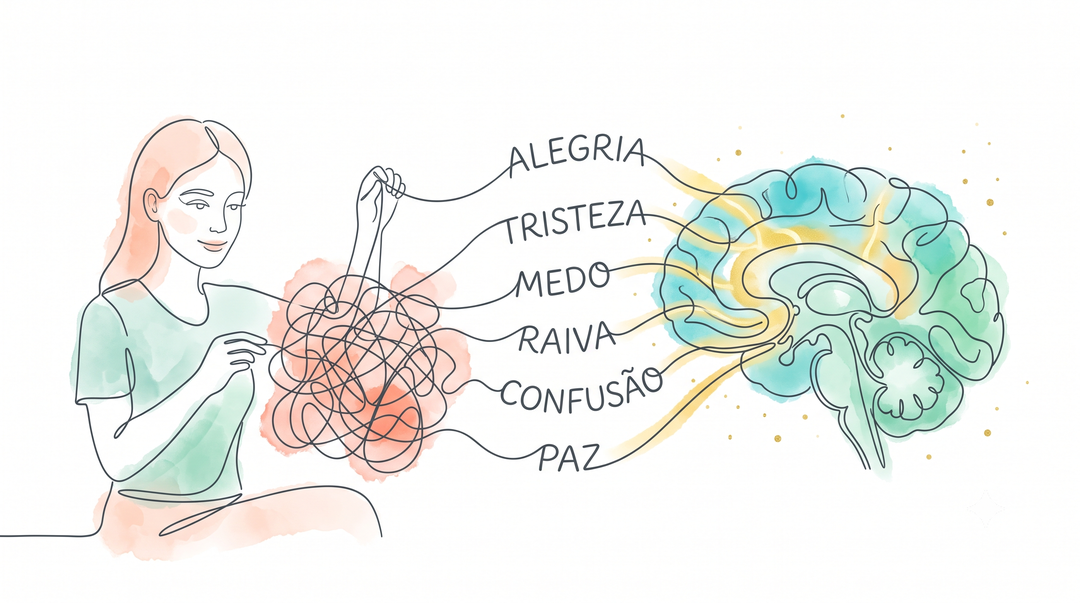
And here's the part almost nobody mentions: alexithymia isn't about feeling less. It's about feeling the whole thing in your body, intensely, without being able to translate the turmoil into a name. It's like having a storm raging inside you with no weather report.

What alexithymia is (and what it isn't)
Alexithymia is a persistent difficulty perceiving, identifying and describing your own emotional states. It isn't a mental disorder in itself but a trait, something that exists in degrees. Population studies in Finland and Germany found that between 10% and 13% of people score above the standard cutoff for alexithymia, and in the Finnish data it was almost twice as common in men (17%) as in women (10%). It is also far more common among autistic people: in a 2019 meta-analysis, about half of autistic participants met the cutoff, compared with about 5% of neurotypical participants. And it is closely linked to depression and to post-traumatic stress.
People with alexithymia often realize something is wrong through the body before the mind: the heart races, the stomach churns, the shoulders lock up. The physical signal comes through loud and clear. The name of the emotion never shows up on the screen.
It's important to be clear about what alexithymia isn't. It isn't a lack of empathy, it isn't coldness, and it isn't a lack of interest in other people. A person can love deeply and still come up empty when asked, “How does that make you feel?” Confusing the two hurts a lot of people who already think of themselves as “robots” when they're nothing of the kind.
The uncomfortable truth: you don't need to feel less, you need to name it better
There's a popular belief that balanced people are people who don't feel much. That the road to peace runs through turning down the volume on your emotions. Neuroscience points the other way: the problem is rarely how intensely you feel. It's the missing translation.
An unnamed emotion floats around, loose and diffuse, and the brain tends to read it as a generic threat, which is exactly what fuels anxiety. A named emotion, on the other hand, becomes information. And information is something the brain knows how to process.
What happens in the brain when the word is missing
To understand alexithymia, it helps to meet three key players in the emotional brain.
The first is the amygdala, a small, ancient structure that works like a fire alarm. It goes off in response to anything that looks like a threat, and it goes off fast, before any reasoning kicks in. The second is the insula, which handles interoception, meaning it reads the body's internal signals (heartbeat, breathing, those butterflies in your stomach). The third is the prefrontal cortex, the thinking part, which gives names, context and meaning to what's going on.
One way to picture alexithymia: the communication between these areas gets slow or noisy. The body feels it (insula), the alarm goes off (amygdala), but the bridge that would carry that signal over to language (prefrontal cortex) gets stuck. The result is plenty of physical sensation and no label. You can feel the fire without being able to say where it's burning.
This is where one of the most elegant findings in affective neuroscience comes in. In a now-classic 2007 study, Matthew Lieberman and his team at UCLA showed that naming an emotion (affect labeling) reduces activity in the amygdala and increases activity in the right ventrolateral prefrontal cortex. In plain English: putting a name to what you feel literally turns down the volume on your brain's alarm. This isn't self-help poetry. It was measured with brain imaging.
In a later review of this line of research, Torre and Lieberman (2018) describe affect labeling as a form of implicit emotion regulation: it calms things down even though it doesn't feel like you're trying to regulate anything. If naming doesn't come easily to you, that brake is harder to reach on your own. The good news: naming is a skill, and skills respond to practice.
Alexithymia isn't the same as suppressing emotions
A lot of people mix the two up, but the mechanisms run in opposite directions. Here's the difference:
| Suppressing emotions | Alexithymia |
| You know what you feel and decide to hide it | You feel something strong but don't know what it is |
| The name is there, and you swallow it on purpose | The name never reaches awareness |
| “I'm angry, but I'll pretend I'm not” | “There's something in my chest and I don't know what it is” |
| It's a choice (even if a costly one) | It's a processing difficulty |
The difference matters because the way out is different. People who suppress need permission to feel. People with alexithymia need vocabulary and practice to connect the sensation to the name.
How to train naming: the EITA approach in 4 steps
EITA (a Portuguese acronym for Elevar a Inteligência a Treino de Autopercepção, roughly “turning intelligence into self-awareness training”) starts from a simple premise: self-awareness is a skill, and skills can be trained. These four steps help rebuild the bridge between body and words.
Step 1: Start with the body, not the emotion
If “what am I feeling?” draws a blank, swap it for something more concrete: what's happening in my body right now? Tight chest? Clenched jaw? Heavy stomach? Cold hands? The body is the one text alexithymia still lets you read. Start there.
Step 2: Expand your emotional vocabulary
You can't name what you don't know. Most of us get by on three or four words: good, bad, tired, stressed. But between “good” and “bad” there's a whole world: frustration, relief, longing, resentment, excitement, helplessness, pride, boredom. The richer your vocabulary, the more precisely you can sort out what you're feeling, and the more useful the label becomes.
Step 3: Link the sensation to the trigger
Once you've read your body and found a word, ask: what happened right before this started? A text, a look, a thought? Alexithymia scrambles cause and effect. Rebuilding the timeline gives the sensation meaning and turns a vague sense of unease into something with a beginning, a middle and a name.
Step 4: Write it down or say it out loud
Naming it in your head helps. Putting it into actual words, spoken or written, in a full sentence (“I feel rejected because nobody wrote back”), gets it out of your head and turns it into something you can look at. In the research, affect labeling takes many forms, from speaking to writing to simply picking a word from a list. And expressive writing, which means writing about what you feel, has shown benefits that can last for months, even if a session can feel heavier right afterward.
Two examples of how this works in practice
Example 1: the nameless tightness in the middle of the day
You're working and, out of nowhere, a weight settles on your chest along with an urge to shut everything down. The alexithymic version stops there: “I don't know, I just feel off.” The trained version follows the path: body (tight chest, shallow breathing), vocabulary (it's not anger, it feels more like dread and overload), trigger (I just watched my to-do list grow), sentence (“I'm overloaded and afraid I won't be able to handle it all”). The discomfort is still real, but now it has a size and an address.
Example 2: the outburst that came “out of nowhere”
Someone close to you makes an offhand comment, and you snap back with a harshness way out of proportion. Then comes the guilt. Alexithymia tends to produce outbursts like this: because the emotion wasn't named while it was small, it grows under the radar until it spills over. Walking the path ahead of time looks like this: body (tension building since the morning), name (pent-up irritation, and not at this person), trigger (an earlier frustration that never got processed). Naming early is what keeps you from boiling over later.
EITA Mentor was designed for exactly this kind of training. In conversations on WhatsApp, available 24/7, she doesn't hand you ready-made answers. She asks the right questions, one at a time, to help you get from “no clue” to a name. It's like having someone by your side teaching you to read your own inner weather report, at 2 a.m., in the middle of a hard moment or on a perfectly ordinary day.
Naming emotions is a skill, not a talent you're born with
There's an idea that some people are “born” in touch with their feelings and others aren't, as if it were a genetic lottery. Neuroplasticity, the brain's ability to change with experience, tells a different story.
The brain adapts to what you practice. Every time you walk the path from body to word, you're rehearsing the link between sensation and language. With repetition, what takes effort today becomes almost automatic. The word starts arriving along with the sensation, not hours later.
One honest reminder: when alexithymia is very intense, or comes with trauma, depression or neurodivergence, this training goes more slowly and usually gets much further with professional support. Practicing on your own helps. Practicing with support helps more.
Frequently asked questions
Is alexithymia an illness?
No. Alexithymia is a trait, a characteristic that exists in varying degrees, not a psychiatric diagnosis in itself. It can show up on its own or alongside other conditions, such as depression, post-traumatic stress and autism. Having trouble naming emotions doesn't mean you have a disorder, but it's a good reason to take a closer look at your emotional life.
Can alexithymia be “cured”?
The better frame isn't cure but development. Because the ability to identify and describe emotions can be trained, it can improve a lot with consistent practice and, when needed, with therapy. Many people go from “I don't know what I feel” to a much finer emotional read over time.
Isn't naming emotions just a self-help trick?
No. The effect of naming emotions (affect labeling) is a well-documented finding in affective neuroscience: putting a feeling into words measurably reduces amygdala activity and recruits the prefrontal cortex. “Give it a name” is backed by brain imaging, not just by your grandmother's advice (although in this case, Grandma was right).
Does this replace therapy?
No. EITA Mentor is a tool for emotional support and self-awareness training, and it doesn't replace professional care. In cases of intense alexithymia, trauma, diagnosed disorders or significant psychological distress, working with a psychologist or psychiatrist is irreplaceable. EITA works best as a complement to therapy, or as a first source of everyday support for people who aren't in treatment yet.
Sources
- Lieberman, M. D., Eisenberger, N. I., Crockett, M. J., Tom, S. M., Pfeifer, J. H., & Way, B. M. (2007). Putting feelings into words: affect labeling disrupts amygdala activity in response to affective stimuli. Psychological Science, 18(5), 421-428. sanlab.psych.ucla.edu (PDF) · PubMed record
- Torre, J. B., & Lieberman, M. D. (2018). Putting feelings into words: affect labeling as implicit emotion regulation. Emotion Review, 10(2), 116-124. journals.sagepub.com
- Salminen, J. K. et al. (1999). Prevalence of alexithymia in the general population of Finland. Journal of Psychosomatic Research. sciencedirect.com
- Franz, M. et al. (2008). Alexithymia in the German general population. Social Psychiatry and Psychiatric Epidemiology. link.springer.com
- Kinnaird, E., Stewart, C., & Tchanturia, K. (2019). Investigating alexithymia in autism: A systematic review and meta-analysis. European Psychiatry, 55, 80-89. PubMed record
- Hemming, L., Haddock, G., Shaw, J., & Pratt, D. (2019). Alexithymia and its associations with depression, suicidality, and aggression: An overview of the literature. Frontiers in Psychiatry, 10, 203. Full text (open access)
- Putica, A., Van Dam, N. T., Steward, T., et al. (2021). Alexithymia in post-traumatic stress disorder is not just emotion numbing: Systematic review of neural evidence and clinical implications. Journal of Affective Disorders, 278, 519-527. PubMed record
Anaclaudia Zani is a psychologist (CRP 06/128106, Brazil) and neuroscientist, creator of the EITA method and of EITA Mentor.